







 Vietnam Mortgage Surge Pushes Homes Out of Reach
 Lithuanian Apartment Prices Accelerate Across Major Cities
 London Flats Lose Value Ahead of Leasehold Reform
 Construction of the Batumi–Sarpi Highway Begins in Georgia
 Baltic Property Investment Accelerates in 2026
 Hong Kong and Singapore Renew Their Expat Rivalry
AI Is Reshaping Hotel Distribution in London
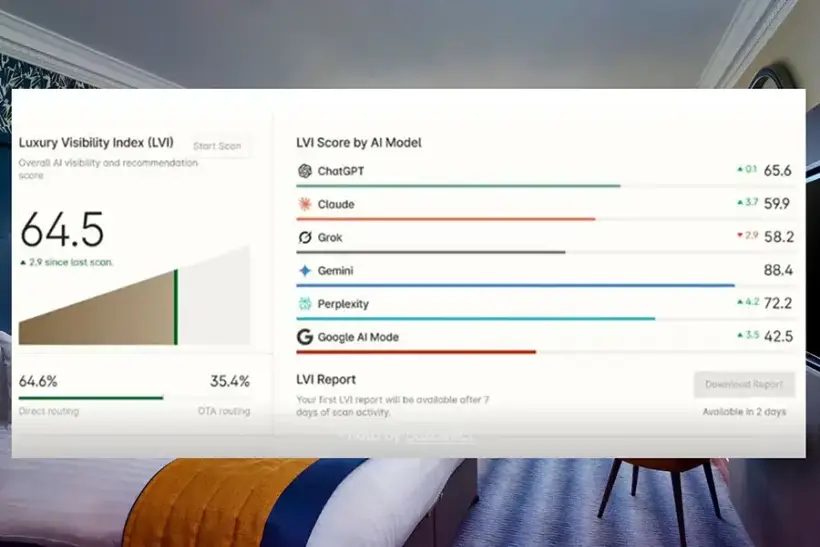
Five London hotels captured most AI visibility
A new distribution channel is taking shape in London’s luxury hotel market before travelers ever reach a booking page. According to the CS7 London study cited by Hospitality Net and conducted by LuxDirect, five London luxury hotels captured 57% of all AI-generated recommendations across a 25-property panel. The study covered 2,700 structured queries across six AI platforms: ChatGPT, Claude, Gemini, Grok, Perplexity and Google AI Mode.
AI hotel recommendations are becoming a new sales gateway
The core implication is that AI search is starting to function as a new upstream discovery layer in hotel distribution. The study argues that travelers are increasingly asking AI systems where to stay and receiving curated recommendations before they interact with traditional search engines or OTA result pages. For hotels, that means the competitive battle is no longer limited to Google rankings and OTA placement. It is now also about whether a property appears in generative AI answers at all.
AI visibility in London hotels is concentrating faster than SEO did
The most striking signal is the level of concentration. Five hotels accounted for 57% of all AI recommendations, while the remaining 20 properties shared less than half of total mentions. The article compares this dynamic to the early years of SEO, when organic traffic quickly consolidated around a small number of highly optimized players. But in this case, the author argues, the concentration is happening faster and under a much less transparent set of ranking signals.
Hotel size and brand strength no longer guarantee AI presence
One of the more surprising findings is that size and brand recognition do not automatically translate into stronger AI visibility. The study says a 26-room independent hotel appeared more often in AI recommendations than a 174-room chain property in the same city and quality tier. LuxDirect suggests that AI platforms may be weighting structured data quality, editorial citation patterns, third-party authority and consistency across the web more heavily than traditional brand scale or marketing spend.
Google AI Mode often routes travelers to OTAs instead of hotel websites
The study’s second major concern is not only which hotels appear, but where users are sent after that recommendation. According to the article, 65.1% of all Google AI Mode responses analyzed routed travelers to OTA booking pages rather than to the hotel’s own site. For hotels that have spent years investing in loyalty, direct booking strategy and owned digital channels, this is a meaningful threat. A property may win the recommendation but still lose the booking path to Booking.com or Expedia.
OTAs seem to benefit from stronger machine-readable infrastructure
The proposed explanation is that OTA pages are often better structured for AI systems to interpret and cite. The article says OTA pages are frequently more consistent in their structured data, updated more often and more heavily cross-referenced across the web. By contrast, many independent hotel websites are less standardized. A broader industry pattern points in the same direction: Cloudbeds has also argued that AI hotel recommendations are shaped by digital signals such as structured content, source authority and consistency across the web ecosystem.
What this means for independent luxury hotels in London
For independent luxury hotels, the shift creates both risk and opportunity. On one hand, concentrated AI recommendation patterns could make part of the market effectively invisible in a fast-growing discovery channel. On the other, the study suggests smaller independents can outperform larger brands if their digital presence is better structured. LuxDirect identifies three priorities for hotels: measuring current AI visibility, improving structured data and managing citation pathways so AI tools link to direct sites instead of OTAs.
AI search is changing the economics of direct hotel bookings
The commercial significance is that direct-booking strategy now begins before a guest even reaches a hotel website. That changes how hotels need to think about digital marketing and distribution. It is no longer enough to rank well in classic search and maintain rate parity. Hotels increasingly need to manage how AI systems read, describe and cite their properties. That direction is reinforced by a recent industry move reported by hospitality media: Lighthouse launched a direct booking integration into ChatGPT, underscoring how AI interfaces are becoming a new hotel distribution layer.
Why the London study matters but still needs careful reading
It is also important to read the findings with the right level of caution. This is not an academic sector-wide study, but an opinion article built on research produced by LuxDirect, a company that sells AI visibility intelligence for independent luxury hotels. That does not invalidate the findings, but it does mean the figures should be treated as an important market signal rather than a definitive map of the global hotel industry. Even so, the core issue appears highly relevant: AI platforms are already beginning to influence attention flows and potentially the route a traveler takes to book.
As International Investment experts report, the London findings show an early but already important stage in the transformation of hotel distribution. Independent hotels are no longer competing only for visibility on search engines and OTAs. They are increasingly competing for placement inside AI recommendation systems. For the sector, that means structured data quality, digital consistency and direct-link authority may soon become just as important to revenue performance as location, brand strength and pricing strategy.