







 Israel Cuts Rate to 3.25% for Third Meeting
 Russian and Belarusian Owners List More Latvian Property
 Georgian Law Enforcement Busts Scammers Posing as Real Estate Brokers
 World’s Largest Economies in 2026: GDP and Purchasing Power Rankings
 Turkish Airlines Cancel Flights to Moscow
 Escalation in the Middle East: New US and Iranian Strikes
Georgia’s Economy Grew by 7.5%: Investment Growth and Strengthening of the Budget
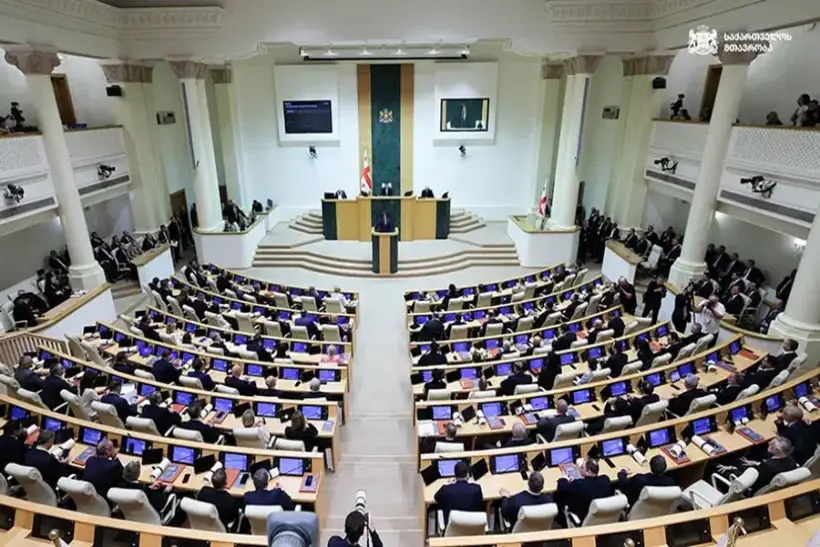
Prime Minister of Georgia Irakli Kobakhidze presented the country’s main economic and social results for 2025 and the beginning of 2026 to Parliament. The speech focused on 7.5% economic growth, strengthened fiscal stability, and expanding investment activity. Improvements in household incomes and large-scale infrastructure projects were also highlighted.
Economic Growth and Georgia’s Historic GDP Milestone
For the first time in the country’s history, Georgia’s GDP exceeded 100 billion GEL in 2025. Prime Minister Irakli Kobakhidze emphasized that the figure of 104.6 billion GEL represents a key structural milestone, marking a transition to a new scale of economic development. The growth rate of 7.5% is also notably strong.
The average growth rate over the past five years reached around 9.3%, reflecting a systemic acceleration. In January–April 2026, growth stood at 8.2%, indicating the continuation of a strong development trajectory.
For comparison, the Prime Minister noted that in 2012, when Georgian Dream came to power, the economy was below 28 billion GEL, and in 2020 it had not reached 50 billion GEL. This means the economy has more than doubled in GEL terms over a relatively short period, with significant expansion also in USD terms.
Over the past three years, consumer prices in Georgia increased by 6.4%. Within the inflation structure, a sharper rise was recorded in food and non-alcoholic beverages, up 9.7%. Against this backdrop, the average salary increased by 47.9%, indicating that income growth has significantly outpaced price dynamics.
Foreign Trade and Investment in Georgia
Prime Minister Irakli Kobakhidze stated that the external sector shows stable positive dynamics, reflecting growing economic competitiveness and stronger investor confidence.
Goods exports increased by 11.2% in 2025, reaching a record level of $7.3 billion. This result confirms the expansion of the country’s export capacity. Foreign direct investment rose by 7.6% to around $1.7 billion, indicating continued investor interest amid macroeconomic stability.
The Ministry of Finance placed $500 million in Eurobonds, with demand exceeding supply by 5.5 times. Treasury bonds worth 400 million GEL were also issued, with demand exceeding supply by 4.5 times.
External economic dynamics are shaped by export growth, rising investment inflows, and active participation in international financial markets.
State Reforms and Infrastructure Modernization
Prime Minister Irakli Kobakhidze linked economic growth to large-scale changes in public administration, emphasizing efficiency improvements and the revision of previous practices.
A key decision was the creation of the Efficiency Department under the government. In 2025, it reviewed state programs and procurement worth 115 million GEL, generating savings of over 67 million GEL. In 2026, an additional 67 million GEL in savings was achieved.
A significant part of reforms focused on the energy sector, where the practice of reselling grid connection permits was eliminated and a 10-year development plan was introduced. Optimization of state-owned energy companies reduced annual costs by nearly 25 million GEL.
In the railway system, around 1,100 positions were cut, and previously outsourced processes were brought back in-house, generating over 40 million GEL in annual savings and additional revenue. Procurement optimization added 190.4 million GEL in savings. The profit of Georgian Railway increased from 68 million to 145 million GEL, while the operating margin rose from 25% to 36%.
In aviation, procurement optimization resulted in 70 million GEL in savings and was accompanied by expanded international agreements. As a result, Tbilisi Airport capacity increased by 53%, with corresponding growth in state revenues.
International Assessments and Forecasts for Georgia
Prime Minister Irakli Kobakhidze noted that Georgia’s economic performance is also reflected in international assessments. The IMF medium-term forecast highlights Georgia among the highest-growth economies in Europe and the region for 2026–2031, based on recent macroeconomic indicators and long-term stability trends.
He emphasized that this trajectory reflects not a short-term effect but structural changes in the economy and fiscal policy. Georgia also maintains leading positions in international rankings on budget transparency, which strengthens trust among external partners and investors.
The Prime Minister also pointed to strong demand for sovereign debt instruments. Combined international assessments and market signals confirm the resilience of the current economic model and reinforce Georgia’s positioning as an economy with a predictable growth trajectory.
What This Means for Investors in Georgia
Analysts at International Investment note that this configuration signals a predictable macroeconomic environment with stable growth and controlled baseline risks. The combination of accelerating GDP, moderate inflation, and declining debt burden creates space for long-term planning.
A significant factor is the active role of the state through reforms and infrastructure projects. For investors, this expands opportunities in transport, energy, construction, and logistics, where government programs set the development pace.
Export growth and rising foreign direct investment indicate deeper integration into global value chains. This reduces dependence on domestic demand and increases resilience to external shocks.
Access to international capital markets and strong demand for sovereign debt instruments further reflect confidence in fiscal policy and reduce risk premiums.
Overall, this forms an investment profile characterized by steady growth dynamics, an expanding infrastructure base, and increasing macroeconomic predictability.