







 Israel Cuts Rate to 3.25% for Third Meeting
 Russian and Belarusian Owners List More Latvian Property
 Georgian Law Enforcement Busts Scammers Posing as Real Estate Brokers
 World’s Largest Economies in 2026: GDP and Purchasing Power Rankings
 Turkish Airlines Cancel Flights to Moscow
 Escalation in the Middle East: New US and Iranian Strikes
Bratislava Adds New Homes as Sales Slow
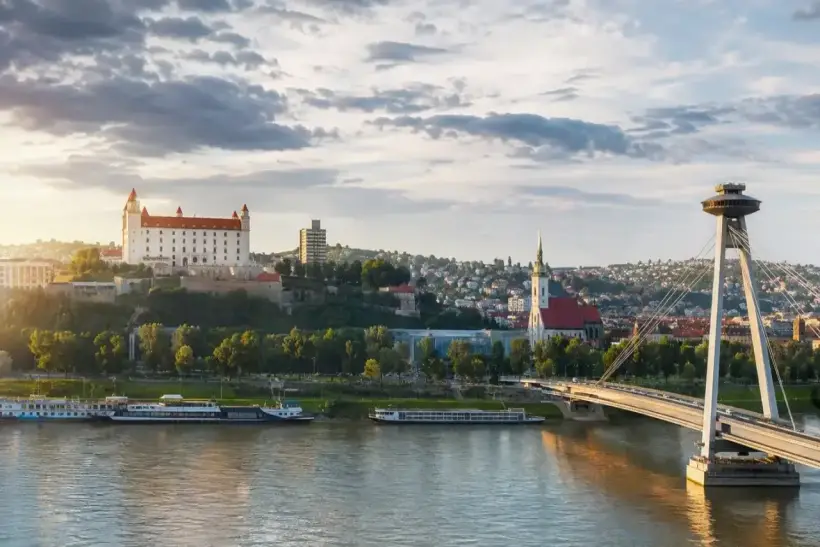
Bratislava's new-build housing market shifted decisively towards greater buyer choice in the second quarter of 2026. Available stock exceeded 4,200 apartments, its highest level in roughly nine years, while sales under CBRE's dataset fell 12% from the previous quarter. Average asking prices edged lower rather than collapsing, and a separate market monitor actually recorded an increase in public sales, making methodology critical when assessing the strength of demand.
Bratislava New-Build Sales Fall 12%
CBRE Slovakia recorded 652 apartments sold in Bratislava's new residential projects during Q2 2026, compared with 742 in the first three months of the year. Available stock simultaneously increased to 4,231 apartments across 105 projects, about 300 more than in the previous quarter and 25% more than a year earlier. Supply exceeded 4,000 units for the first time since 2017. Average new-build asking prices declined by €43 per square metre, or less than 1%, to €5,341 per sq. m, while remaining around 2% above their year-earlier level. The average apartment on offer measured 66 sq. m. Rental supply fell to 2,195 apartments, down 16% quarter on quarter and 18% year on year. Prime rents in Staré Mesto were around €19 per sq. m a month, compared with approximately €16 in Ružinov, Nové Mesto and Petržalka. The estimated gap between the monthly mortgage payment and rent on an equivalent property widened from €209 to €233 in favour of renting. Quarterly sales are expected to stabilise at around 600–700 units, while another substantial increase in inventory could generate additional pressure on asking prices.
The central change is therefore not a collapse in prices but a shift in the balance between inventory and buyers. Developers are offering considerably more homes than several quarters ago, giving purchasers greater choice across locations, apartment sizes and stages of construction.
BuiltMind Records Higher, Not Lower, Sales
A separate BuiltMind dataset presents a different picture of demand. It recorded 704 publicly sold apartments in Q2, nearly 12% more than in Q1 and the strongest quarterly reading since Q2 2025. Available and reserved supply rose by more than 4% to approximately 3,900 units, the highest level since late 2017, while the absorption rate exceeded 18%. Average asking prices for available apartments stood at €5,622 per sq. m including value-added tax and excluding exterior areas. Two- and three-room apartments averaged around €5,500 per sq. m, while larger units approached €6,000. Staré Mesto averaged approximately €7,900, Ružinov €6,200 and Nové Mesto €5,800 per sq. m. The average sold apartment became considerably smaller, falling from more than 62 sq. m to 57 sq. m, compared with almost 65 sq. m for available stock. Bratislava II and Bratislava IV together represented roughly 61% of sales.
The difference between 652 and 704 sales is important. The two series also produced different Q1 totals, with 742 transactions in the CBRE dataset and 631 public sales in the other series. They should therefore not be treated as two independent measurements of an identical universe.
What both datasets do show is unusually high new-build availability. The disagreement concerns short-term sales momentum rather than the broader expansion of supply.
Slovak Housing Prices Continue to Rise
The broader Slovak housing market has not entered a downturn. The National Bank of Slovakia reported that average residential property prices rose 1.2% quarter on quarter in Q2 2026, or €36, to €3,041 per sq. m. Annual growth slowed to 9.5%. Apartment prices increased 1.6% during the quarter to €3,430 per sq. m and were 10.2% higher year on year. New-build properties rose by 2.9% quarter on quarter, compared with 0.7% for older homes. The central bank also highlighted weaker momentum in Bratislava, saying a strong June prevented a quarterly decline and that prices in the capital had probably reached a local ceiling. By June, the average interest rate on housing loans with an initial fixation of one to five years stood at 3.66%, while residential property prices were 9.51% higher than a year earlier.
This does not contradict the slight decline in the average asking price of Bratislava new builds. The national indicator covers a much broader property universe, while a quarterly average for new developments is also affected by the mix of projects and units entering the market.
Bratislava buyers are therefore facing an unusual combination: greater choice, slower asking-price growth, high absolute purchase prices and borrowing costs that remain significant.
ECB Rate Increase Complicates the Mortgage Outlook
The monetary backdrop in Q2 was less favourable than the previous version of this article suggested. On June 11, 2026, the European Central Bank raised all three policy rates by 25 basis points. Effective June 17, the deposit facility rate increased to 2.25%, the main refinancing rate to 2.40% and the marginal lending rate to 2.65%. The decision followed increased inflation risks linked to an energy shock arising from the conflict in the Middle East. On July 23, policymakers kept all three rates unchanged and repeated that future decisions would remain data-dependent rather than follow a predetermined path.
This matters directly for Bratislava. Expectations of cheaper financing had helped support the housing recovery, but the June increase demonstrated that mortgage costs are not necessarily moving continuously lower.
For buyers of relatively expensive capital-city apartments, even small changes in borrowing rates can materially affect monthly affordability.
Renting Retains a Monthly Cost Advantage
The widening monthly gap between rent and mortgage payments helps explain the resilience of rental demand.
If servicing a mortgage on an equivalent home costs about €233 more each month than renting it, buyers need either substantial equity or a sufficiently long investment horizon to make ownership financially compelling.
At the same time, the number of rental listings has declined sharply. The fall from 2,613 units to 2,195 in one quarter means that the rental market and the new-build sales market are moving in opposite directions: developers have more apartments available, while tenants have fewer options.
That distinction matters to investors because rising competition between developers does not automatically imply weaker rents.
Buyers Are Moving Toward Smaller Apartments
The fall in the average size of a sold new-build apartment to 57 sq. m is one of the clearest signs of affordability pressure.
When the price per square metre remains high, one of the few ways buyers can reduce the total purchase price is to accept a smaller floor area. The gap between the typical sold unit and available stock therefore provides additional evidence that demand is concentrating on compact layouts.
For developers, this means rising inventory alone does not guarantee that available product matches effective purchasing power. Larger apartments can become difficult to sell even when their price per square metre appears competitive.
Bratislava Housing Starts Did Not Collapse
The previous version contained its most important factual error in this section. Slovakia completed 2,210 dwellings in Q1 2026, the lowest first-quarter total since 2000 and the second-lowest quarterly result over that period. National completions fell by more than a quarter year on year and were more than 40% below the corresponding ten-year average. Construction started on almost 2,100 dwellings, the lowest quarterly total since 1998, more than one-third below the year-earlier level and roughly half the long-term average. Bratislava Region, however, moved in the opposite direction for housing starts: the number of newly started dwellings increased by more than 60% year on year. Completed dwellings in the region fell by 56%. The Statistical Office also cautions that housing-construction figures have been provisional since Q3 2025 following a transition to a new electronic register and may later be revised.
That distinction materially changes the outlook. Weak national construction cannot simply be used as evidence that Bratislava faces an imminent shortage of future supply.
The region is currently experiencing fewer completions but substantially more new starts, suggesting a timing mismatch rather than a straightforward contraction across every stage of the development pipeline.
The current 4,231 apartments for sale therefore cannot yet be confidently described either as a lasting structural surplus or as a short-lived peak before an inevitable shortage.
Bratislava's Housing Market Moves Toward Competition
The second quarter indicates a gradual transition away from the supply-constrained market that previously gave developers substantial pricing power.
New-build availability has increased sharply and one major dataset shows a modest decline in average asking prices. At less than 1%, however, the drop is too small to establish a broad price correction.
The alternative sales series also argues against describing demand as collapsing. It instead shows higher sales alongside expanding inventory.
For purchasers, this creates more choice and stronger negotiating leverage. For developers, apartment size, total purchase price, financing arrangements and the timing of new phases are becoming increasingly important.
As International Investment experts report, the current Bratislava market looks more like a transition toward greater balance after several supply-constrained years than the beginning of a full-scale new-build crisis. The main risk for sellers is not the disappearance of demand but a widening mismatch between abundant inventory and what mortgage-financed households can afford. At the same time, the evidence does not support an assumption that a new supply shortage is imminent: although completed housing in Bratislava Region fell sharply, housing starts increased by more than 60% year on year in Q1. In the near term, stronger competition between projects, more cautious list-price adjustments and greater use of incentives or financing packages appear more plausible than a sharp market-wide fall in nominal asking prices. A deeper correction would require inventory to exceed effective sales for a more prolonged period.
FAQ: Bratislava Property Market in 2026
How many new apartments were sold in Bratislava in Q2 2026?
The answer depends on the dataset. CBRE recorded 652 sales, while BuiltMind counted 704 public sales. The two figures should not be treated as directly comparable measurements of an identical market universe.
How many new apartments are available in Bratislava?
CBRE recorded 4,231 available apartments across 105 projects at the end of Q2, the highest level since around 2017.
How much does a Bratislava new-build apartment cost per square metre?
Estimates vary by methodology. One dataset puts the average at €5,341 per sq. m, while another records an average asking price of €5,622 per sq. m for available apartments.
Which parts of Bratislava are most expensive?
Among major districts, Staré Mesto had the highest average asking price at roughly €7,900 per sq. m, followed by Ružinov at about €6,200 and Nové Mesto at around €5,800.
Are Bratislava apartment prices falling?
There is no evidence yet of a broad decline. One new-build measure fell by less than 1% quarter on quarter, while Slovak residential property prices continued to rise nationally.
Is it cheaper to rent or buy in Bratislava?
On the comparison used for equivalent properties, the average mortgage payment was around €233 per month higher than rent in Q2. Individual results depend on the down payment, mortgage rate, term and property.
Is housing construction declining in Bratislava?
The picture is mixed. Completed dwellings in Bratislava Region fell 56% year on year in Q1, but new housing starts increased by more than 60%.
Could greater supply push Bratislava prices lower?
Yes, particularly if inventory continues to expand faster than actual sales for an extended period. So far, the market is showing price stabilisation and stronger competition rather than a deep correction.