







 Housing Prices in Israel Fell 1.5% Year-on-Year
 Immigration Slowdown Reshapes the US Sun Belt
 Slovakia Reforms Building Rules as Housing Starts Slide
 EU Proposes New Restrictions on Short-Term Housing Rentals
 Canada Fast-Tracks Tax Rulings for C$1 Billion Investments
 China Nears a Decision on Fresh Stimulus
The Number of Millionaires in the UK Fell by 59%

IMI Daily
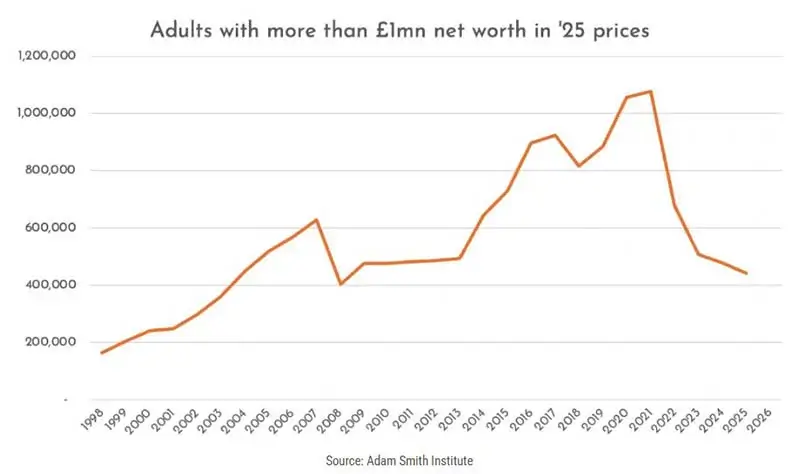
The number of dollar millionaires in the UK, adjusted for constant prices, has fallen by nearly 59% over the past four years, reaching its lowest level since the 2008 global financial crisis, according to IMI Daily, citing data from the Adam Smith Institute think tank.
The Number of Millionaires Falls to Its Lowest Level Since 2008
The study defines a millionaire as an adult UK resident with personal wealth of at least £1 million ($1.33 million) in constant 2025 prices. The calculation includes all types of assets, including real estate, financial investments, and pension savings.
The number of millionaires in the UK began rising rapidly in 2020, when it exceeded the 1 million mark for the first time. In 2021, the figure reached a historic high of 1.07 million. However, the trend changed afterward, with the number declining every year from 2022 onwards. In 2025, the figure fell by another 7% compared with 2024, reaching 442,000 people. Overall, the number of British millionaires decreased by approximately 59% over four years, reaching its lowest level since the global financial crisis of 2008. The institute notes that the top 1% of the highest-earning taxpayers account for 29.1% of all income tax revenues.
The authors of the study emphasize that the UK does not maintain a register of personal wealth, meaning that the number of millionaires is calculated using a statistical model. The model is based on the total net wealth of British households, which amounted to around £10.75 trillion in 2024, according to the Office for National Statistics (ONS). A Pareto distribution model is then applied to estimate the number of people whose wealth exceeds the £1 million threshold.
According to the Office for National Statistics (ONS), around 14% of UK households had total wealth exceeding £1 million between April 2020 and March 2022. However, these figures refer to households rather than individual citizens. Analysis by the Resolution Foundation showed that the real wealth of British households declined by 19% between 2021 and 2023.
Why the Number of Wealthy People in Britain Is Falling
The decline in the number of wealthy residents in the UK is linked to several factors. Higher interest rates and weaker economic expectations reduced the inflation-adjusted value of pension savings and prime property, particularly in London. At the same time, low household savings rates slowed the accumulation of capital needed to reach the £1 million wealth threshold.
The reasons cited include the abolition of the preferential tax regime for non-domiciled residents (non-dom), high taxation levels, and worsening conditions for business activity and wealth creation.
The non-dom regime ended in April 2025. It was replaced by a four-year foreign income and gains tax regime for new residents. In addition, the UK has had no dedicated investor visa route since February 2022, when the Tier 1 (Investor) visa programme was closed.
Risks of Further Capital Outflows
Adam Smith Institute economist Mitchell Palmer said that some representatives of the political left may view the decline in the number of millionaires as a positive outcome. However, he argued that the trend should instead be seen as a warning sign for the economy. James Quarmby, a partner at law firm Stephenson Harwood, noted that wealthy individuals today can “very easily” relocate themselves, their capital, and their businesses to another jurisdiction.
David Lesperance, Managing Director at Lesperance & Associates, said that wealthy entrepreneurs are waiting for the British government to announce its new tax policy. In his view, instead of introducing a wealth tax, authorities could increase capital gains tax or introduce an exit tax. He expects the number of wealthy Britons leaving the country to rise significantly after the autumn budget is published and before the end of the tax year.
Lesperance also pointed out that many British millionaires acquired this status mainly due to rising property values. In his view, a more meaningful indicator would be the number of people with wealth of £10 million, £100 million, and £1 billion. Based on his own experience working with wealthy clients, the expert believes that losses among these groups could be significantly greater.
Arguments Against a Wealth Tax
The institute calls for the abolition of inheritance tax and a gradual phase-out of capital gains taxes, referring to the experience of France, Austria, and the Netherlands. In those countries, similar measures were abandoned after capital outflows or widespread tax avoidance schemes emerged. Analysts also propose assessing the international competitiveness of the UK tax system for high-net-worth individuals and former non-dom residents.
The Adam Smith Institute’s proposals are directed at the new British government, which recently took office. After Keir Starmer’s resignation on June 22, Andy Burnham became prime minister, while John Healey was appointed Chancellor of the Exchequer. The Labour Party has maintained its election pledge not to raise the main rates of income tax, VAT, and employee national insurance contributions. Burnham has also indicated that introducing a wealth tax is not a government priority, although he has not ruled out the possibility entirely.
At the same time, the abolition of the non-dom regime, which the Adam Smith Institute considers one of the reasons behind the outflow of wealthy residents, took place under former Chancellor Rachel Reeves. John Healey’s first budget is not expected before autumn.
New Measures Affecting Wealthy Residents in the UK
The new government is already considering several initiatives that could affect wealthy residents and foreign investors. One of them is an additional municipal surcharge for owners of high-value property in England. Consultations on the proposal ended on July 14, but the final decision has not yet been published. Under the proposal, from April 2028, owners of homes worth more than £2 million ($2.7 million) would pay an additional annual charge of £2,500 ($3,350), while owners of properties valued above £5 million ($6.7 million) would pay £7,500 ($10,050).
Another measure concerns reforms to the rules for obtaining indefinite leave to remain. The proposal would increase the basic residence period required to obtain permanent status to 10 years. For applicants with taxable income above £125,140 ($168,000) during the three years before applying, the required period could be reduced by seven years.
In addition, the possibility of launching a restricted investor visa requiring a minimum investment of £5 million was discussed. The initiative, promoted by former Business Secretary Peter Kyle, failed to receive support from the Treasury and the Home Office. Kyle left his position after Andy Burnham came to power.
Conclusion
Tax advisers, including specialists from Grant Thornton, believe that the government may avoid raising the main income tax rates but could instead focus on increasing the tax burden on assets, land, and capital gains.
Analysts at International Investment note that in the coming months the key factor for wealthy residents will be the content of the autumn budget and the final decisions on tax reforms. These decisions will determine whether the UK can maintain its position as one of the leading jurisdictions for entrepreneurs and investors or continues to face an outflow of international capital.
A further departure of wealthy residents could affect not only tax revenues but also the country’s ability to attract investment.