










Construction Permits Decline in Georgia

Construction activity in Georgia remained high in the first half of 2026, although its structure changed. The number of new permits edged down, while the total area of planned projects increased and the pace of construction completions slowed, according to the National Statistics Office of Georgia (Geostat).
Tbilisi and Adjara Lead in Construction Permits
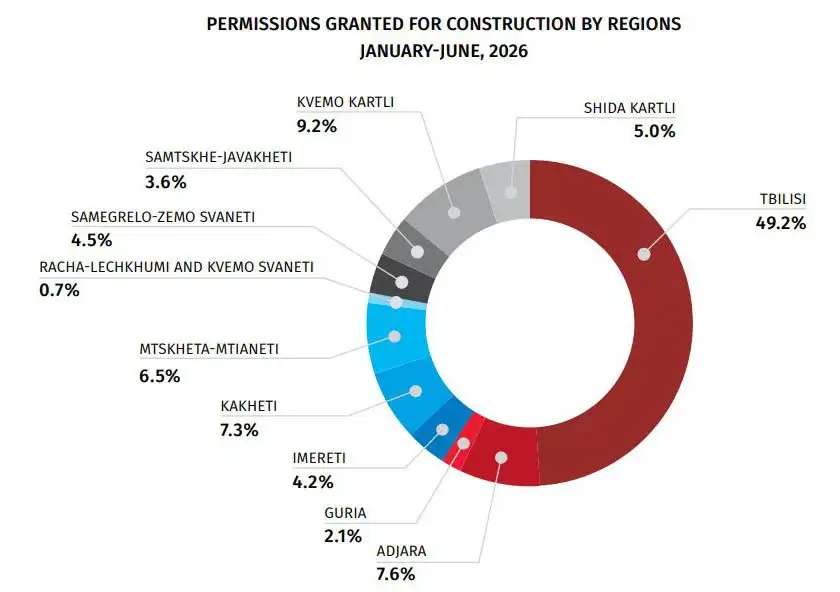
In January–June 2026, Georgia issued 5,391 construction and reconstruction permits, down 0.6% from the same period of 2025. The total area of planned properties increased by 1.7% to 5.28 million sq. m.
Most construction activity is concentrated in Tbilisi, which accounted for 49.2% of all permits issued. Kvemo Kartli represented 9.2%, Adjara 7.6%, and Kakheti 7.3%. Together, these four regions accounted for almost three-quarters of all permits in the country.
They were followed by Mtskheta-Mtianeti (6.5%), Shida Kartli (5%), Samegrelo-Zemo Svaneti (4.5%), Imereti (4.2%), and Samtskhe-Javakheti (3.6%). Guria accounted for 2.1% of permits, while the smallest share was recorded in Racha-Lechkhumi and Kvemo Svaneti at 0.7%.
Applications and permits covered multifunctional residential complexes, retail facilities, hotels, industrial enterprises, agricultural buildings, and other types of construction.
Completed Construction Volume Declines in Georgia
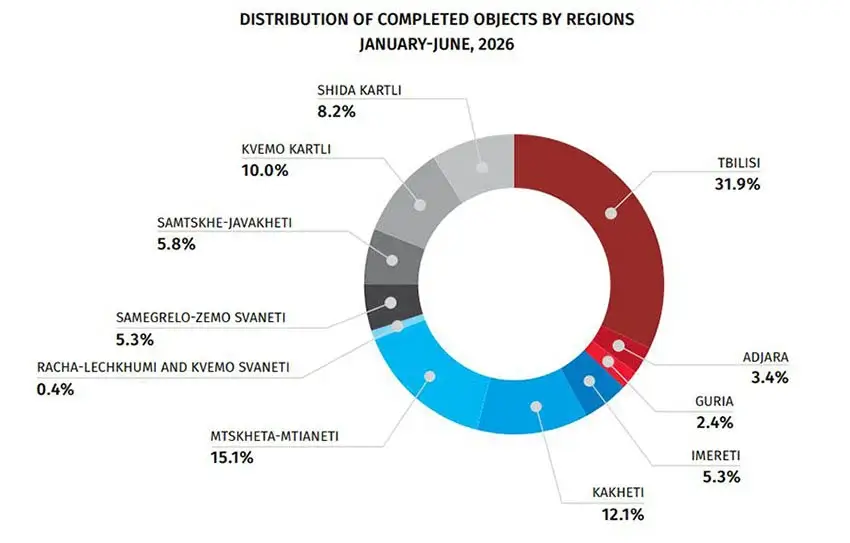
A total of 1,459 projects were completed during the first half of the year, 5.3% fewer than in the same period of 2025. Their combined area also decreased, falling by 3.6% to 1.55 million sq. m.
Tbilisi also ranked first in this segment, accounting for 31.9% of completed projects. It was followed by Mtskheta-Mtianeti at 15.1%, Kakheti at 12.1%, and Kvemo Kartli at 10%. Together, these four regions accounted for more than two-thirds of completed construction.
Shida Kartli accounted for 8.2% of completed projects, Samtskhe-Javakheti for 5.8%, and Imereti and Samegrelo-Zemo Svaneti for 5.3% each. Adjara represented 3.4% and Guria 2.4%. The lowest share was recorded in Racha-Lechkhumi and Kvemo Svaneti at 0.4%.
Investors in Georgia Shift Toward Bulk Purchases
Amid strong activity in the construction market, the nature of demand is also changing. Nino Absandze, founder of the Georgian Real Estate Association (GREA), notes growing interest from foreign investors in projects at the pre-sale stage. Instead of buying individual apartments, some investors are purchasing packages of 30–50 units at a time.
According to GREA, such transactions can generate returns of around 25–30% over a relatively short period. In one project, about half of the 150 apartments sold within two to three months were purchased through bulk deals.
The association links interest in real estate partly to the limited range of alternative investment instruments available in Georgia. Local buyers also view property as a way to preserve and increase their capital.
Tbilisi and Batumi Expand Their Residential Markets
Home sales continue to rise in Georgia’s largest cities. According to Colliers Georgia, 22,402 apartment transactions were registered in Tbilisi in the first six months of 2026, up 18.7% from January–June 2025. The market value increased by one-third to $1.8 billion. Transactions involving new apartments rose by 21.9%, while the share of foreign buyers remained unchanged at 10%.
In Batumi, 7,838 transactions were recorded over the same period, an increase of 11.4%, while the market value grew by 29% to $507 million. Foreign buyers play a much larger role there: in June, they accounted for 47% of apartment transactions and 87% of the overall increase in sales.
At the same time, trends within the Batumi market were mixed. In June, transactions involving resales of apartments in new developments increased by 24.5%, while direct sales from developers declined by 0.8% and transactions involving older housing stock fell by 26.4%.
The weighted average price of new apartments reached $1,455 per sq. m, up 22.6% year on year. Colliers attributes part of the increase to the delayed registration of some transactions and sales in several high-end projects.
Growing Supply Increases Risks for Investors
Further growth in supply could intensify competition. Galt & Taggart points to an oversupply of residential property in Georgia, particularly in Adjara. Around 58,000 new apartments are expected to enter the Batumi market between 2025 and 2029, of which 46,300, or 80%, are intended for short-term rentals. In some areas, investment apartments account for as much as 96% of supply.
At the same time, gross residential yields have declined from 10% to 7.4% over the past three years and could fall further to 5% or even 1.5%.
International Investment analysts note that actual rental returns after expenses are even lower, typically around 3–5%, and may decline further during periods of vacancy. Claims of double-digit returns on apartment purchases therefore require cautious assessment, particularly given the rapidly growing supply. Experts consider premium hotel real estate a more reliable and potentially higher-yielding segment.