







 Alta Banka Collapse in Serbia: What Happens to Russian Depositors' Money
 Covivio Hotels Revenue Grows 4.7% as European Markets Split
 Lithuanian Apartment Prices Accelerate Across Major Cities
 Georgia's Tourism Revenue Hits Record High
 Norway's Sovereign Fund Commits €1.5bn to European Warehouses
 Market Rout of October 2026: Can Branded Hotels Protect Capital?
World Bank Assesses the Middle Corridor’s Prospects and Georgia’s Role
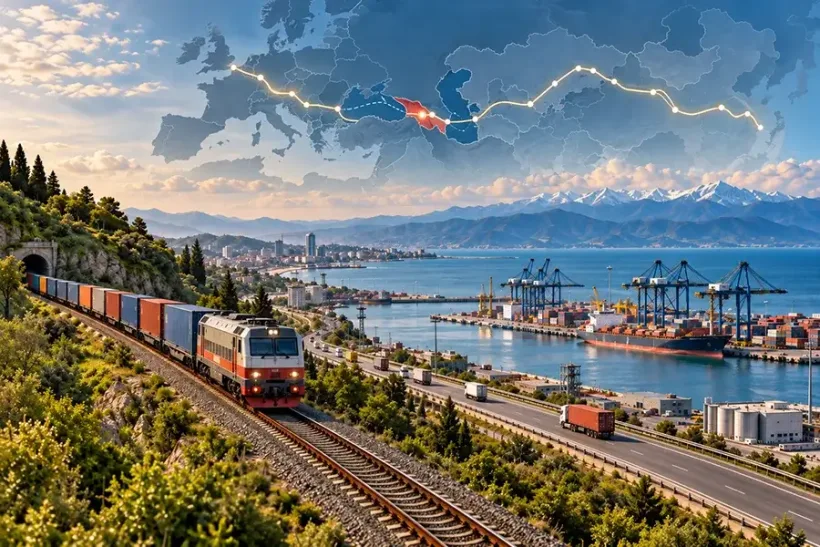
The World Bank has assessed the development prospects of the Middle Corridor, which connects Asia and Europe via the Caspian Sea and the South Caucasus. Its new study examines the investment needed, opportunities to increase freight volumes, and the impact of international trade on regional economies through 2040. Particular attention is given to Georgia and its role in expanding transport links.
Investment in the Middle Corridor
Developing the Middle Corridor will require substantial investment in transport infrastructure and logistics services. The World Bank estimates that more than $55 billion will be needed by 2040. At least $25 billion is required to expand railway sections, seaports, and transport connections along the core route. Another $30 billion or so will be needed for access roads, inland terminals, warehouses, rolling stock, and equipment.
The study identifies 16 priority projects that will largely determine the route’s capacity. Three-quarters are already being implemented, while the others are included in government plans and are at advanced stages of preparation. Investment covers major transport links, connections to seaports, and logistics facilities serving international trade.
Infrastructure investment is expected to be accompanied by better coordination of freight operations among Middle Corridor countries. The World Bank proposes a unified system for sharing transport and customs data, coordinating railway and maritime operators’ schedules and tariffs, and tracking cargo throughout the route.
Georgia’s Transport Projects
Freight Traffic Trends
The development of the Middle Corridor is strengthening Georgia’s role as a transport hub between Central Asia, the Black Sea, and Turkey. Freight volumes in the country are already increasing: from January through August 2026, ports and terminals handled 13.7 million tonnes of cargo, 24% more than in the same period of 2025. Rail freight rose by 11% to 9.7 million tonnes, transit freight increased by 14%, and container throughput reached 554,200 TEU, up 9%.
|
Indicator |
Volume |
Change |
|
Ports and terminals |
13.7 million tonnes |
+24% |
|
Rail freight |
9.7 million tonnes |
+11% |
|
Transit freight |
— |
+14% |
|
Container throughput |
554,200 TEU |
+9% |
Georgia plans to invest around $7 billion in transport infrastructure by 2032, including roads, railways, seaports, and airports. The authorities aim to roughly double the capacity of the railway and port infrastructure. Projects supporting international connections between Asia, Turkey, and Black Sea routes occupy an important place in the programme.
Seaports and Terminals
One of the largest projects is the Anaklia deepwater port. The first phase is scheduled to enter service in 2029, with a planned annual capacity of 10 million tonnes of cargo and 600,000 TEU. A road and a railway branch are planned to connect the harbour with the national transport network. Design work on the railway branch was completed by September 2026, and a construction tender was expected to be announced by the end of October. The new facilities will expand maritime transport options along the Middle Corridor.
The second phase of construction at the new port in Poti began in June 2026. It includes an additional 250-metre berth, dredging of the approach basin, and the installation of cargo-handling equipment. Once the project is completed, the complex is expected to have an annual capacity of 3 million tonnes. The existing ports of Poti and Batumi, together with the future Anaklia port, form the route’s Black Sea connection.
Highways
By the end of September 2026, Georgia had built around 325 km of high-speed sections of the East–West Highway. The road links Tbilisi with Black Sea ports and the route to Turkey, while also providing access to the Azerbaijani border. Work on the Rikoti section in central Georgia has been completed. In September, a contract was signed to build the 11.3-km Batumi–Sarpi road, including a 7.6-km tunnel and bridges.
The Asian Development Bank also approved $250 million for two sections of the Tbilisi bypass, with a combined length of 18.9 km. The new roads are intended to increase the capacity of road freight transport.
Railways and Logistics
The World Bank identifies Georgian Railway as a strategically important part of the Middle Corridor. Despite a network of around 1,400 km, the company has high infrastructure utilisation and a well-developed management system. Modernisation of the Marabda–Kartsakhi section was completed in June 2026, enabling the Baku–Tbilisi–Kars railway to become fully operational. Its freight capacity is estimated at 5 million tonnes.
In 2025, AD Ports Group and its partners opened the Tbilisi Intermodal Hub dry port. The facility integrates road and rail transport, providing container cargo handling and distribution services.
The World Bank also supports the TC-GATE programme: in June 2026, it approved $372 million in financing for a project with a total cost exceeding $750 million. The funds are intended to renew freight electric locomotives, improve railway operations, and upgrade road sections in Kakheti.
|
Project |
Key parameters |
|
Anaklia port |
First phase in 2029; 10 million tonnes and 600,000 TEU a year |
|
New port in Poti |
Second phase; capacity of up to 3 million tonnes a year |
|
East–West Highway |
Around 325 km of high-speed sections completed |
|
Batumi–Sarpi road |
11.3 km, including a 7.6-km tunnel |
|
Baku–Tbilisi–Kars railway |
Freight capacity of 5 million tonnes |
Trade and Economic Forecasts Through 2040
The World Bank examines two scenarios for the development of the Middle Corridor. With targeted investment, trade volumes along the route could more than triple, while delivery times could be halved. If countries complement infrastructure upgrades with reforms in trade, transport services, and border procedures, freight flows could quadruple and transit times could fall by roughly two-thirds compared with 2023. Both scenarios look ahead to 2040.
By 2040, investment in the Middle Corridor and related reforms could generate an additional 3.3% increase in the combined GDP of nine countries in the region and create around 2 million jobs. The economic gains would come from expanding trade, lowering transport costs, and developing businesses along the route.
The development of the Middle Corridor could increase Georgia’s GDP by an additional 3.61% and employment by 0.79% by 2040. The World Bank links these effects to investment in transport infrastructure, faster shipments, and stronger trade connections. The forecast also envisages growth in exports and imports.
|
Indicator |
Forecast through 2040 |
|
Trade volumes with targeted investment |
More than threefold increase |
|
Trade with additional reforms |
Fourfold increase |
|
Additional GDP gain across nine countries |
3.3% |
|
New jobs across the region |
Around 2 million |
|
Additional GDP gain in Georgia |
3.61% |
|
Increase in employment in Georgia |
0.79% |
What This Means for Investors
International Investment analysts note that the Middle Corridor could strengthen Georgia’s position in international trade and support economic diversification. Shorter delivery times will make European and Asian markets more accessible to local producers and simplify the procurement of equipment and raw materials. This will create favourable conditions for export growth and private capital inflows.
For investors, a key factor will be the domestic demand generated by new transport routes. Rising freight volumes will increase the need for warehousing, logistics services and commercial premises. The establishment of new businesses and stronger ties with international partners will provide further economic benefits.
The tourism sector offers particularly promising opportunities. The construction of high-speed highways will make travel across Georgia more convenient, while diverting some transit traffic away from the coastal road in Adjara could make Gonio and Kvariati more attractive to visitors. These changes will create opportunities for the hospitality industry, encourage hotel investment and support the expansion of related services.
Frequently Asked Questions
What is the Middle Corridor?
The Middle Corridor is an international transport route connecting Asia and Europe via the Caspian Sea and the South Caucasus. It uses railways, highways, and maritime services to move freight.
Why is the Middle Corridor important for Georgia?
Georgia provides a route for freight from Central Asia to Black Sea ports and transport connections with Turkey. Higher freight volumes could support exports, logistics businesses, and regional development.
How much investment is needed to develop the Middle Corridor?
The World Bank estimates that the route will require more than $55 billion through 2040. Funding is needed to expand the main transport links, ports, access roads, and logistics infrastructure.
Which Middle Corridor projects are being developed in Georgia?
Major projects include the Anaklia deepwater port, expansion of port facilities in Poti, the East–West Highway, the Batumi–Sarpi road, the Baku–Tbilisi–Kars railway, and transport network upgrades under the TC-GATE programme.
When is Anaklia port expected to open?
The first phase of the Anaklia deepwater port is scheduled to open in 2029. Its planned annual capacity is 10 million tonnes of cargo and 600,000 TEU.
What does the World Bank forecast for the Middle Corridor by 2040?
With targeted investment, trade volumes along the route could more than triple and delivery times could be halved. Further reforms could enable a fourfold increase in trade and reduce transit times by roughly two-thirds.
How could the Middle Corridor affect Georgia’s economy?
According to the World Bank, developing the route could increase Georgia’s GDP by an additional 3.61% and employment by 0.79% by 2040. These figures represent projected economic gains, not annual growth rates.
What opportunities could the Middle Corridor create for investors?
The expansion of international trade could increase demand for logistics and business services, commercial property, and export products. Better transport accessibility may also encourage investment in the regions and tourism.