







 Turkey Lowers Cap on Residential Rent Increases
 Tskhaltubo Needs a New Strategy to Attract Tourists as Visitor Numbers Decline
 Maldives Introduces Email Verification for Tourists
 Scammers Target Tourist Parks Across Australia
 Serbia Plans Unified Real Estate Listings Database
 "Emotions are Georgia": Georgia's Tourism Roadshow in Kazakhstan
Rule of Law: Fresh Data Shows Georgia Ahead of Albania, Moldova, and Ukraine

According to the World Bank's 2026 Worldwide Governance Indicators (WGI) update, Georgia's Rule of Law score stands at 60.2 points on a 100-point scale. The indicator assesses the effectiveness of the legal system, judicial and law enforcement operations, property rights protection, and compliance with the rule of law.
The World Bank has published the 2026 update of its Worldwide Governance Indicators (WGI) database, covering more than 200 countries and economies and spanning the period from 1996 to 2025.
According to the latest data, in 2025 Georgia's Rule of Law score stood at 60.2 points on a 100-point scale.
One of the six key WGI components, “Rule of Law”, assesses the extent to which society's institutions and agents abide by the rules of society and how effectively the legal system functions.
Georgia's Performance in International Comparison
According to World Bank data for 2025, Georgia's results present a mixed picture when compared with several neighboring states and European Union countries.
Georgia's score of 60.2 points surpasses those of Albania (58.0), Moldova (56.1), and Ukraine (45.6). However, the country trails several EU member states, including the Czech Republic, France, Spain, and Italy.
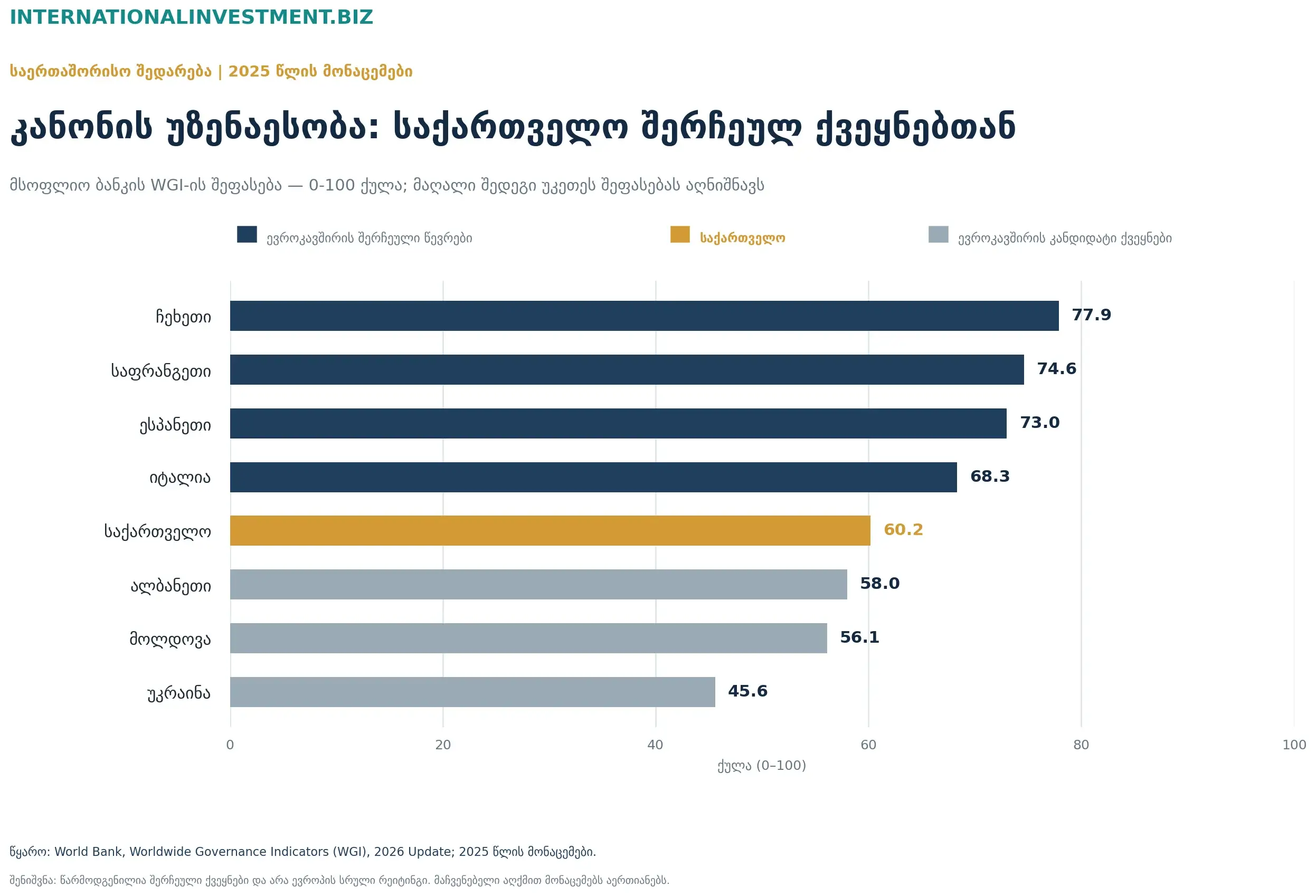
These data indicate that Georgia's position from a regional perspective is relatively competitive compared to several countries. Nevertheless, a substantial gap still remains when compared to the mature legal systems of the European Union.
What Does the Rule of Law Indicator Measure?
According to the World Bank methodology, the Rule of Law indicator is a much broader concept than judicial independence or the efficiency of commercial dispute resolution.
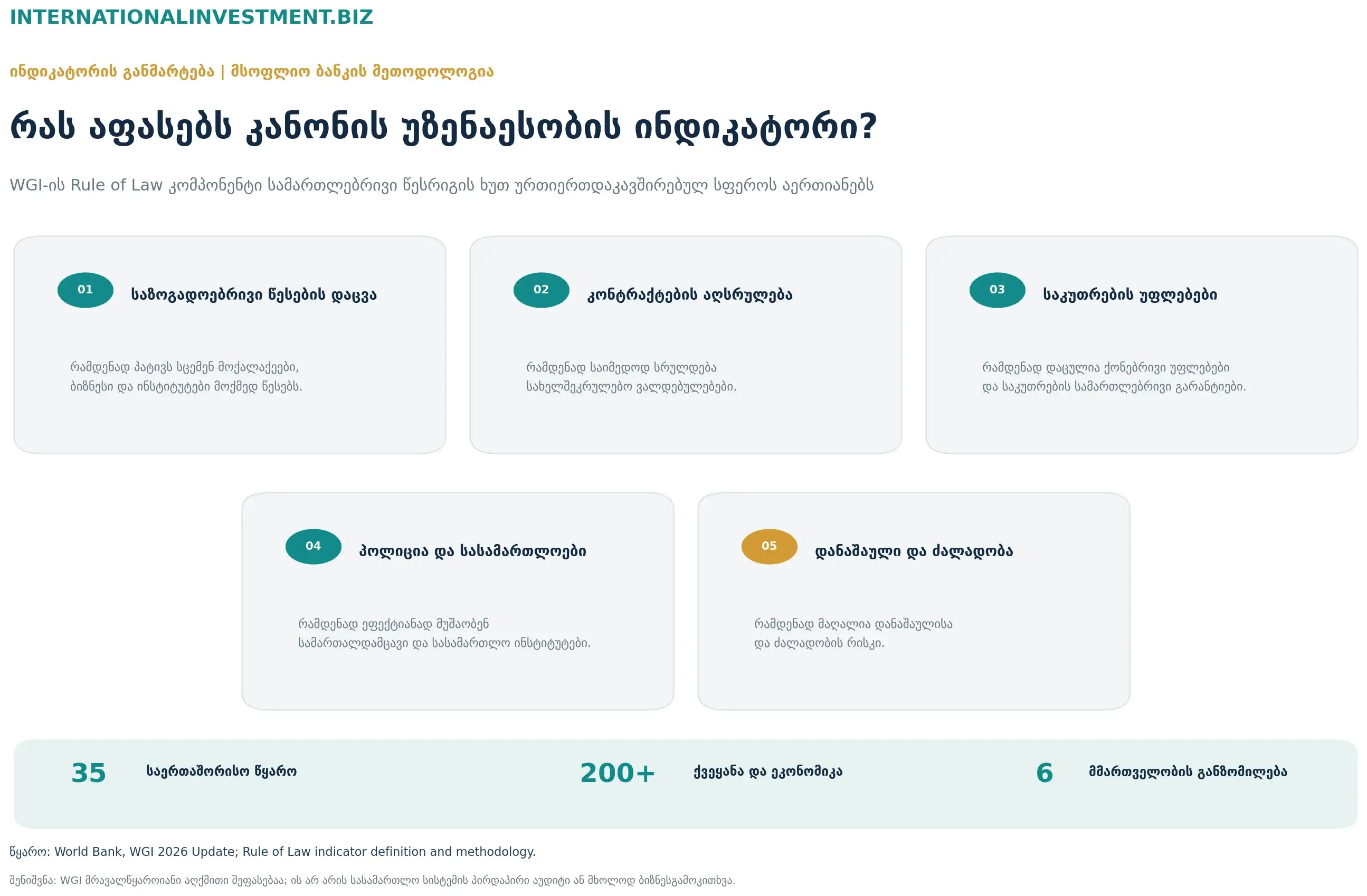
The indicator encompasses several key dimensions:
-
Contract enforcement and property rights protection;
-
Effectiveness of the judiciary and law enforcement bodies;
-
Compliance with and enforcement of legal norms;
-
Risks of crime and violence.
Thus, the indicator evaluates not only the degree of judicial independence, but also how predictable and effective the overall legal environment is.
According to the WGI methodology, the data are based on 35 international sources, including household and business surveys, assessments by international organizations, and independent expert evaluations.
It is important to note that the World Economic Forum's (WEF) Executive Opinion Survey is just one of these sources. Consequently, the aggregate WGI score is not shaped solely on the basis of a business executive survey.
Why Is This Indicator Important for Investors?
The rule of law stands as one of the most critical institutional factors in the investment environment. For investors, it is of paramount importance how well property rights are protected, how reliably contracts are enforced, and how independently and effectively the judicial system operates.
The significance of this component lies in the fact that the predictability of the legal environment reduces business uncertainty, strengthens trust in contract enforcement, and directly influences long-term investment decisions.
From this perspective, Georgia's score of 60.2 points serves as an important aggregate assessment of the country's institutional environment. However, international comparison shows that enhancing the quality of the legal system still requires ensuring the effectiveness of the courts and law enforcement, guarantees of property rights, and consistent enforcement of legal norms.
The World Bank emphasizes that the WGI is based on perception data and should be used exclusively as a tool for research and public policy analysis. It is not intended to be used as a standalone and definitive measure of sovereign credit risk or specific investment risks.
In conclusion, Georgia's score of 60.2 points on the rule of law scale indicates the current state of its legal and institutional environment, improvements in which can exert a significant impact on the country's investment attractiveness. For international investors, what will matter most is not only the ratings themselves, but how institutional reforms translate into practice.
Sources: World Bank — Worldwide Governance Indicators, 2026 Update; World Bank Data — Rule of Law: Governance Score (0–100); World Bank — WGI Documentation and Methodology; World Bank — WGI Usage Advisory