







 Turkey Is Losing Its Cheap-Holiday Advantage
 Development Is Rewriting Southeast Asia’s Historic Districts
 How Ukraine’s New-Build Housing Market Has Changed Over Four Years
 European Prime Rents Rise as Property Yields Turn Higher
 The Most Expensive Airlines in Europe in 2026
 Housing Prices in Italy Reach a Two-Year High
Guaranteed Income – A Decisive Advantage in the Off-Plan Real Estate Market
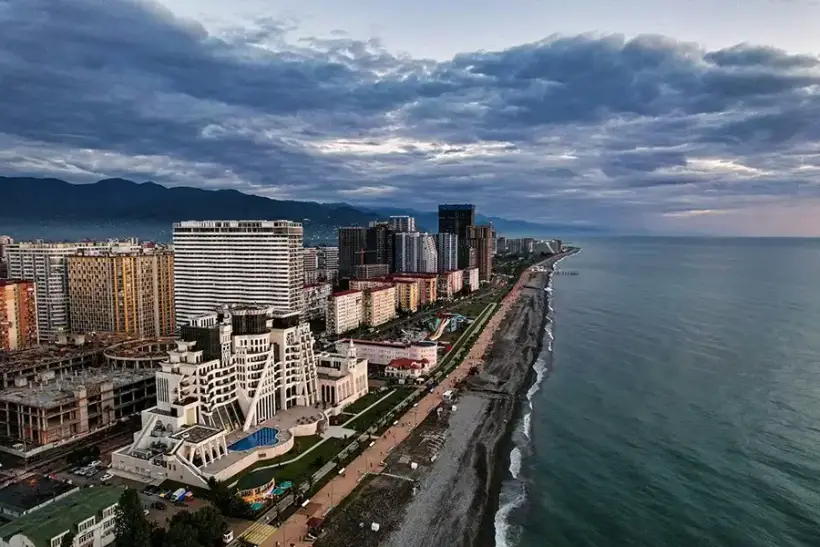
All developers promise buyers favorable conditions “after the purchase.” How can one determine the reality of these promises? Today we will examine such an option as “guaranteed income,” which can destroy the entire pyramid of developers’ promises.
What Is Guaranteed Income?
Guaranteed yield — what is it really? It is the income that an investor will receive from the acquired real estate. The level of this income is promised to the investor by the development company — the developer. How justified is this promise? Is it simply a marketing move or even deliberate deception?
Let us consider the example of a hotel under construction in which rooms are being sold. The developer promises buyers “guaranteed income.” What is it? How is it formed? Who guarantees it?
So, the project includes:
-
the developer
-
the hotel brand
-
the management company
Who guarantees the income: the developer, the brand, or the management company?
Guaranteed income is an obligation of the developer. Already at this stage, an investor can eliminate 90% of the options. A developer confident in its product pays guaranteed income from the moment of receiving payment — already at the construction stage. There are only a few such offers on the global market.
Payment of guaranteed income from the moment of payment, already at the construction stage — this is unequivocally guaranteed income.
Of course, these conditions must be stipulated in the contract — otherwise there are no guarantees.
At whose expense does the developer pay guaranteed income to the owner of a room in a branded hotel?
In fact, the buyer lends money to the developer. The financial model of partnership between the buyer and the developer is the same as in banking. Only the developer takes a loan not from a bank, but from a client. And guaranteed income is an analogue of interest in bank lending. In Georgia, banks lend to developers at 12–15% per annum. Therefore, it is more advantageous for the developer to pay interest to the client in the form of guaranteed income at the level of 10% per annum. Moreover, to pay guaranteed income from the moment of receiving the money, at the construction stage — just as the developer would pay the bank. This model is mutually beneficial. The client begins to receive profit from the moment of purchase, even before completion of construction. And the developer saves money on paying interest to the bank.
This model is client-oriented. It is more advantageous for the client that the developer pays interest to them rather than to the bank. This model is mathematically justified. Therefore, by using the client’s money and paying guaranteed income to them instead of to the bank, the developer reduces risks both for itself and for the client. And a developer who takes bank loans increases risks both for itself and for the client.
Criticism of this model is based on the claim that the developer simply includes the guaranteed income in the price of the property. This criticism is unfounded and is easily refuted mathematically. If the developer promises to pay guaranteed income for one year after the purchase, then this amount can indeed simply be included in the price of the property. But in the case of Wyndham Grand Batumi Gonio, the developer pays guaranteed income. The obligation of the developer to pay guaranteed income is included in the contract for a period of five years with the possibility of extending. An obligation to pay guaranteed income for one year is 10% of the value of the property. This amount can still be included in the price. But an obligation to pay guaranteed income for five years is half of the value. It is impossible to increase the price by one and a half times — in that case any profitability is lost, and the entire financial model collapses. Only a developer confident in its financial model and real income can assume multi-year obligations to pay guaranteed income. And this testifies to the high reliability of the product. If a developer does not assume multi-year obligations to pay guaranteed income, it means that they are not confident in their product and their financial model.
What ensures the fulfillment of the contract terms regarding guaranteed income?
Fulfillment of the terms stipulated in the contract is ensured by the assets of the developer company — not only the specific property, but also other projects, land plots, and all property.
For example, the developer of the Wyndham Grand Batumi Gonio hotel complex — European Village LLC — pays guaranteed income from the moment of receiving payment, already at the construction stage. All these conditions are included in the contract.
European Village is also a pioneer in the premium low-rise construction segment in Adjara and along the entire sea coast of Georgia. The premium villa complexes built by this company became the first such investment product on the Black Sea coast of the country. The acute shortage of such a product on the Georgian market allowed the company to guarantee income for many years. For five years now, European Village has continued to pay buyers of these villas guaranteed income in the amount of 8% per annum and extends guaranteed income agreements, remaining the only developer in Georgia that pays guaranteed income to its clients continuously, which is confirmed by villa owners. This is the only example in Georgia of confirmed investment expectations of buyers.
The Hotel Concept Is the Foundation of the Financial Model
As in the case of premium villas, product scarcity is a reliable foundation of the financial model of the Wyndham Grand Batumi Gonio project. The concept of a luxury hotel with the first all inclusive services in Georgia has no analogues on the Georgian market.
Market statistics show that the occupancy rate of internationally branded hotels in Georgia in 2025 exceeded 70% and reached an average annual level of 72%. In high season, occupancy of branded hotels under international brands exceeds 90%. For comparison: the average annual occupancy of non-branded hotels and hotels of local brands in Georgia is less than 50% on average for the year. Apartment occupancy does not even reach 40%, and is often less than 30% with daily rentals.
The average annual rental rate for apartments in resort Batumi is about 30 dollars per night.
In non-branded apart-hotels and hotels of local brands, even in high season, it averages 80 dollars.
In hotels of international hotel chains, the accommodation rate reaches 250 dollars on average for the year.
In luxury-level hotels, it is 500–700 dollars per night on average for the year. There are only a few luxury-level hotels in Georgia. For example, Paragraph Freedom Square, a Luxury Collection in Tbilisi and Paragraph Resort & Spa in Shekvetili.
And there are no all inclusive hotels in Georgia at all yet. Consequently, their price will be higher than the existing market ceiling due to exclusivity. And the price of all inclusive luxury will be even higher — up to 3,000 and even up to 5,000 dollars per night.
Based on these market data, the financial model for the elite hotel complex Wyndham Grand Batumi Gonio is built. The missing data on the market of all inclusive luxury, which does not yet exist in Georgia, are taken from similar markets in neighboring countries — Turkey and Russia (Krasnodar region), where a hotel room in this narrow segment costs up to 5,000–7,000 dollars per night.
Thus, guaranteed income on apartments cannot exceed 3–4% at best; on a room in a hotel of a local brand or a non-branded hotel — a maximum of 8%, and only if the hotel is 5-star; while an exclusive guaranteed income offer in the highest all inclusive luxury segment from a global brand may reach 10% or more per annum. Only for such an offer can a developer provide guaranteed income for 5 years or more.
Is Real Estate Under a Global Brand an Investment Product?
Branded real estate is not always an investment product. Even the world leaders of the hotel industry have hotel residences in their brand portfolios. Hotel residences are real estate for recreation and living, not for generating income. In essence, this is housing, but with hotel service. Even in the luxury segment, such a product does not imply profit; its price is formed without taking into account possible profit. Therefore, promises of guaranteed income from developers in such cases are, as a rule, nothing more than a marketing move.
The Wyndham Grand Batumi Gonio project is a hotel in the full sense of the word, hotel real estate whose function is to generate income. Wyndham Grand is exclusively a hotel brand. The structure of this complex includes a 20-story hotel, hotel villas and townhouses, as well as family residences. Family residences in this case are a product that combines both comfortable living and profit generation. But only in this case. In the Wyndham Grand Batumi Gonio project, family residences are integrated into the infrastructure of the hotel complex, that is, they are part of the hotel and generate profit as a hotel. Many developers offer exclusively family residences under a hotel brand. But without hotel infrastructure, residences are not an investment product.
Does a Casino in a Hotel Generate Additional Profit for Room Owners?
Hotels with casinos not only do not generate profit for room owners, but also are an obstacle to maximizing their income. The casino is managed either by the management company or by a third party — a company that owns the technical premises of the gaming halls. As a rule, the concept of a casino with a hotel provides that the main profit is derived from the casino, not from accommodation in rooms. Therefore, in order to attract more visitors to the casino, the management company lowers the accommodation price in such a hotel almost to cost price. This causes direct damage to room owners and their financial interests.
In addition, the clientele of hotels with casinos is incompatible with the concept of family recreation and the concept of hotel residences. Therefore, selling “family vacation” in a hotel with a casino is nothing more than a marketing trick and a financial risk for investments in such properties.
Finally, the presence of a casino is an obstacle to attracting guests with one of the highest average bills in the world — from Muslim countries of the Arab world. They are desirable clients for casinos, but for family vacations they will not choose a hotel with a casino. And for room owners, the loss of this clientele means financial losses.
Thus, for the financial model of a profitable hotel it is important that the property is exclusively a hotel, not a residence. And without a casino, which is a completely different, although related, type of business, and not investment hotel real estate.
Who Ensures Guaranteed Income After Completion of the Hotel Construction?
When the hotel is completed, it is transferred to the management company. In the case of Wyndham Grand Batumi Gonio — to the global leader in hotel management, Aimbridge Hospitality.
The management company is engaged in attracting guests, ensuring a high level of service, increasing the popularity of the hotel and the cost of accommodation in it. Together with the cost, the hotel’s income grows, and therefore the income of room owners grows.
Hotel income also largely depends on the brand. Hotel brands have loyalty programs. Leading global brands have tens and even hundreds of millions of loyal customers. A professional investor relies on this indicator.
A large international management company means marketing developments tested over decades to attract clients. Aimbridge Hospitality is exactly such a company. A local management company is nothing more than staff, technical personnel.
In addition to occupancy, the brand also ensures a high cost of accommodation in the hotel and, accordingly, the income of the hotel and room owners. The larger the brand, the higher the occupancy and the higher the cost of accommodation per room.
Who and How Exactly “Guarantees” a Certain Level of Income to the Owner of a Room in a Branded Hotel?
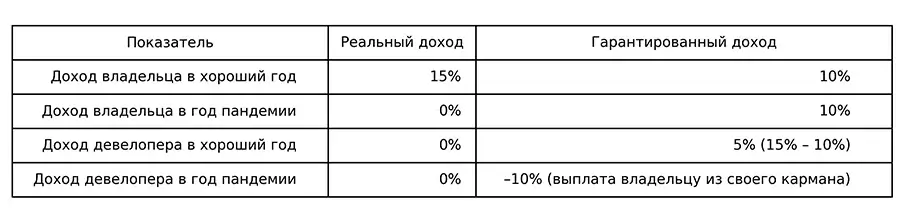
The developer assumes the risks of the room owner. In the Wyndham Grand Batumi Gonio project, the developer guarantees the client 10% annual income and includes these obligations in the contract. This means the developer is confident that the real income will be higher. The difference between the real income and the guaranteed income is the developer’s earnings. In such a case, if the hotel, for example, generates 15% income, the developer earns 5%, and pays the remaining 10% to the room owner.
However, let us imagine that turbulence in tourist flows occurs. For example, a pandemic. And the hotel generates only 3% real profit. In that case, the missing 7% to reach the guaranteed income is paid to the room owner by the developer from its own funds.
It is important to remember: the room owner decides what to choose — guaranteed income without risks or real income with risks. If the owner chooses real income, they will earn more, but assume the risks. In a good year, they may earn, for example, the full 15%, and in a turbulent year only 3%. If the client transfers all risks to the developer, they receive the guaranteed income (10%), regardless of circumstances.
This is guaranteed income. Income without risks. And it is precisely because of the risks that developers do not offer this option to clients. Only the most reliable and stable developers assume the risks and guarantee risk-free income to clients.
Should the Contract Include the Possibility of Extension at the Request of the Room Owner in the Hotel Complex? How Exactly?
Guaranteed income must обязательно be specified in the contract. Almost all developers promise guaranteed income. But few of them include their obligations to pay guaranteed income in the contracts.
There are also developers who include guaranteed income in the contract for one or two years after completion of construction. After that, they remove these obligations from themselves. This is also, in essence, deception.
The contract must include the possibility of extending the guaranteed income agreement. The standard practice of Wyndham Grand Batumi Gonio is to conclude a guaranteed income agreement for 5 years with the extension of the agreement at the request of the room owner.
The Wyndham Grand Batumi Gonio hotel complex is being built under the Wyndham Grand brand. This is the best brand in the portfolio of the global leader Wyndham Hotels & Resorts. The company’s loyalty program includes more than 100 million clients.
The complex is managed by Aimbridge Hospitality — a global leader in hotel management. Income is distributed between it and the room owner in the proportion of 60% to 40% in favor of the room owner. These conditions are included in the contract between the room owner and the management company.
The guaranteed income agreement is included in the contract with the developer for a period of 5 years with a condition of extension at the request of the room owner.
All this constitutes legal guarantees and real justification of high income.
What Is the Real “Net in Hand” Return When Investing in a Hotel of an International Brand? Is It “Gross” or “Net”?
As a rule, developers indicate income “gross.” That is, taxes, expenses and other costs are additionally deducted from the income amount. As a result, the buyer receives, at best, 3–4% per annum “net,” and sometimes ends up at break-even.
In the Wyndham Grand Batumi Gonio hotel complex, the guaranteed and real income are indicated “net.” That is, expenses for salaries, utilities, consumables, repairs and so on are borne by the management company. After receiving guaranteed income in the amount of 10%, the room owner only needs to pay income tax or corporate tax — depending on their status.
The maximum tax rate is 5%. But this 5% is not applied to the total profit; it is applied to the owner’s personal income. That is, these 5% are not half of the 10% guaranteed income; they are 5% (one twentieth) of the amount — that is, only 0.5% deducted from 10%. As a result, 9.5% of “net” profit remains after taxes. There are no other expenses.
How to Understand the Reliability of a Financial Model with Guaranteed Income from Ownership of a Room in a Hotel of an International Brand?
The reliability of the financial model is determined by market statistics and independent research of the market as a whole.
The Georgian hospitality market has been widely studied by independent research. In particular, it is recommended to review:
-
open sources.
The key advantages of the Wyndham Grand Batumi Gonio project for buyers of hotel rooms / investors in the hotel complex are: it is the first all inclusive in Georgia and especially the first all inclusive in the luxury segment in Georgia, as well as the world leader in hotel management, the largest hotel infrastructure in the country, year-round occupancy. All this is not represented on the Georgian market by other companies and allows adjusting the expected income (average for the market) upward.
In What Currency Is Guaranteed Income Paid from Ownership of a Room in a Hotel of an International Brand?
This is an important question. Because if an investor purchases a room in some local currency, their income is subject to inflation along with that currency.
Many developers indicate the payment amount in local currency. Over a year, an unstable currency depreciates.
For example, the most resonant precedent took place in Izmir, Turkey — in the Radisson RED Izmir Point Bornova hotel. There, income was paid in Turkish lira. In Turkey, inflation of the local lira amounts to tens of percent annually. By the time income was paid to room owners, their real income in dollar terms had decreased by half or more.
In the Wyndham Grand Batumi Gonio hotel complex, guaranteed income is paid in euros. The amount of guaranteed income in the contracts is also indicated in euros, as is the transaction amount.
Are There Risks of Delays in the Construction of the Hotel Complex? How Will This Affect Returns? What Will Happen If the Hotel Does Not Open on Time?
Long-term construction delays are a key risk of the construction market. A delay in construction postpones the timing of profit generation for investors.
This risk can only be eliminated by specifying in the contract a specific date for the start of payments, without linking it to the actual completion of construction. Such offers are practically absent on the market.
One of the unique exceptions is the Wyndham Grand Batumi Gonio project. Buyers of rooms in this hotel complex begin receiving guaranteed income from the moment of payment. That is, even earlier than the planned construction completion date and regardless of possible delays.
How Does the Developer Secure Guaranteed Income and on What Basis Is It Paid Already at the Construction Stage?
The security of guaranteed income before the launch of the hotel is ensured by the assets of the developer company itself. This is economically justified and more advantageous than bank lending to the developer and, consequently, to the investor.
And it is paid due to the fact that the developer does not take bank loans and does not pay interest to banks. Instead, the developer pays guaranteed income to clients.
The guaranteed income rate is lower than the bank lending rate. The developer chooses between the bank and the client. Choosing the client is a mutually beneficial option. By choosing the client, the developer offers them more favorable purchase conditions.
In fact, the client really lends money to the developer, receiving more favorable conditions in return. However, in the perception of the client this option may seem more alarming. Bank lending subjectively seems less frightening, but in reality it increases risks both for the developer and for the investor.
The developer of Wyndham Grand Batumi Gonio abandoned the generally accepted practice of bank lending with the onset of stagnation in global markets in order to improve purchase conditions for clients, since the “arithmetic” is equally beneficial for both the company and the clients.
The Brand’s Position on Guaranteed Income: What Is Important to Consider When Signing the Contract?
An important question: does the brand remain uninvolved in the guaranteed income promises made by its developers?
The brand does not guarantee income and does not engage in options that go beyond standard market practice. However, when working with a developer, the brand checks its reliability and financial security.
What Are the Risks? What Happens in the Event of a Crisis, Force Majeure, or a Decline in Tourist Flow? Risk Management and Comparison of Conditions When Investing in a Hotel Complex of an International Brand
The conditions for investment security and project reliability are:
-
inclusion of guaranteed income payment terms in the sale and purchase agreement, which eliminates the risk of not receiving income in case of construction delays;
-
payment of guaranteed income from the moment of receipt of payment, already at the construction stage;
-
presence of a major international brand with no fewer than 100 million loyal clients;
-
presence of a major international management company;
-
distribution of income between the management company and the client in favor of the client;
-
“net” guaranteed income, with only income tax, without deductions for salaries, utilities, consumables, depreciation and other expenses;
-
voluntary choice of the client between guaranteed and real income;
-
the client’s right to extend the guaranteed income option with inclusion of this right in the contract;
-
reliability of the financial model confirmed by market statistics and independent marketing research;
-
presence of market-unique options — services and infrastructure;
-
fixation in the contract of income payments in a stable currency.
On the global market, one of the few projects meeting all these requirements is the Wyndham Grand Batumi Gonio hotel complex. On the Georgian market, there is only one such project.
Is It Possible to Sell the Property During the Period of Guaranteed Income?
The Wyndham Grand Batumi Gonio hotel complex allows resale of the purchased room already at the construction stage. This can be done in two ways.
The first way is to sell the room back to the developer at an increased price. Moreover, at the client’s request, the developer is obliged to buy back the room.
The second way is to resell the room through the developer at market price. If the developer has not been able to resell the room within six months, the buyer may sell the room independently.
In either case, the “Guaranteed Income” option is sold together with the room and is transferred to the next buyer.
How Do Guarantees Work in Real Projects?
Most developers do not guarantee the promised income in any way. This is a marketing trick and often simply deliberate deception.
Only a few developers include guaranteed income in the contract, but for one or two years after completion of construction. Moreover, without the possibility of extending this option at the request of the buyer.
The guaranteed income conditions offered by Wyndham Grand Batumi Gonio are unique for Georgia and are among the best on the global market as a whole.
When the Guarantee May Not Work
Risks are always present. These are force majeure circumstances. For example, natural disasters or global financial crises due to which not only large companies, but entire states, go bankrupt.
But even in this case, luxury hotels under leading global brands are a more protected segment. Insurance companies are more willing to insure such properties. And during global crises, luxury segments typically experience only a decline in income, but not losses.
There are no other reasons why the guarantee may not work in the Wyndham Grand Batumi Gonio project.
Comparison: Guaranteed Income vs Real (Floating) Income
Real income is the income that the hotel will generate after completion of construction and commissioning. Real income fluctuates from year to year. It depends on the number of tourists. And the number of tourists, in turn, depends on many factors. Turbulence in tourist flow is a certain risk. And each room owner independently makes a choice — to assume these risks or to choose the “Guaranteed Income” option and transfer these risks to the developer.
For example, the hotel generates on average 15% annual income in good years. Suppose the room owner chose real income instead of guaranteed income. In that case, these 15% constitute their income. But then a pandemic occurs, borders are closed, there are no tourists. In that case, the room owner remains without profit.
And what happens if the room owner chooses the “Guaranteed Income” option? For example, at the level of 10% per annum. In that case, in a good year, the developer who guarantees this income to the room owner earns 15%, of which 10% is paid to the room owner. 5% remain with the developer. But then a pandemic occurs. The hotel generates no income. In that case, the developer still pays 10% guaranteed income to the room owner from its own funds.
Is an Asset with a Guarantee Liquid?
At the construction stage, a room in the Wyndham Grand Batumi Gonio hotel complex has instant liquidity. The developer’s obligation to buy back the room at an increased price is stipulated in the contract as the “Buyback” option.
However, in this project there has not been a single person willing to sell the room back to the developer with a 10% markup for each year. Because elite hotel real estate under a global brand increases in value annually by 30% or more.
Here are the price statistics at which rooms in the Wyndham Grand Batumi Gonio hotel complex were sold (per square meter at the beginning of the year):
in 2023 (beginning of the year) — $4,360
in 2024 (average transaction price for the year) — $6,170 (+41.51% per year)
in 2025 (average transaction price for the year) — $8,830 (+43.11%).
Thus, the capitalization of these assets already at the construction stage amounts to more than 40% per year.
The developer also offers room owners assistance in selling the room at market price. This assistance is also stipulated in the contract. Assistance in the sale is provided within six months from the moment of the room owner’s request.
Under Which Law Is the Contract Concluded — Local or International? What Should an Investor Do in Case of a Dispute?
Contracts are concluded in accordance with the legislation of Georgia and are registered with the Ministry of Justice of Georgia.
Resolution of commercial disputes is handled by the relevant court authority in Georgia.
Can the Contract Be Changed Unilaterally?
In the Wyndham Grand Batumi Gonio project, neither party has the possibility to independently change the terms of the contract. There is no “fine print” in the contract.
This is also an important advantage of the project. Since many other developers draft contracts in such a way that any possible disputes are initially interpreted in favor of the developer.
What Exactly Is Considered “Fulfillment of Income Obligations” — Accrual or Actual Payment?
Fulfillment of the developer’s obligations to the client regarding guaranteed income is the actual payment.
What Is the Actual Profitability of the Hotel Without a Guarantee? And Why Does an International Brand Win?
According to market statistics in recent years, the occupancy rate of international brand hotels in Batumi has been continuously growing and already amounts to more than 70% on average per year. And in high season it exceeds 90%. In contrast, ordinary apart-hotels have an average occupancy of less than 30% per year.
The cost of accommodation in chain branded hotels also steadily increases and is 4–5 times higher than the cost of accommodation in apart-hotels. In general, the profitability of chain branded hotels is 7–8 times higher than the profitability of apart-hotels.
In addition, a long-term stable trend is observed on the Georgian market — the growth of room stock in non-branded hotels and hotels of local brands increases faster than the growth of tourist flow in this segment. According to market operators, after the pandemic the room stock in this segment increased by 50%, while the number of tourists in this segment grows by only 3–4% per year. As a result, occupancy rates of such hotels decline and, accordingly, revenues decrease. Hoteliers in this segment are even forced to reduce prices in order to win competition for clients. In contrast, in deficit segments, attendance grows every year, together with accommodation prices, while supply grows more slowly than the flow of high-spending tourists.
Who Bears the Costs in Case of Under-Occupancy? The Investor or the Management Company?
In chain branded hotels, there is no such concept as “under-occupancy.” Their occupancy and accommodation rates always generate profit. When distributing profit, as already stated, all expenses are borne by the management company.
Who Exactly Manages the Hotel — the Brand or the Local Team?
The Wyndham Grand Batumi Gonio hotel complex is managed by Aimbridge Hospitality — the largest hotel management company in the world.
Hotel occupancy is also increased by loyal clients of the international hotel company Wyndham Hotels & Resorts. There are more than 114 million such clients.
How Is Seasonality Addressed in International Brand Hotels?
The Wyndham Grand Batumi Gonio hotel complex is designed for year-round recreation. For this purpose, the complex has the largest infrastructure in Georgia and one of the largest in the world. In total — more than 100 facilities designed to provide recreation, wellness, leisure for the whole family, work and business throughout the year.
Does the Management Company Have Long-Term Contracts with Tour Operators?
The existence of such contracts and individual cooperation terms with tour operators, platforms such as Airbnb, Booking and similar are among the main advantages of Aimbridge Hospitality and other global management companies over local management companies.
How Overheated Is the Batumi Coast Market?
An oversupply has formed in the economy segment in Adjara — budget apartments and flats.
At the same time, the region maintains an acute deficit in the premium and luxury segments — primarily elite villas and luxury hotels.
Wyndham Grand Batumi Gonio will become the first luxury hotel in Georgia under a leading global brand with all inclusive services.
A deficit of available land for development is also observed on the market. In the historical part of Batumi, no such land remains. The main construction activity is concentrated in the Gonio district of Batumi.
This is the “golden coast,” a narrow strip of scarce land between the mountains and the sea, only a few kilometers long.
These lands have received recreational status; the height of future construction here is limited to 15 meters. This guarantees that luxury hotel real estate on the “golden coast” will always remain scarce and will not be excessively built up with other high-rise hotels.
How Is Investor Income from Investment in a Global Brand Hotel Taxed?
As already stated, the investor pays only 1% income tax. All other expenses are borne by the management company.
Can the Tax Regime Be Changed Unilaterally?
Georgia is a tax haven for investors. It has one of the most business-friendly tax systems, which is noted annually in the relevant World Bank rankings.
In addition, Georgia has a unique constitutional provision: a tax rate can be increased only through a national referendum.
How Easy Is It to Sell a Room with an Active Guarantee?
It can be sold instantly — back to the developer. According to the contract, the developer of the Wyndham Grand Batumi Gonio hotel complex is obliged to buy back the room at the request of the owner. Including at the construction stage. And at an increased price.
The room owner may also set their own price, and the developer provides assistance in the sale using its marketing resources. This option is also stipulated in the contract.
Additional Advantages of the Wyndham Grand Batumi Gonio Project
An important and attractive concept for European and American buyers in the Wyndham Grand Batumi Gonio project includes:
– orientation of the hotel complex toward people with special needs. The infrastructure of the complex is equipped with everything necessary for this category of guests — from ramps to its own physiotherapy and rehabilitation clinic.
– strict adherence to international environmental standards — use of eco-materials, minimization of environmental impact during hotel operation, decarbonization, and so on. This is the global Wyndham Green program — a brand requirement for all hotels in the chain, monitored by the brand.
– overcoming racial prejudice. For example, the hotel complex provides halal and kosher cuisine, pools and spa facilities, including halal. The hotel concept unites people of different faiths, nationalities and races under the idea of a common open world for everyone.