













Anaklia Port to Connect with Railway: $205M International Tender Announced
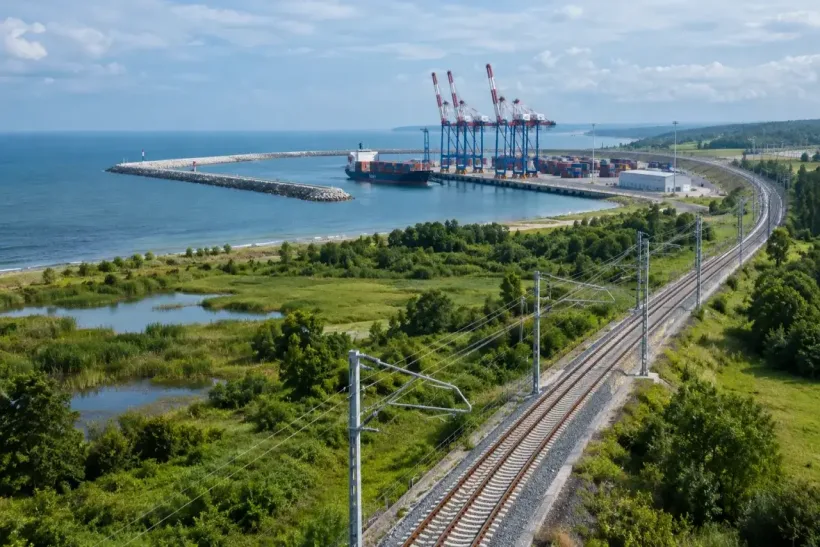
JSC Georgian Railway has announced an international tender for the design and construction of an electrified railway line measuring 17.7 kilometres, which will link the Anaklia deep-sea port to the country's railway network. The estimated cost of the construction works is 205 million dollars, including VAT. The new infrastructure will connect Anaklia Port with the operational railway network of Georgia and will help unlock the potential of the Middle Corridor.
The development of the Anaklia deep-sea port has gained another key infrastructure component. Georgian Railway has announced an international tender for the design and construction of a new railway line that will connect the port with the country's existing main railway line.
The project envisions the construction of a fully electrified railway branch approximately 17.7 kilometres in length. The new section will connect to the mainline near the village of Khamiskuri and run directly to Anaklia Port.
The estimated cost of the works is 205 million US dollars, including VAT. Following contract signing, 30 calendar months are allocated for design and construction activities. According to Georgian Railway, the railway infrastructure must be ready for the commencement of port operations in 2029.
What Does the 205 Million Dollar Project Include?
According to the tender documentation, the project covers not only laying a new track bed. The scope of work includes the design and construction of accompanying infrastructure, station development and renovation, installation of electrification systems, and other engineering works.
Key components of the project:
-
construction of a new electrified railway line approximately 17.7 km long;
-
construction of a new railway station in Anaklia;
-
renovation of infrastructure at the Khobi railway station;
-
modernisation of the Khamiskuri railway junction;
-
installation of the track superstructure, subgrade, bridges, and culvert structures;
-
installation of overhead contact networks and traction power supply systems;
-
installation of signalling, telecommunications, and dispatch control systems;
-
development of rail access tracks to the port territory.
World Bank documentation notes that the configuration of the new line provides for the possibility of laying a second track in the future, facilitating infrastructure expansion if freight traffic increases.
Upon completion of the construction contract, an 18-month defects notification period is also provided.
World Bank Financing: Total Project Scope of $225.56 Million
The construction of the branch is part of a broader integrated project prepared with the support of the World Bank, designated in its documents as Rail Access and Intermodal Linkages (ARGO RAIL).
According to a World Bank project document dated 29 October 2026, the total estimated cost of the entire operation is projected at 225.56 million dollars. The same volume of proposed financing is earmarked by the International Bank for Reconstruction and Development (IBRD).
The indicative project approval date is scheduled for 18 June 2027. Thus, at this stage, the project represents an upcoming financial operation rather than an already approved or disbursed loan.
It is important to highlight that the programme is split into two key directions. The first includes the direct establishment of the rail corridor to Anaklia Port and the modernisation of related infrastructure. The second direction aims at the institutional strengthening of Georgian Railway: enhancing project and asset management, implementing digital technologies, and developing intermodal freight transport.
This is an important distinction: 205 million dollars is the estimated value of the construction contract, whereas 225.56 million dollars represents the full anticipated budget of the comprehensive World Bank project.
Why Is Rail Connection Critical for Anaklia Port?
Developing a deep-sea hub entails far more than constructing marine hydraulic structures. The port's competitiveness largely depends on the speed and cost efficiency of transshipping cargo from sea transport to overland routes.
Rail connectivity serves as the foundational link here. With it, the port will be able to rapidly dispatch arriving containerised, bulk, and general cargo along both domestic and international routes.
According to World Bank assessments, in order to fully realise the economic potential of Anaklia Port, proactive development of land transport arteries is necessary. Without an adequate rail network, the terminal's capacity to attract transit flows, logistics investments, and regular shipping lines will remain constrained.
The main objective of the new mainline is to scale up capacity for redistributing cargo into the domestic railway network in sync with the port's commissioning. This will help prevent logistical bottlenecks and establish seamless integration between maritime and overland transport.
The Middle Corridor and Georgia’s Transit Potential
Connecting Anaklia Port to the rail network aligns with the overarching development strategy for Georgia's transport system.
The Middle Corridor, which connects China and Central Asia to Europe via the Caspian Sea, the South Caucasus, and Turkey, is seen as a pivotal pathway for reinforcing the country's transit role.
The efficiency of transit along this route relies not on isolated local developments, but on their integration into a cohesive intermodal network. To achieve these goals, the seaport, railways, highways, customs checkpoints, and terminal-logistics centres must operate in close coordination.
The new rail line to Anaklia will become a cornerstone of this supply chain. Its launch will grant the port direct access to Georgia's railway network and unlock extensive prospects for processing international cargo.
World Bank documents also emphasise the necessity of synchronising railway investments with the construction of an access highway to the port and other infrastructure projects along the transport corridor.
Environmental and Social Aspects: Key Challenges
Construction will take place across the Colchis Lowland, where environmental protection traditionally receives heightened attention.
In the World Bank's environmental and social assessment, it is noted that the project implementation zone affects sensitive ecosystems, including coastal strips, sand dunes, and wetlands. The document highlights the protection of migratory bird habitats and the preservation of relict Colchic rainforests.
The World Bank classified the project under the 'Substantial' environmental and social risk category. This requires stringent monitoring of ecological impacts, proper land acquisition and resettlement procedures, open stakeholder dialogue with local communities, and social safety net guarantees.
Furthermore, highway and railway infrastructure will be laid within a single corridor, making coordination over land acquisition and environmental protection measures even more critical.
Consequently, the project's success will be determined not only by adhering to the budget and schedule, but also by strict adherence to environmental regulations and the consideration of local community interests.
The Tender and Next Steps
The international tender announced by Georgian Railway is being conducted under a single-stage, two-envelope procedure: bidders submit technical and financial proposals separately.
Tender number: GE-GR-581481-CW-RFP. The final submission deadline is set for 15 January 2027, by 16:00 Tbilisi time.
The winning bidder will undertake the complete engineering cycle: both design works and the physical construction. The contract execution period is 30 calendar months from the start date.
According to Georgian Railway's plan, the infrastructure must become operational in 2029 to align smoothly with the commissioning of the deep-sea port's first phase.
Infrastructure Connectivity as the Foundation of Anaklia’s Competitiveness
For Georgia, the Anaklia project represents much more than the addition of another maritime harbour. The economic return on the port will directly depend on the quality of its links with the country's road and rail networks, cargo turnaround speed, and the scale of international transit attracted.
Announcing the tender for the construction of the 17.7-kilometre line marks a significant practical step. However, the eventual outcome will be shaped not only by meeting construction timelines, but also by tight operational synergy among the port, the railway, and logistics providers.
If construction is completed on schedule, Anaklia Port will gain direct access to the national railway network, providing a fundamental prerequisite for boosting the country's transit potential and reinforcing Georgia's standing along the Middle Corridor.
InternationalInvestment.biz — English edition