












The Economist Warns of Crisis Risks in 2027

The global economy is approaching 2027 with a growing risk of financial crisis. Rising debt and the investment frenzy surrounding artificial intelligence are making financial markets more vulnerable, The Economist warns. If investors' expectations are disappointed, problems in the technology sector could trigger broader economic turmoil.
Debt and Expensive Borrowing
Governments in advanced economies are increasingly dependent on bond markets. To cover budget deficits and repay existing obligations, they must regularly raise fresh funds. When investors demand higher yields, the cost of servicing public debt rises. That leaves less money for social programmes, infrastructure and other priorities.
France is among Europe's more vulnerable economies, as fiscal difficulties add to political tensions. Reducing the deficit requires unpopular decisions, while the approaching 2027 presidential election makes compromise harder to achieve. Financial instability in such a major economy could also affect other eurozone countries.
Higher government bond yields also affect the private sector. Banks revise their lending terms, businesses postpone investment projects and homebuyers face larger mortgage payments. Highly indebted firms are particularly exposed when they need to refinance existing loans.
A bond-market sell-off would create another danger. Falling bond prices could inflict losses on banks, investment funds and pension schemes. If credit also becomes harder to obtain, the effects could spread well beyond sovereign debt markets.
AI: An Investment Boom and Bubble Risks
The key question for the technology sector is whether new services will generate profits large enough to justify the cost of developing them. Companies are spending billions of dollars on processors, data centres and energy infrastructure. Yet some projects are being built for demand that has not materialised.
As long as investors believe in future earnings, high share valuations help technology giants raise capital. But disappointing results from just a few major players could quickly change market sentiment. Falling stock prices would make it harder to finance new facilities and could force companies to scale back expansion plans.
The concentration of stock-market value adds to the risk. If the largest technology groups fail to meet expectations, losses could affect not just their shareholders but also funds with substantial holdings in these companies. Declining portfolio values may, in turn, curb spending by businesses and consumers.
None of this means artificial intelligence will prove useless. The internet transformed the global economy even though many dot-com companies went bankrupt. The parallel is that valuable infrastructure can be built faster than the customer demand needed to repay its cost.
Debt at AI Companies
Technology giants are increasingly borrowing to build data centres and buy equipment. From January to October 2026, AI debt financing exceeded $680 billion. The comparable figure for the whole of 2023 was about $130 billion, according to the US Federal Reserve.
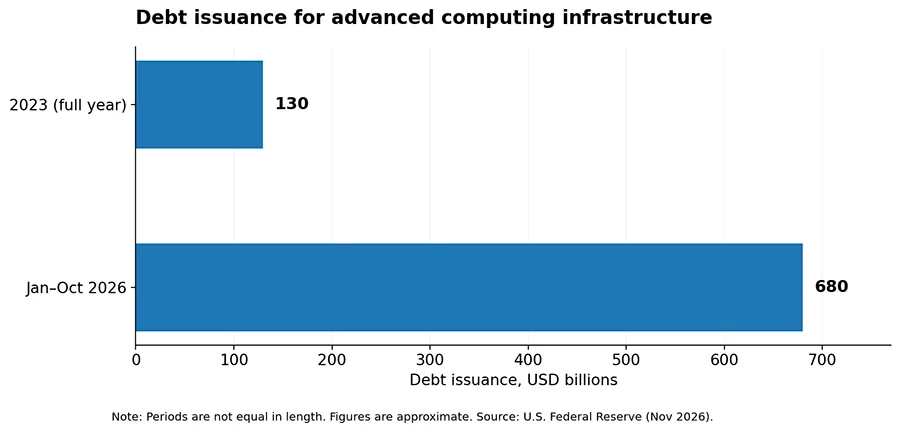
Chart 1. Debt issuance for advanced computing infrastructure in 2023 and 2026, USD billions. The 2026 figures cover January–October. Source: US Federal Reserve.
By October 2026, outstanding publicly issued debt instruments associated with this sector exceeded $1.1 trillion. Unlike annual fundraising figures, that amount represents obligations borrowers have yet to repay.
In addition to bonds, businesses use bank loans, project finance and private transactions. These tools allow infrastructure to expand faster but increase dependence on outside capital and future revenue.
Spending and Off-Balance-Sheet Liabilities
Artificial intelligence investment continues to expand. According to a forecast cited by the ECB, the combined capital expenditure of seven major US technology corporations could reach $5.5 trillion by 2030. Already in 2026, many cloud-service operators were spending more on infrastructure than they generated from their core operations.
Long-term leases, guarantees to partners and other payments not recorded as conventional debt add to the burden. Their combined value exceeded $4 trillion at the end of June 2026. The ECB measures these liabilities separately from the public debt tracked by the Federal Reserve, so the two figures must not be added together.
Another risk is the close financial interdependence of market participants. Chipmakers invest in AI developers, which then use the money to purchase processors and rent computing capacity. If demand falls short of expectations, several partners could face financial difficulties at once. The rapid obsolescence of equipment sometimes pledged as loan collateral adds to the uncertainty.
The Energy Cost of AI
Data centre electricity demand is rising alongside interest in AI. According to the IEA, facilities worldwide used 485 TWh of electricity in 2025. By 2030, consumption could reach 950 TWh, or around 3% of global electricity demand.
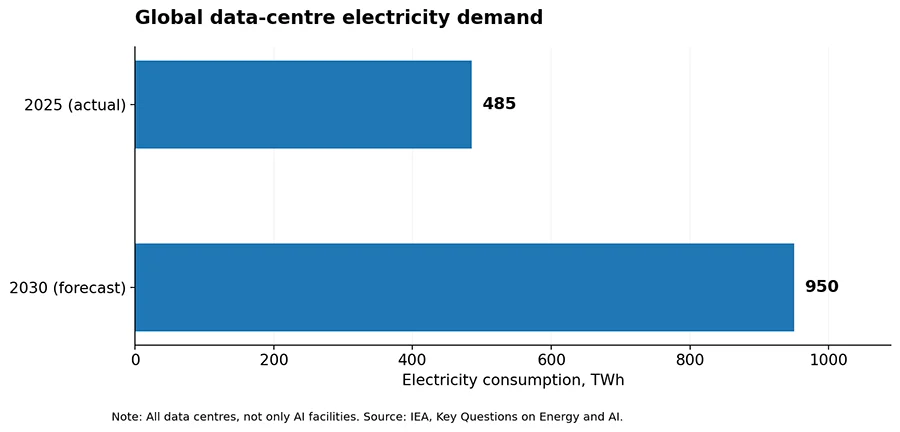
Chart 2. Electricity consumption by data centres: 2025 and the forecast for 2030, TWh. Source: International Energy Agency.
Growing demand requires additional power plants, transmission lines and cooling systems. Where spare grid capacity is limited, large data centres can face lengthy connection delays and higher construction costs. For energy companies, this creates opportunities for long-term contracts; for infrastructure owners, it raises the risk of delays and overruns.
The Economist considers some fears surrounding AI, including mass job losses and environmental consequences, exaggerated. Nevertheless, the power-supply challenge is real: electricity consumption is already increasing. The effect on local tariffs and water resources depends on the region, cooling technology and condition of the grid. The scale of future labour-market changes remains a matter of debate.
Cyberattacks and Chip Supplies
More capable AI models can help criminals organise sophisticated cyberattacks. Disruptions to payment systems, securities trading and data exchange between banks pose particular risks to the financial sector. A major incident could interrupt settlements and undermine customer confidence.
AI adoption is changing financial-sector cybersecurity requirements. Federal Reserve Governor Michael Barr notes that the technology helps identify fraud and suspicious activity. At the same time, widespread use of similar algorithms creates new vulnerabilities: a single error could affect several market participants simultaneously.
Equipment supplies depend on a small number of chip and component manufacturers. Trade restrictions or disruptions at individual factories could delay new projects. For businesses already paying interest on loans, missed deadlines increase financial pressure.
Three Scenarios for 2027
What happens next will depend largely on demand for AI services and whether companies can earn enough from new capacity. If revenue grows alongside investment, the sector should be able to service its debts, while stock markets may experience only limited corrections. Weaker results could lead to falling shares, fewer orders and the suspension of some construction projects.
The most dangerous outcome would be an AI-sector downturn coinciding with higher government bond yields. Borrowing would become more expensive not only for technology projects but also for ordinary businesses, housing and infrastructure. The table outlines the editorial team's possible scenarios, not probability-based forecasts from The Economist.
|
Scenario |
Key indicator |
Potential outcome |
|
Baseline |
Demand grows; gradual payback |
Limited corrections; financing remains available |
|
Adverse |
AI companies' revenue misses expectations |
Lower share prices; new projects delayed |
|
Crisis |
AI correction coincides with sovereign debt problems |
Credit squeeze; losses spread beyond the sector |
The main difference between these scenarios is the availability of capital. If demand remains robust, companies can complete existing projects and gradually generate returns. If conditions deteriorate, borrowers funding data centres with loans and expecting quick capacity utilisation are likely to face the greatest difficulties.
Risks for Investors
When selecting assets, the income that existing AI infrastructure can actually generate matters more than the scale of planned spending. Investors should examine debt levels, repayment schedules and the need for additional funding. Projects without long-term agreements with creditworthy customers are particularly vulnerable.
In equity markets, a sharp fall in a handful of large technology stocks could affect broad indices. In bond markets, a sell-off could increase borrowing costs for other industries. Risks still vary significantly across AI businesses: companies with reliable revenue and moderate debt are better placed to withstand a shift in sentiment.
The property market is similarly diverse. Sites with grid connections already in place and established tenants may remain in demand even if new data-centre construction slows. Properties developed for customers that have not yet been secured face a harder outlook: equipment costs have already been incurred, while income may arrive later than expected.
The threat facing the economy in 2027 stems from the combination of expensive borrowing, high technology valuations and opaque financing structures. A stock-market correction alone would not necessarily trigger a global crisis. But the resilience of this investment cycle increasingly depends on actual data-centre occupancy, profits and borrowers' ability to repay their debts.
FAQ
Is a global crisis inevitable in 2027?
No. The Economist warns that risks are rising, not that a crisis is inevitable. The scale of any disruption will depend on bond markets and the financial performance of technology companies.
Why is the AI debt boom a concern?
Large loans must be serviced long before data centres have fully paid for themselves. If revenue falls below forecasts, companies may need to raise more funds or cut spending.
What do high interest rates mean for real estate?
Expensive borrowing raises the cost of construction and refinancing. Investors pay closer attention to tenants, repayment periods and the returns their projects can generate.
Which property assets depend most on the AI boom?
Primarily data centres and sites with reliable power supplies. Their appeal depends on available electrical capacity, tenancy agreements and the useful life of installed equipment.