







 Foreign Investment in Indian Real Estate Rises 17%
 Finland Misses Residence Permit Processing Deadlines
 Europe Living Investment Reaches €44.6bn
 Urban Homes Cost 27% More Across OECD
 Adjara Overtakes Tbilisi: How Georgia's Regional Hotel Sector Structure Is Shifting
 Georgia to Boost Transit Potential with $7 Billion in Investments: Key Projects to Complete by 2031
Georgia's Port Cargo Traffic Surges by 24% as Capacity Targeted to Double by 2029
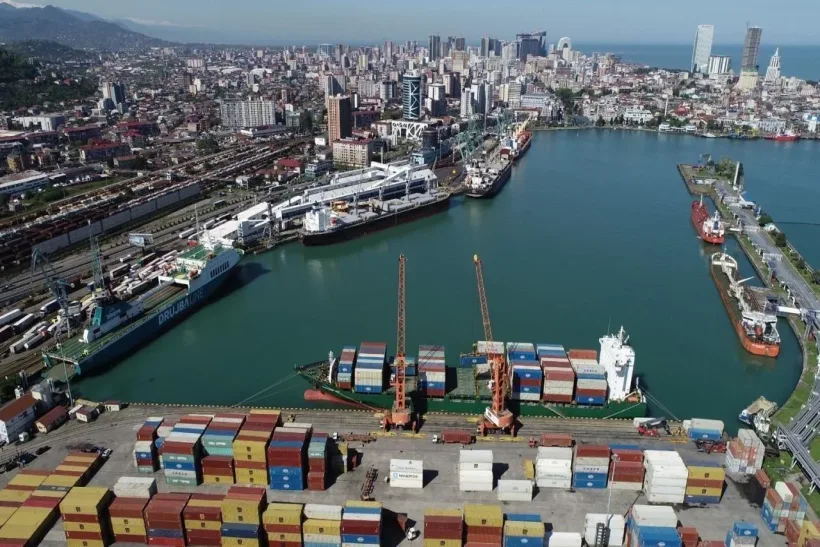
Freight traffic continues to grow across Georgia's seaports and maritime terminals. According to the latest statement from the Ministry of Economy and Sustainable Development dated November 16, 2026, the volume of cargo handled in the ports increased by 24% this year compared to the same period last year. In parallel, the state is planning large-scale transport infrastructure development: by 2029, the throughput capacity of Georgia's railway and port infrastructure is projected to reach 30 million tonnes.
nCargo Traffic in Seaports Surges by 24%
nAccording to Deputy Minister of Economy and Sustainable Development of Georgia Mariam Kvrivishvili, in 2026 the volume of cargo handled at each Georgian port and terminal exceeded the previous year's figure by 24%. The minister announced this on November 16 at the conference "Business Environment in Georgia: Dialogue Between Government and Business."
nAccording to the ministry, record results have been recorded this year across various segments of Georgia's transport and logistics sector. In particular, in maritime infrastructure, growth encompassed both individual ports and terminals as well as primary cargo categories.
nAccording to data released by the agency on September 14, 13.7 million tonnes of cargo were handled in Georgia's seaports and terminals in January–August 2026, which is 24% more than in the same period last year. Over the same period, the number of processed containers stood at 554,174 TEU, representing a 9% year-on-year increase.
nThese figures for January–August became a record over the past decade. In her November statement, the minister confirmed that this upward momentum was sustained in the subsequent period.
nPort of Batumi: 6.9 Million Tonnes of Cargo in Ten Months
nAccording to official data from Batumi Sea Port, the port handled 6.9 million tonnes of cargo in January–October 2026, which is 13% more compared to the same period last year.
nGrowth in port figures was recorded across several segments:
n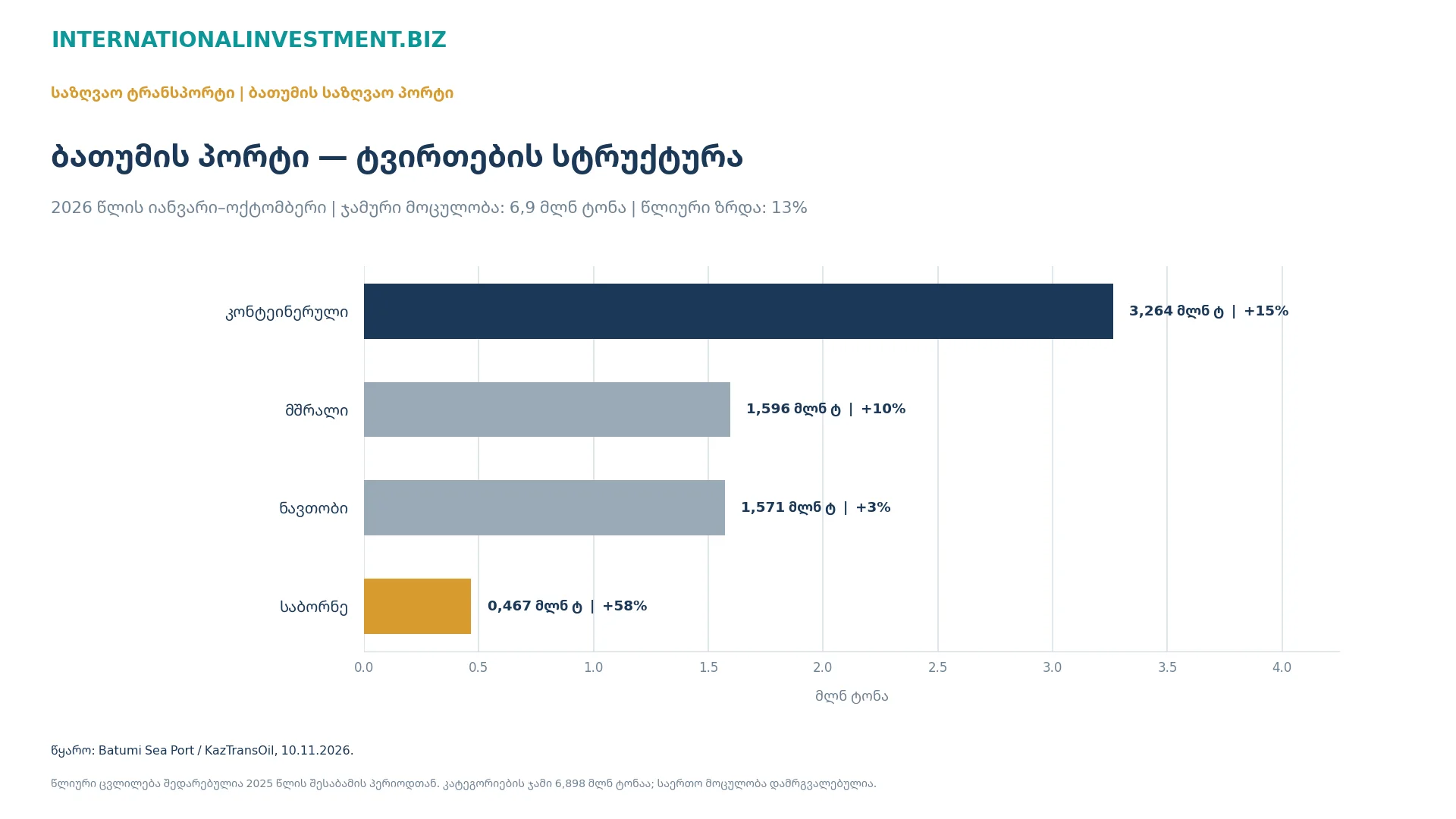
As can be seen, the strongest growth was recorded in the ferry transport segment. According to the port's explanation, the result was driven by the launch of an additional Constanța–Batumi service and the deployment of an extra ferry on the Varna–Batumi route.
nThe expansion of ferry freight is one of the key indicators of broadening Black Sea transport connections. Regular ferry service enables the port to enhance the role of not only containerized and liquid bulk cargoes, but also ferry operations linked with overland transport.
nThe performance of the Port of Batumi demonstrates that growth does not depend on a single cargo category: alongside an increase in containerized and dry cargoes, the ferry segment has gained notable momentum.
nPort of Poti: General Cargo Volume Up by 61.7%
nAccording to operational data released by APM Terminals Poti, the Port of Poti handled 525,211 TEU containers in January–September 2026, up 9% from the same period last year.
nDuring this period, 336 container vessels called at the port, compared to 268 in the first nine months of 2025.
nParticularly strong growth was registered in general cargo. Its volume reached 324,656 tonnes, which translates to a year-on-year increase of 61.7%.
nIn addition, ferry cargo transshipment increased: in the first nine months of 2026, the volume reached 162,843 tonnes, compared to 123,350 tonnes in the corresponding period of the previous year.
n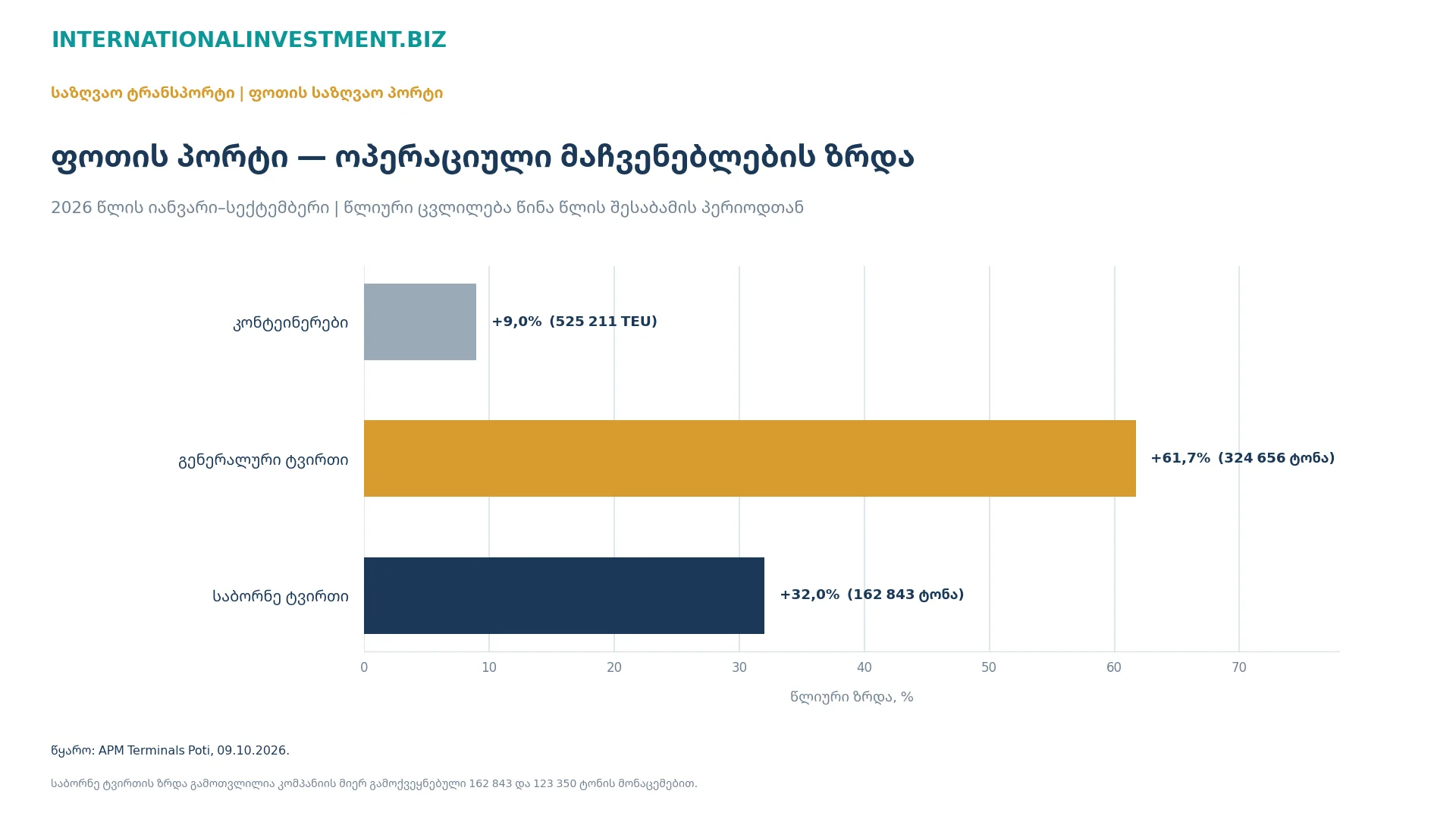
To accommodate the growing freight flow, APM Terminals Poti is acquiring a new multifunctional mobile harbor crane. According to the company, delivery of the equipment is scheduled before the end of 2026. The investment totals 7.1 million US dollars.
nThe new crane will increase container handling capacity to over 650 thousand TEU. Furthermore, container and non-container cargo handling capacity will expand by approximately 500 thousand tonnes.
nAccording to APM Terminals Poti, the company processed a record 636,466 TEU in 2025. Consequently, the acquisition of new machinery amid ongoing growth is aimed at enhancing the port's throughput capacity and operational flexibility.
n2025 Results: Substantial Share of General Cargo
nAccording to the National Statistics Office of Georgia, 16.6376 million tonnes of cargo were handled in the country's ports and terminals in 2025, which was 6.8% higher than in 2024.
nIn the cargo structure, the largest share belonged to general cargo — 47.7%. The share of liquid bulk cargo stood at 31%, and dry bulk cargo accounted for 21.3%.
nAccording to 2025 figures, general cargo volume stood at approximately 7.94 million tonnes, liquid bulk cargo at 5.16 million tonnes, and dry bulk cargo at 3.54 million tonnes.
nLong-term trends show that after 2022, when total volume dropped to 15.2887 million tonnes, the market maintained an upward trajectory. Cargo handled totaled 14.7095 million tonnes in 2023, 15.5845 million tonnes in 2024, and 16.6376 million tonnes in 2025.
n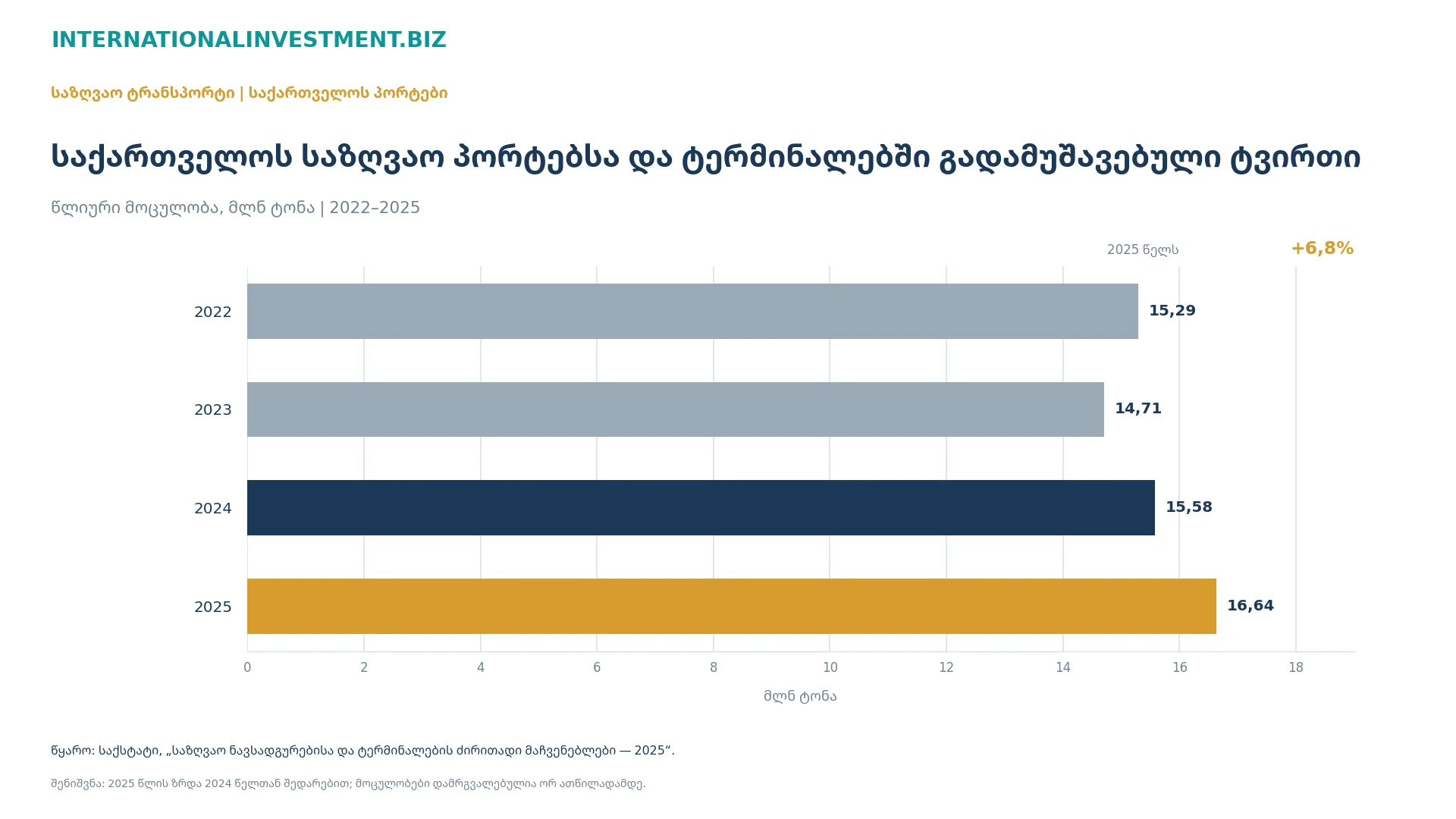
These figures demonstrate that port operations rely on several distinct cargo categories. Accordingly, when evaluating total cargo turnover growth, it is essential to consider not only overall tonnage, but also the cargo mix and dynamics across each separate category.
nTarget for 2029: Expanding Capacity to 30 Million Tonnes
nAt the conference held on November 16, Mariam Kvrivishvili also outlined one of the key goals for the development of Georgia's transport infrastructure.
nAccording to the minister, under the state's ambitious roadmap, Georgian Railway and the country's port infrastructure are set to double their current cargo throughput capacity by 2029, reaching 30 million tonnes.
n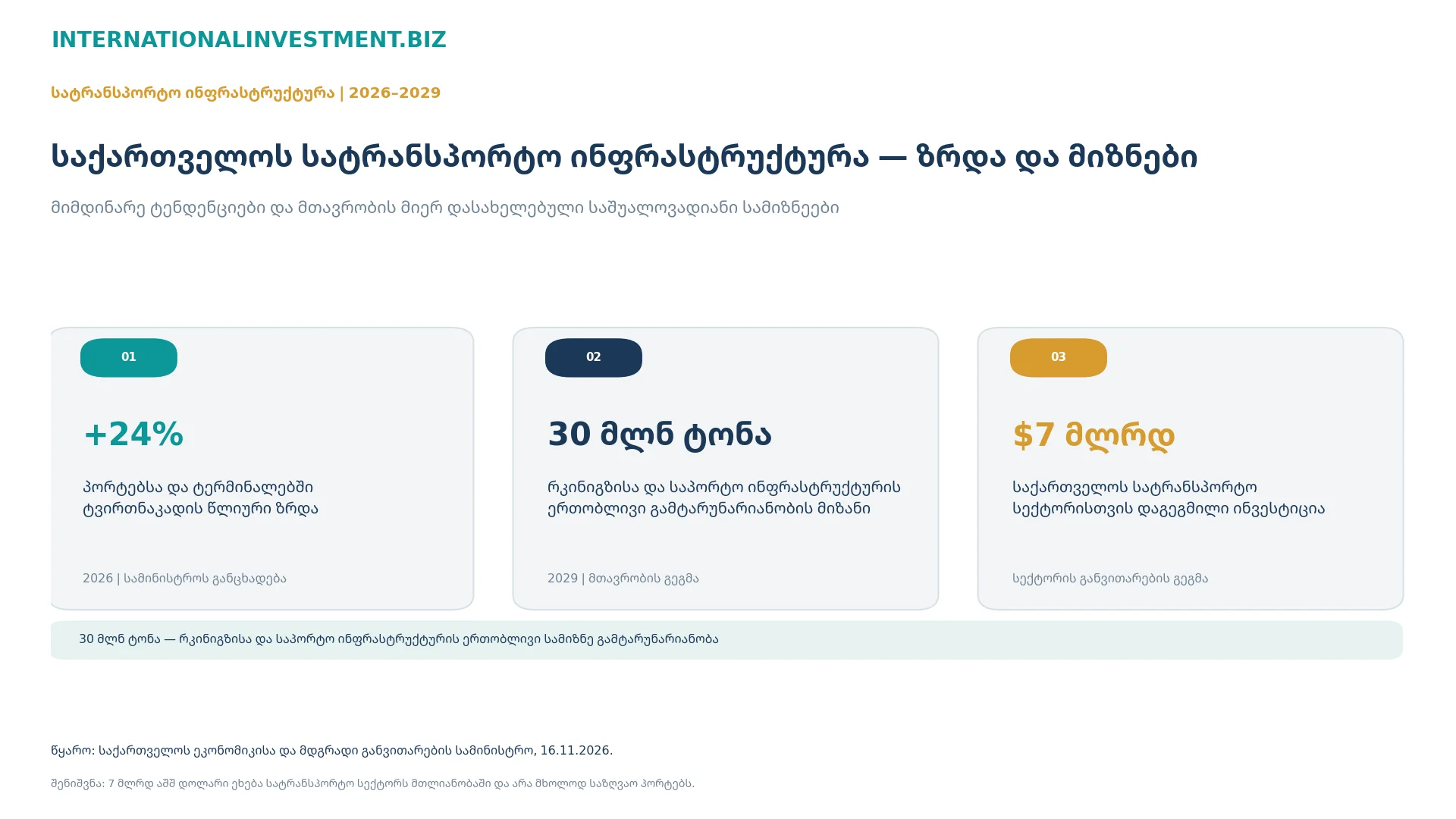
To achieve this target, the government plans to invest approximately 7 billion US dollars into the transport sector.
nAs the minister clarified, over the next three years, around 2 billion GEL will be allocated for upgrading and expanding Georgian Railway's rolling stock. The procurement of 50 new locomotives, 10 passenger trains, and around 2,000 freight wagons is planned.
nAccording to the minister, more than 400 freight wagons have already been acquired, while an active tender process is underway for the purchase of 10 passenger trains and 50 locomotives.
nThese initiatives are directly linked to the expansion of port capacity: the efficient operation of maritime gateways relies heavily on the capabilities of the interconnected rail and highway networks.
nAnaklia Deep Sea Port: First Vessel Scheduled to Call in 2029
nThe Anaklia Deep Sea Port project occupies a special place in Georgia's long-term transport infrastructure development plan.
nAccording to the Minister of Economy, the project is in an active phase of development, with construction work already in progress. In particular, dredging operations are currently taking place on site.
nFurthermore, according to the ministry, a tender has been announced for the construction of an access railway to Anaklia. Under the project's target timeline, Anaklia Deep Sea Port is scheduled to welcome its first vessel in 2029.
nThe significance of the Anaklia port is not confined merely to building a new harbor. The project is tied into the unified development of Georgia's maritime and rail infrastructure. Its effectiveness will depend on terminal development, attracting investments, completing overland access routes, and drawing international transit traffic.
nGeorgia's Transit Competitiveness: The Next Stage of Transport Infrastructure Development
nThe 24% rise in freight traffic across Georgia's ports, the operational results released by Batumi and Poti operators, and the state target set for 2029 highlight that maritime infrastructure remains a cornerstone of the country's transport policy.
nHowever, growth in cargo turnover in itself does not guarantee that current infrastructure will suffice to meet future demand. Sector competitiveness will depend on technical modernization of ports, development of berths and terminals, improvement of rail links, and reduction of cargo handling times.
nIt should also be noted that figures from Batumi and Poti reflect divergent trends. In particular, ferry and container traffic rose markedly in Batumi, whereas general cargo showed substantial growth in Poti. This divergence emphasizes the importance of expanding the ports' functional capabilities and specialization.
nConsequently, in the years ahead, Georgia's primary challenge will be turning growing transit demand into sustainable economic opportunity. Achieving the 30-million-tonne throughput capacity target by 2029 will require not only major infrastructure investments, but also unified, well-coordinated development across ports, rail networks, and logistics services.