













German Property Funds See €17.3bn Withdrawals
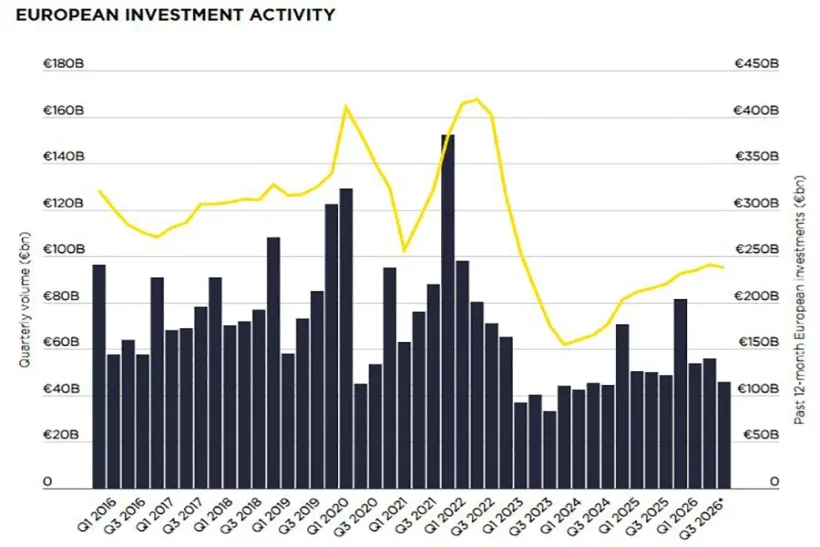
German open-ended property funds are under sustained liquidity pressure. Investors have withdrawn approximately €17.3bn from the sector since early 2024, according to Savills.
The figure matters to real estate markets not because €17.3bn of property has already been sold, but because continuing redemptions can create pressure for funds to dispose of assets.
That could bring more motivated sellers into the market.
Withdrawals are not property sales
The most important distinction is between fund redemptions and asset disposals.
When investors withdraw money, a fund can initially use cash reserves and other liquid resources. Property sales become necessary only if redemptions exceed available liquidity and incoming capital.
The €17.3bn figure therefore does not represent €17.3bn of real estate already offered for sale.
For buyers, the key question is what happens next: which assets funds are prepared to sell, how quickly and at what price relative to previous valuations.
Germany is part of a weaker core-market group
Savills estimates that investment across the UK, Germany and France was about 8% lower year on year in the first nine months of 2026.
The broader European market was stronger, with preliminary nine-month investment around €156bn, up 4%.
CEE was up an estimated 34%, the Nordics 25% and Southern Europe 20%.
Capital has not disappeared. It is being allocated unevenly and with more caution toward core markets where financing costs and asset pricing remain difficult to reconcile.
A motivated seller is not necessarily distressed
Savills expects fund liquidity pressure to create more motivated opportunities.
That should not be confused with widespread distress.
A fund that needs cash may choose to sell a high-quality asset earlier than planned. It may still achieve a strong price if the building has a prime location, secure income and competitive demand.
The data support the prospect of more assets reaching the market, not a forecast of mass fire sales.
Savills expects gradual European growth
Savills has lowered its forecast for European investment to approximately €248bn in 2026, about 7% growth, followed by €266bn in 2027, another 7% increase.
CEE, the Nordics and Southern Europe are expected to provide the strongest momentum.
This creates two strategies for capital. Investors can pursue stronger current growth in expanding markets or wait for high-quality assets to emerge from more pressured core-market portfolios.
Cross-border capital remains selective
International buyers accounted for slightly less than 45% of European investment volume in the first three quarters of 2026.
US investors remain the largest source of international capital, while Canadian institutions are also active.
But financing costs, geopolitics and the limited supply of large prime assets are slowing cross-border decisions.
More German fund selling would therefore increase opportunity, but it would not guarantee immediate liquidity.
What investors should watch
The most attractive opportunities may not be the weakest buildings.
Liquidity-driven selling can release assets in locations that rarely trade. Well-capitalised buyers may gain access to properties that were previously unavailable.
The key is still price relative to cash flow, tenant quality, capex, ESG requirements and financing.
The €17.3bn withdrawal figure is a supply signal. It becomes an investment opportunity only when a specific asset reaches the market at a price that compensates for risk.
FAQ
What does the €17.3bn figure represent?
Investor withdrawals from German open-ended property funds since early 2024.
Does it represent property already sold?
No. Fund redemptions and property disposals are different.
Why could redemptions lead to sales?
Funds may need to raise liquidity to meet investor withdrawals.
What is Savills’ Europe investment forecast?
Approximately €248bn in 2026 and €266bn in 2027.