







 Inner London House Prices Fall 7.2%, Sharpest Since 2009
 Swissôtel Kobuleti Beach Resort: $300M Investment in Kobuleti
 Georgia Plans to Build 600 km of Highways in 5–7 Years: Is Local Business Ready for Large-Scale Projects?
 IBTM World Barcelona 2026: Georgia at the International Business Tourism Exhibition
 Spanish Home Sales Drop 13.4% in September
 Passenger Traffic at Georgian Airports Rose by 6.1%: Key Trends in Q3 Statistics
Georgia Counts 2,783 Accommodation Facilities: How Rooms and Beds Are Distributed in 2025

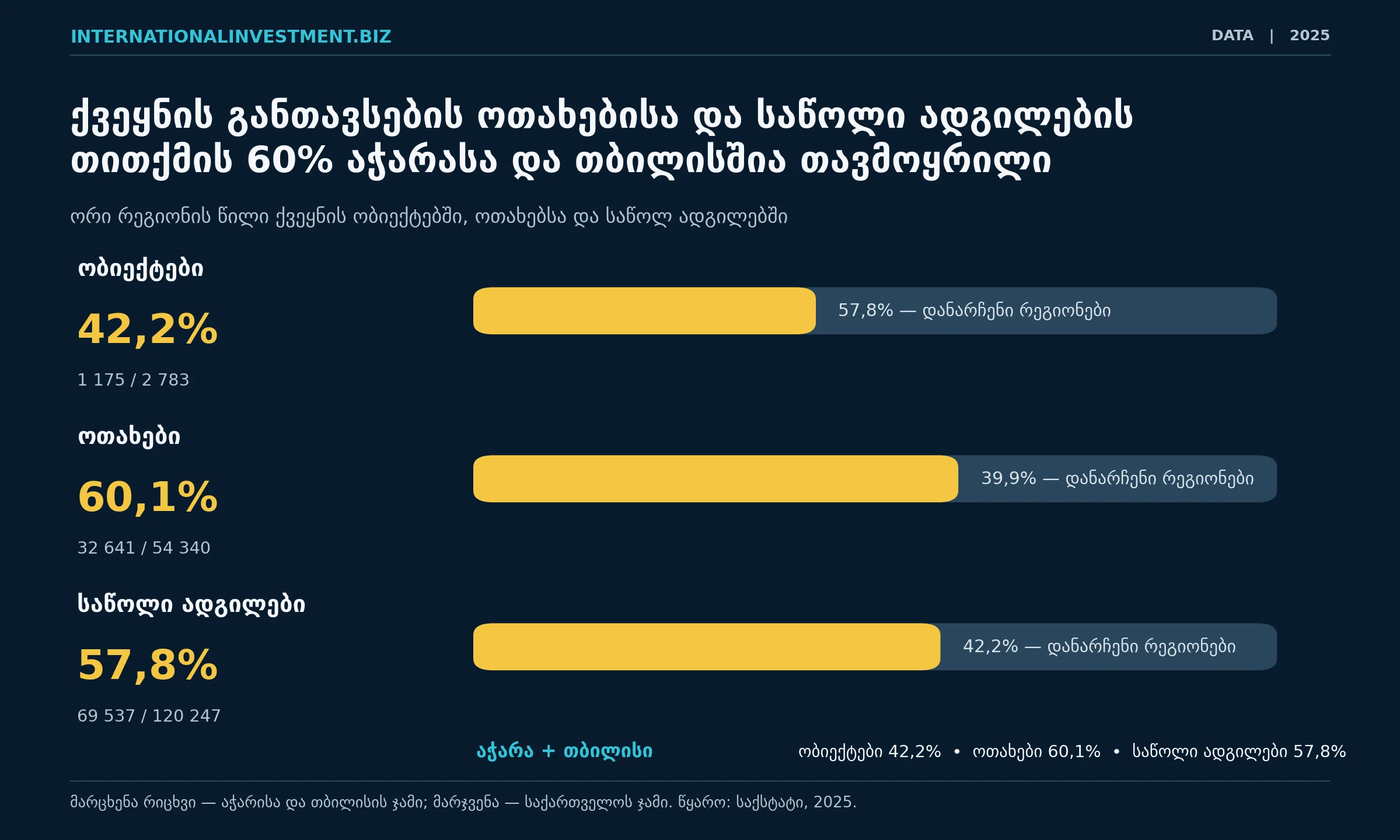
According to 2025 data, Georgia recorded 2 783 accommodation facilities, 54 340 rooms, and 120 247 bed places. The regional distribution of accommodation infrastructure demonstrates high concentration: Adjara and Tbilisi account for 42.2% of all facilities in the country, 60.1% of rooms, and 57.8% of bed places. Moreover, differences between regions are not limited to the number of facilities — the average capacity of each property also varies significantly.
The regional structure of Georgia's hotel sector clearly shows that tourism infrastructure and accommodation facilities are unevenly distributed across the country. According to annual data from the National Statistics Office of Georgia (Geostat) for 2025, Adjara and Tbilisi lead in the number of facilities operating on the market. However, their advantage becomes even more pronounced when analyzing the number of rooms and bed places.
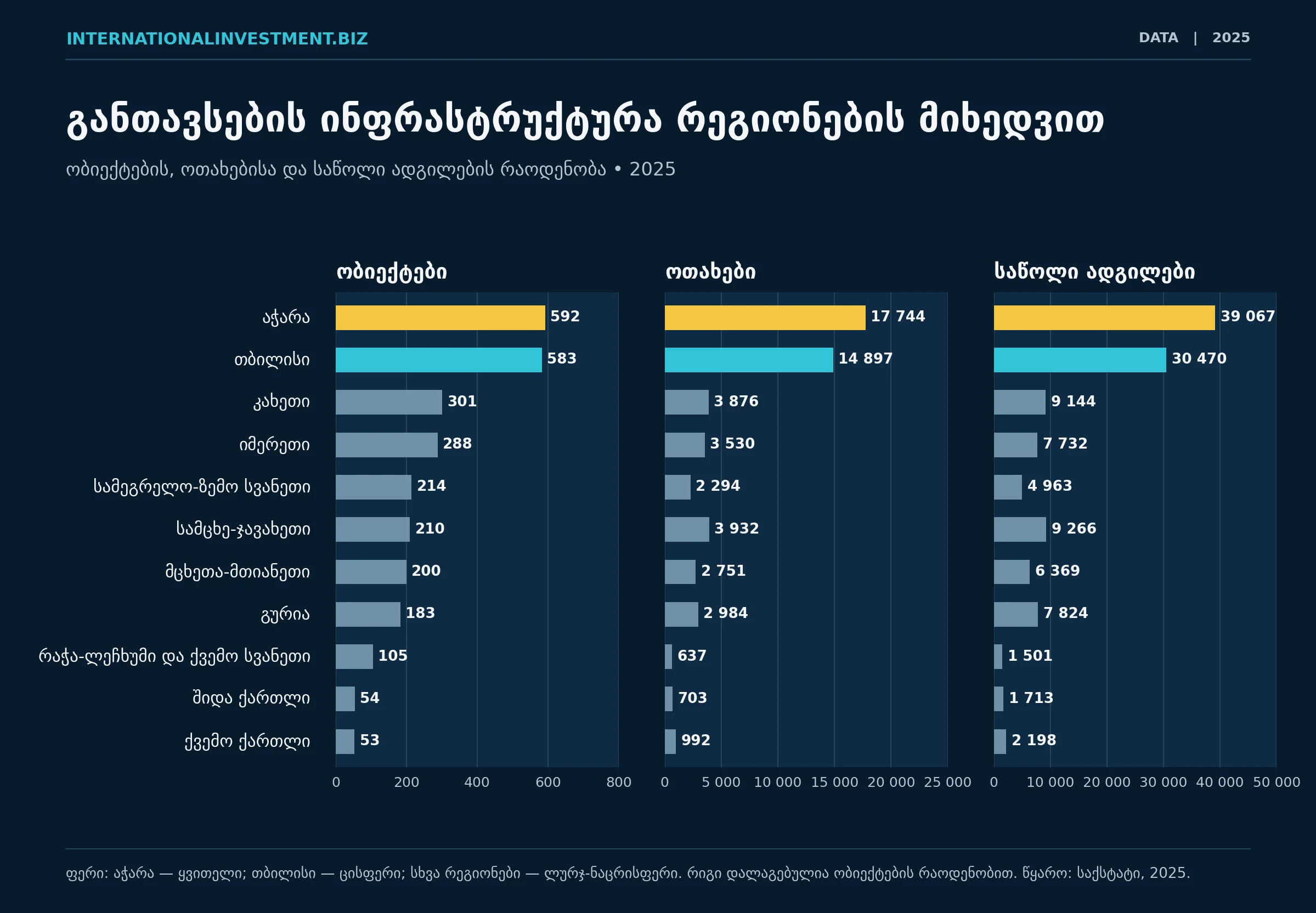
Specifically, out of 2 783 accommodation facilities recorded across the country, 592 are located in Adjara and 583 in Tbilisi. Thus, each of these regions separately accounts for roughly one-fifth of all establishments in the country. Nevertheless, the regional distribution by number of rooms and bed places presents a slightly different picture.
Adjara Leads in Accommodation Infrastructure Capacity
According to 2025 data, 592 accommodation facilities were registered in Adjara, accounting for 21.3% of the national total. The region boasts 17 744 rooms and 39 067 bed places.
At the same time, Adjara holds the top spot both in the number of accommodation establishments and in the count of rooms and beds. Its dominance is particularly evident in terms of infrastructure capacity.
In particular, compared to Tbilisi, Adjara has only 9 more facilities. However, the number of rooms exceeds the capital's figure by 2 847 units, and bed places by 8 597 units. In percentage terms, Adjara has 19.1% more rooms and 28.2% more bed places than Tbilisi.
This discrepancy indicates that the average size of accommodation establishments in Adjara significantly exceeds Tbilisi's figures. Specifically, one facility in Adjara averages 30 rooms and 66 bed places, while in Tbilisi these figures stand at 25.6 and 52.3, respectively.
In addition, the average number of rooms per facility in Adjara is 53.5% above the national average, and bed places exceed it by 52.7%.
Thus, Adjara's leadership is not solely determined by the number of properties: the region also stands out for the total capacity of its tourism infrastructure.
Tbilisi Is the Second-Largest Accommodation Sector Hub
As of 2025, Tbilisi registered 583 accommodation facilities, 14 897 rooms, and 30 470 bed places.
The capital's share in the nationwide totals constitutes 20.9% by number of establishments, 27.4% by number of rooms, and 25.3% by number of bed places. Accordingly, data from Tbilisi indicates that the scale of the capital's infrastructure is substantially larger than what the raw number of facilities suggests.
Regarding combined metrics, together with Adjara, Tbilisi accounts for 60.1% of rooms and 57.8% of bed places in the country. These two regions also concentrate 42.2% of all accommodation establishments.
This gap serves as a prime indicator of regional concentration: while a significant share of properties is distributed across other regions, the bulk of overall capacity is concentrated in just two key hubs.
Regional Distribution: The Difference Between Quantity and Capacity
Following Adjara and Tbilisi, Kakheti and Imereti stand out by the number of facilities. Specifically, Kakheti has 301 registered establishments, and Imereti has 288. However, in terms of rooms and beds, their positions diverge. Kakheti accounts for 3 876 rooms and 9 144 bed places, whereas Imereti has 3 530 rooms and 7 732 bed places.
This means that Kakheti, despite a relatively high number of establishments, lags substantially behind Adjara and Tbilisi in total room inventory and bed capacity.
Against this backdrop, the indicators of Samtskhe-Javakheti are of particular interest. The region recorded 210 accommodation establishments, yet the number of rooms reaches 3 932, and bed places amount to 9 266. As a result, Samtskhe-Javakheti outpaces both Kakheti and Imereti in rooms and beds while possessing fewer hotels. On average, a facility here provides 18.7 rooms and 44.1 bed places, which exceeds the national average and positions Samtskhe-Javakheti as a relatively large regional market in terms of infrastructure volume.
As for other parts of the country, Guria has 183 facilities, 2 984 rooms, and 7 824 bed places. The ratio of beds to rooms is especially noteworthy: there is an average of 2.62 bed places per room, representing the highest figure among all examined regions.
Mtskheta-Mtianeti registered 200 facilities, 2 751 rooms, and 6 369 bed places, while Samegrelo-Zemo Svaneti recorded 214, 2 294, and 4 963 units, respectively.
Substantial differences are also observed between these regions in quantitative metrics. Specifically, Samegrelo-Zemo Svaneti has more facilities than Mtskheta-Mtianeti, but falls behind in room inventory and bed spaces.
These findings serve as further evidence that the number of facilities alone is not an exhaustive metric for assessing the potential of a regional accommodation sector.
Smaller Regional Markets
The smallest accommodation capacity is noted in Racha-Lechkhumi and Kvemo Svaneti. The region registered 105 establishments, but the total room inventory comprises only 637 units, with a bed capacity of 1 501 places.
Consequently, an establishment here averages only 6.1 rooms and 14.3 bed places, which is significantly below the national average.
Even fewer accommodation properties are registered in Kvemo Kartli and Shida Kartli — 53 and 54 facilities, respectively.
However, the average capacity per facility in these two regions exceeds that of Racha-Lechkhumi and Kvemo Svaneti. In Kvemo Kartli, a facility averages 18.7 rooms and 41.5 bed places, while in Shida Kartli, the figures are 13 rooms and 31.7 bed places.
Thus, a small number of properties does not necessarily mean a small scale for each individual business. To accurately compare regional markets, it is necessary to consider both the total count of establishments and their average capacity.
Average Facility Capacity — The Key Structural Distinction
On average across Georgia, an accommodation establishment accounts for 19.5 rooms and 43.2 bed places. Comparing regional data demonstrates that this average varies noticeably depending on geographic location.
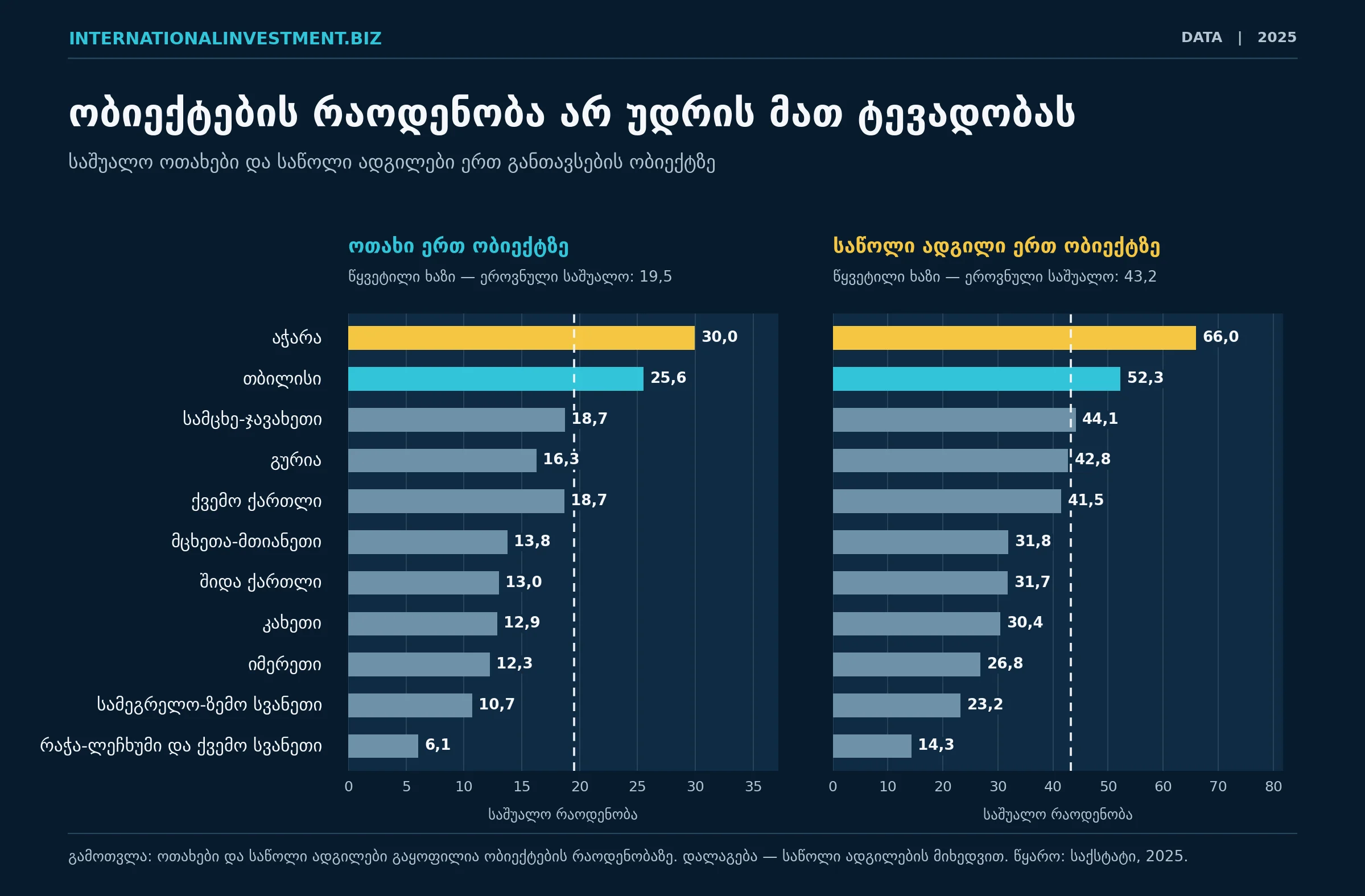
In particular, as illustrated in the chart, the average capacity per facility in Adjara and Tbilisi surpasses the national average. In Samtskhe-Javakheti, Kvemo Kartli, and Guria, individual indicators are also close to or exceed the nationwide benchmark. Conversely, in Racha-Lechkhumi and Kvemo Svaneti, Samegrelo-Zemo Svaneti, and Imereti, the average number of rooms and beds per facility is considerably lower.
The ratio of beds to rooms is equally interesting. Nationwide, there is an average of 2.21 bed places per room. In Guria, this coefficient is 2.62, in Shida Kartli it stands at 2.44, and in Kakheti and Samtskhe-Javakheti, it is approximately 2.36. Regarding key regions, Tbilisi averages 2.05 bed places per room, while Adjara averages 2.20.
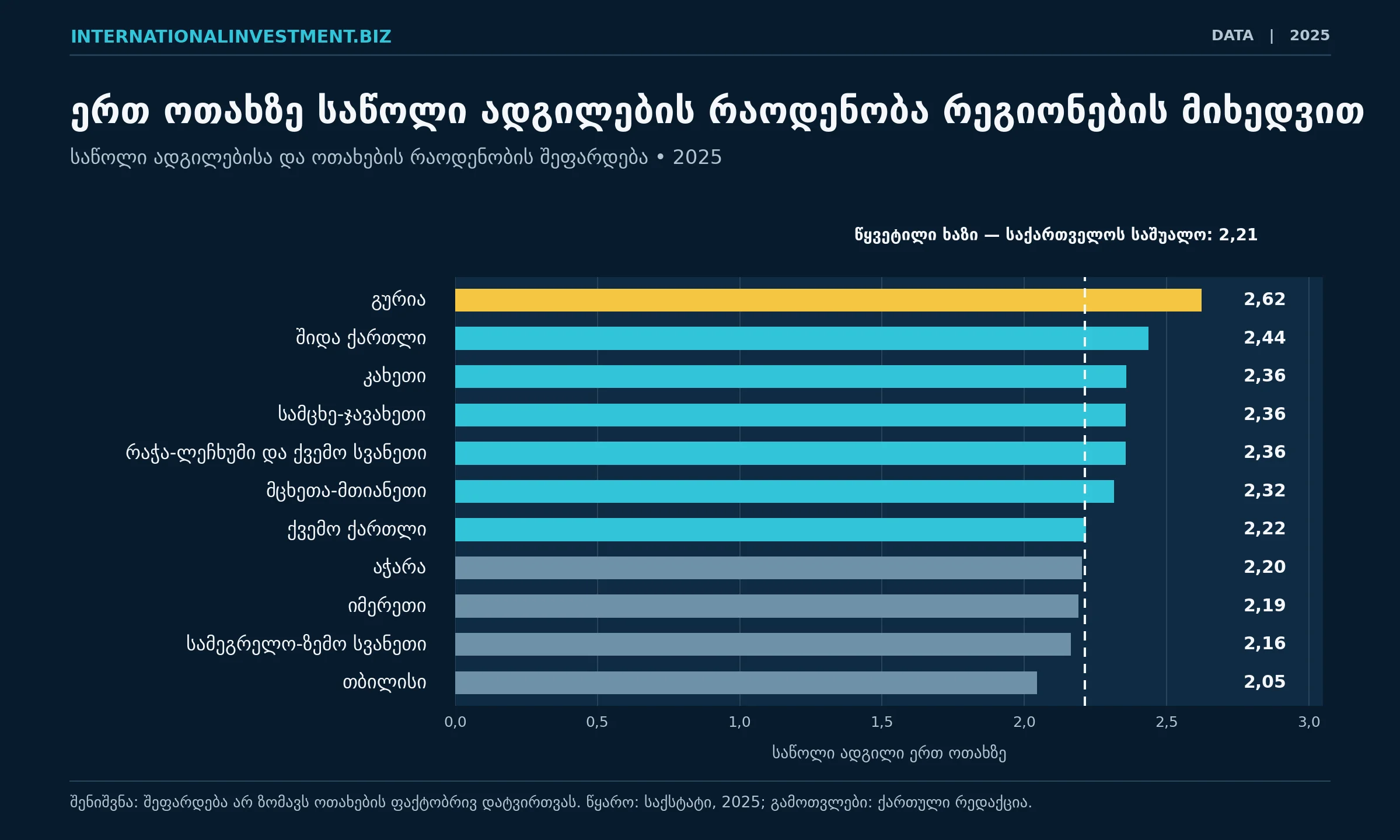
These metrics highlight nominal capacity variations among regions. Nevertheless, by themselves, they do not provide data on room categories, actual occupancy rates, or tourist flow distribution.
Hotel Infrastructure Concentration — What Does the Regional Picture Reveal?
A comprehensive analysis of the data allows several fundamental conclusions to be drawn:
First — Georgia's accommodation infrastructure is heavily concentrated in Adjara and Tbilisi. These two regions account for 42.2% of all facilities nationwide and nearly 60% of total rooms and bed places.
Second — the standings of regional markets shift depending on the evaluation criteria applied. For example, Kakheti surpasses Imereti in property count, but Samtskhe-Javakheti outperforms both in rooms and beds despite having fewer hotels.
Third — the average scale of accommodation facilities differs radically across regions. This factor is critical for industry analysis, as an equal number of facilities by no means guarantees an equal inventory volume.
Fourth — a region's total capacity cannot be judged solely by the number of bed places. A thorough analysis requires evaluating the number of rooms, the number of facilities, and their average capacity collectively.
Thus, based on 2025 data, regional concentration remains the defining structural feature of Georgia's accommodation sector. Adjara and Tbilisi lead not only in facility numbers but also in the total capacity of their infrastructure. At the same time, metrics from other regions indicate no direct correlation between the number of hotels and the actual scale of room inventory, emphasizing the necessity of using comprehensive indicators when analyzing the industry.
Source: National Statistics Office of Georgia (Geostat), number of accommodation establishments by region, annual data for 2025. Calculations were made based on the source's regional and national metrics.
InternationalInvestment.biz - Georgian editorial board