







 "Georgia's Tourism Must Shift from Quantitative Growth to Qualitative Development" — Maia Sidamonidze
 Georgian Railway Freight Turnover Increases by 16.8%
 More Than 800 Construction Companies Fail in Israel
 Foreign Investors in Georgia’s Real Estate Market: Where Is the International Share Highest?
 Housing protests in Spain: tenants demand reforms
 The artificial intelligence bubble: Why global markets are in turmoil
From 10.8k to 85.7k Tourists and up to $72.8M in Revenue: The Investment Potential of Goderdzi Resort in Numbers

The "Goderdzi" ski resort is moving to a new stage of development. Natural snow cover, year-round tourism potential, proximity to Batumi and the Black Sea tourism market, along with scheduled infrastructure projects, make it one of Georgia's most promising investment destinations. According to TBC Capital estimates, by 2030 the number of visitors to Goderdzi could reach 85.7 thousand people, and tourist-generated revenue could amount to 72.8 million US dollars. To achieve this goal, both the execution of infrastructure projects and the resort's positioning on the international tourism market will be crucial.
The "Goderdzi" Resort — From an Early Stage of Development to an International Tourist Destination
Located in mountainous Adjara, the "Goderdzi" ski resort represents one of the most exciting opportunities for mountain tourism development in Georgia. Its investment appeal rests on several interconnected factors: natural conditions, diversity of tourist products, regional transport accessibility, and the opportunity to develop brand-new infrastructure.
The resort's development concept is not limited solely to winter ski tourism. The strategic direction of "Goderdzi" is to establish a four-season mountain resort combining winter skiing with outdoor activities, trekking, wellness tourism, and family vacations during the warmer months.
Such positioning is particularly important for regional destinations where seasonality remains one of the primary drivers determining hotel occupancy and revenue levels.
The competitive advantage of "Goderdzi" lies in the combination of its natural abundance and its largely undeveloped territory. Heavy precipitation, superior snow cover, forested landscapes, and mountainous terrain enable the resort to offer a unique experience to both domestic and international travelers.
According to TBC Capital data, the winter season at the resort lasts from December to April. Average winter temperatures range from minus 9 to minus 7 degrees Celsius, while summer temperatures hover between 17 and 19 degrees. Such climatic conditions, in addition to winter skiing, create an excellent foundation for mountain recreation and ecotourism during the warm season.
Natural Resources and a Four-Season Tourist Product
One of the key components of the "Goderdzi" resort development concept is the diversification of tourism offerings.
During the winter season, the resort's core product is skiing on natural snow. Several disciplines stand out, including Powder Skiing, Tree Skiing, Cat Skiing, and Ski Touring. Along with traditional family recreation, these activities enable the resort to cater to active and specialized ski tourism segments.
In the warmer months, the core offering is built around scenic landscapes, lakes, waterfalls, alpine meadows, and historical heritage sites. Green Lake, Black Lake, as well as Karagol and Shuamta lakes, are especially popular. In addition, the surroundings of Goderdzi are rich in cultural heritage: nearby lie Khikhani Fortress, Skhalta Monastery, Vardtsikhe, Tsikhiskeli, and Begleti Mosque.
Special mention should be made of the alpine botanical garden situated approximately 8 km from the resort. It covers an area of 10 hectares at an altitude ranging from 1,600 to 2,400 meters above sea level and features 161 plant species.
To expand tourism opportunities, five marked routes are planned for operation. These include the "Goderdzi" circular cycling route, the Chirukhi – Khikhani – Goderdzi itinerary, as well as trails leading from the pass towards Zarzma, Chudurouli, and Agara.
Developing a comprehensive tourism product based on these resources will allow the resort to provide varied recreation beyond the ski season. From an investment perspective, this opens opportunities for constructing hotels, guesthouses, dining venues, sports equipment rentals, as well as expanding guiding services and wellness infrastructure.
Existing Infrastructure and Expansion Potential
When assessing investment opportunities in Goderdzi, it is essential to distinguish between the current state of the resort and the scale of planned development.
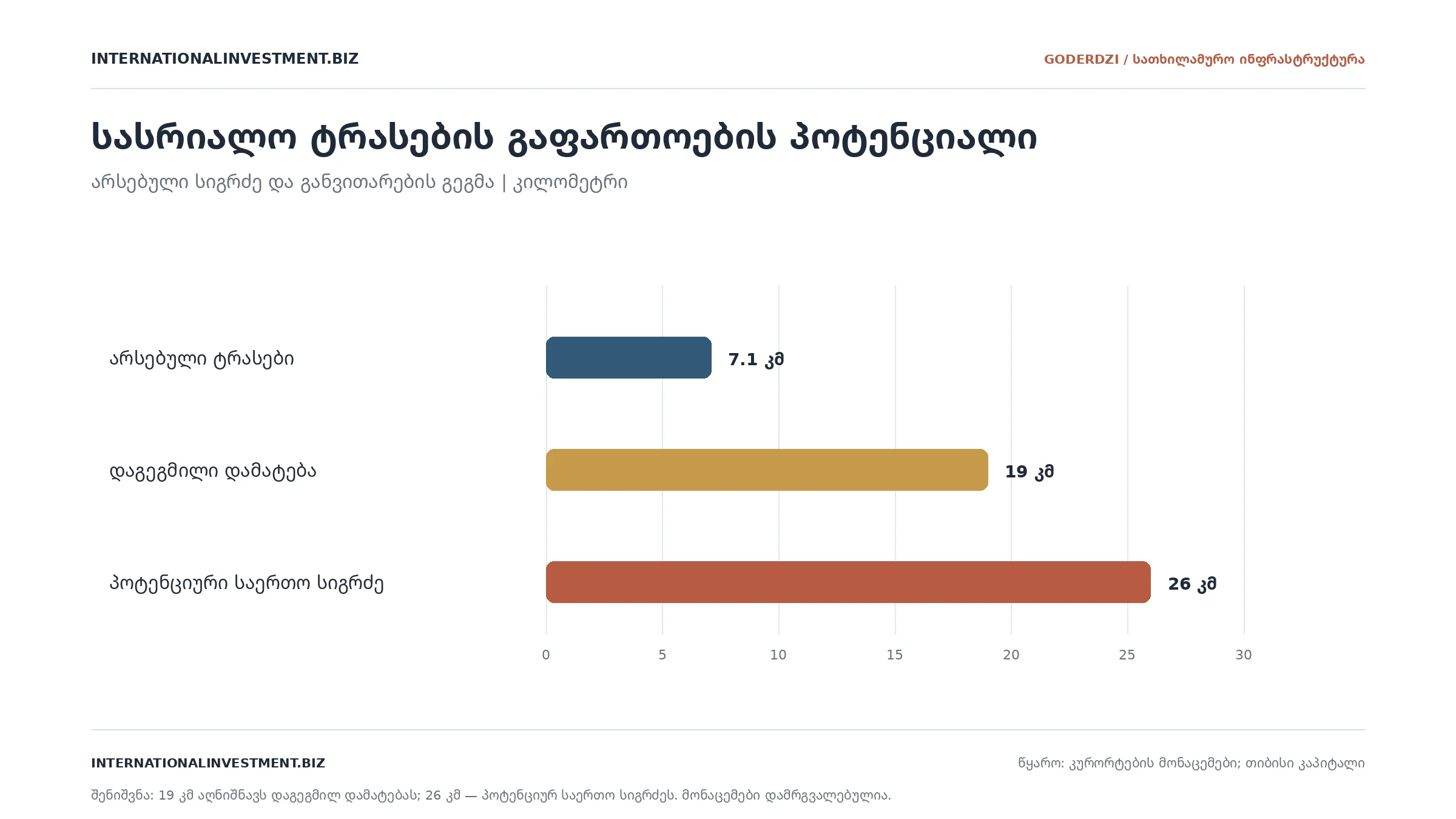
According to TBC Capital, the designated resort area spans around 120 hectares. At present, the operational ski infrastructure includes three slopes, three cableways, and one T-bar lift. The total length of the slopes is 7.1 km, against an estimated potential of 26 km. Additionally, an 80-metre carpet lift for children has been installed.
As for hotel infrastructure, according to TBC Capital, nine hotels with 505 rooms and a total capacity of 1,209 guests are already operating at the resort. Another 11 hospitality properties are under construction; once commissioned, the resort's potential capacity will reach approximately 2,300 beds.
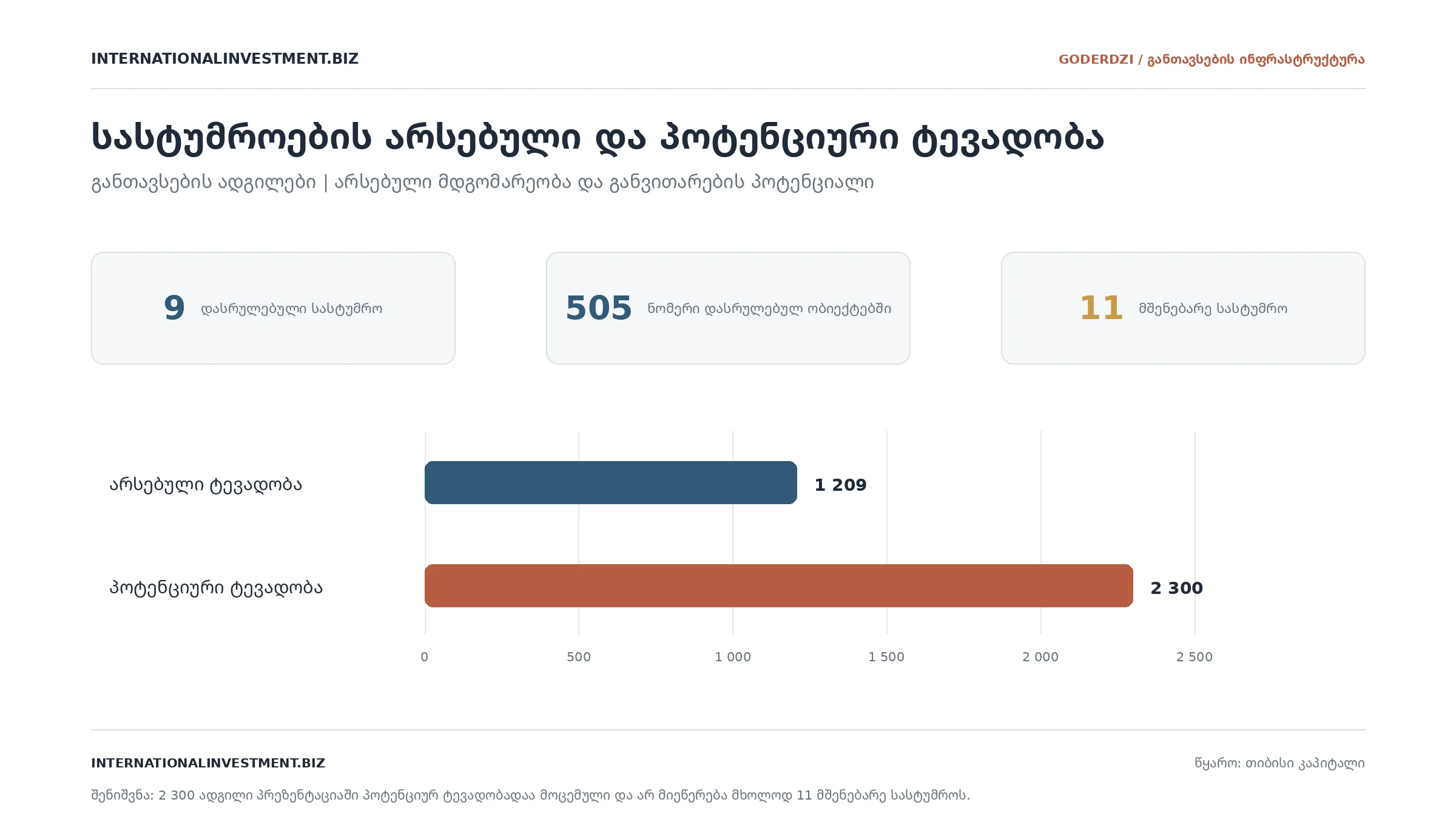
These figures demonstrate that the basic foundation for Goderdzi's development is already laid. However, achieving international competitiveness will require substantial scaling of the lift network, ski trails, hotels, and accompanying amenities.
New Infrastructure Projects — Development Plan for 2026–2028
A decisive factor in realizing Goderdzi's potential will be the execution of projects planned for 2026–2028.
The TBC Capital study highlights several key directions:
Ski infrastructure: development of 19 new kilometers of slopes, construction of a new cable car, evening slope illumination, construction of a 36-metre overpass, and a 26-metre pedestrian bridge. Once implemented, Goderdzi's skiing infrastructure will expand significantly, bringing total trail length to approximately 26 km.
Transport and utility infrastructure: rehabilitation of the Khulo – Zarzma road, construction of a 500-metre internal road, construction of a 500-ton water reservoir, and laying of new water supply networks. Gasification of mountainous Adjara is also planned.
Ancillary infrastructure: parking for 80 cars, a hangar for snow groomers, and an exhibition space.
The plan extends beyond the boundaries of the "Goderdzi" resort zone alone. Within the four-season concept, plans include facilitating the development of Beshumi resort, reconstructing the cableway in Tago, creating tourism and transport infrastructure around Green Lake, and developing equestrian tourism in the Gordzhomi Gorge.
The comprehensive implementation of these initiatives will link the tourist routes of mountainous Adjara and significantly streamline travel across the region.
At the same time, the research outlines these items as plans for 2026–2028; therefore, any investment assessment requires tracking the funding status, timelines, and actual construction progress.
New Development Zones — Opportunities for Hotel and Residential Projects
Another major vector of Goderdzi's growth is the acquisition and development of new resort lands.
According to the study, the second phase of resort development covers 130 hectares and provides for the development of 264 land plots. Of these, 13.3 hectares are allocated for sports and recreational facilities.
The master plan envisions the construction of diverse real estate categories:
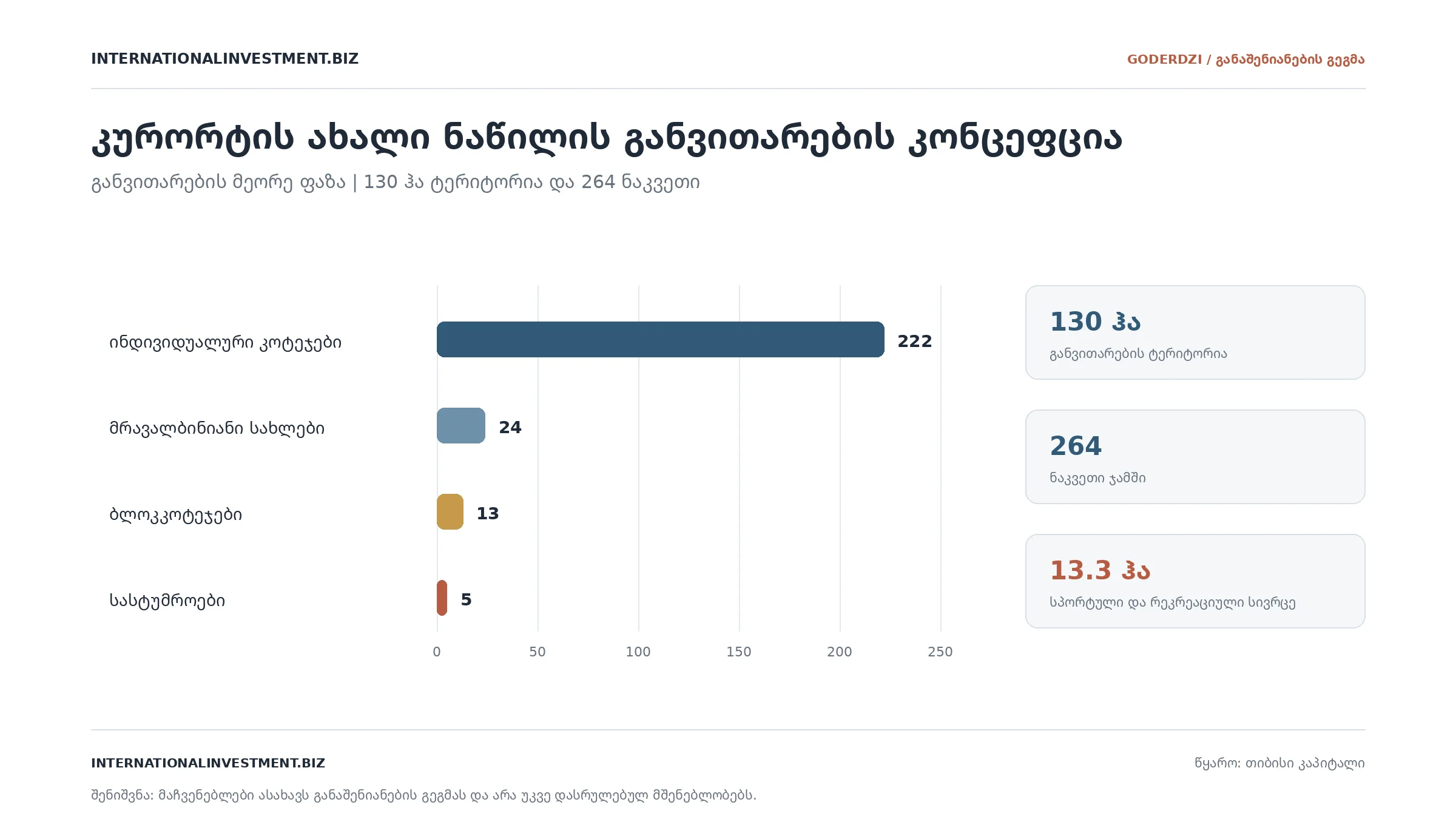
For the first phase of development, 34 plots with a total area of 2.75 hectares have been designated. Of these, 31 plots have an area of up to 700 square metres, while three plots range between 2,000 and 5,000 square metres.
This offers prospective investors a choice of various formats. Smaller plots are suitable for individual chalets and compact accommodation facilities, while larger ones are geared toward full-service hotels and commercial complexes.
Nevertheless, prior to making investment decisions, detailed due diligence on land titles, urban planning regulations, utility connection capacity, and permitting documentation is indispensable.
Tourist Demand — Adjara as the Base Market for "Goderdzi"
A key growth catalyst for "Goderdzi" is the established tourist flow into Adjara. According to the Georgian National Tourism Administration, between 2023 and 2025 the country welcomed an average of about 6.5 million international visitors annually, with international tourism receipts averaging 4.4 billion US dollars.
Around 42% of these travelers visit Adjara, and 27% enter the country through Adjaran checkpoints.
This regional standing establishes a robust demand base for "Goderdzi". The Batumi tourism cluster, with its international airport and well-developed hospitality base on the Black Sea coast, provides an excellent foundation for creating a combined "sea + mountains" tourism product.
In terms of target audiences, the following segments stand out:
Domestic market — estimated at around 1.9 million leisure trips; it can serve as a primary source for repeat visits and short weekend getaways.
Neighboring countries market — accounts for roughly 4 million visits. Its key advantage is overland access and short travel distances.
European market — generates around 400 thousand visits with an annual growth rate of 10%; shows strong interest in outdoor recreation, freeride, and ecotourism.
Middle Eastern market — approximately 600 thousand trips. For this segment, the cool mountain climate during the summer heat combined with seaside leisure in Batumi serves as a decisive selling point for "Goderdzi".
It should be noted that these numbers represent overall market potential rather than current traffic to the resort. Converting this into actual bookings will require efficient logistics, aggressive marketing, international distribution channels, and competitive service quality.
Competitive Positioning: Natural Advantages and Pricing
The competitive positioning of "Goderdzi" compared to other Georgian and international resorts rests on two pillars: natural assets and attractive pricing.
In Georgia's domestic market, "Goderdzi" is positioned as an emerging year-round resort distinguished by unmatched snow quality, tree-lined terrain, and diverse active recreation opportunities.
For comparison: the total slope length in Gudauri is 75 km, in Bakuriani 37 km, in Mestia and Ushguli 33 km, while Goderdzi's potential is estimated at 26 km.
In terms of current slope network size, "Goderdzi" still trails Georgia's market leaders; however, inaugurating new trails and lifts will significantly close this gap.
On the international stage, the pricing advantage is most noticeable. For instance, according to TBC Capital calculations (which include a ski pass, gear rental, half-board meals, and one night's stay), the minimum price of such a package in Goderdzi is around 151 US dollars. By comparison, a similar package at the Vogel resort in Slovenia costs 253 dollars, in Pamporovo (Bulgaria) 288 dollars, in Alpe d'Huez (France) 340 dollars, and in Breuil-Cervinia (Italy) 612 dollars.
Thus, "Goderdzi" enjoys an appealing price advantage over European counterparts. However, low cost alone does not ensure long-term success: high safety standards, well-groomed trails, advanced logistics, and a comprehensive service offering are essential.
A positive signal comes from industry recognition: in the European Best Destinations 2025 ranking, Goderdzi took 1st place in the "Best Snow Destination in Europe" category. This opens broad prospects for international branding and promotion during the resort's active construction phase.
85.7k Tourists by 2030 — Demand and Revenue Projections
According to TBC Capital estimates, a primary development goal for Goderdzi by 2030 is to achieve an average annual accommodation occupancy rate of 50%. To reach this benchmark, the resort will need to attract around 86 thousand visitors.
The projected growth trajectory for tourist arrivals is as follows: 10.8 thousand in 2026, 18.1 thousand in 2027, 30.4 thousand in 2028, 51 thousand in 2029, and 85.7 thousand people by 2030.
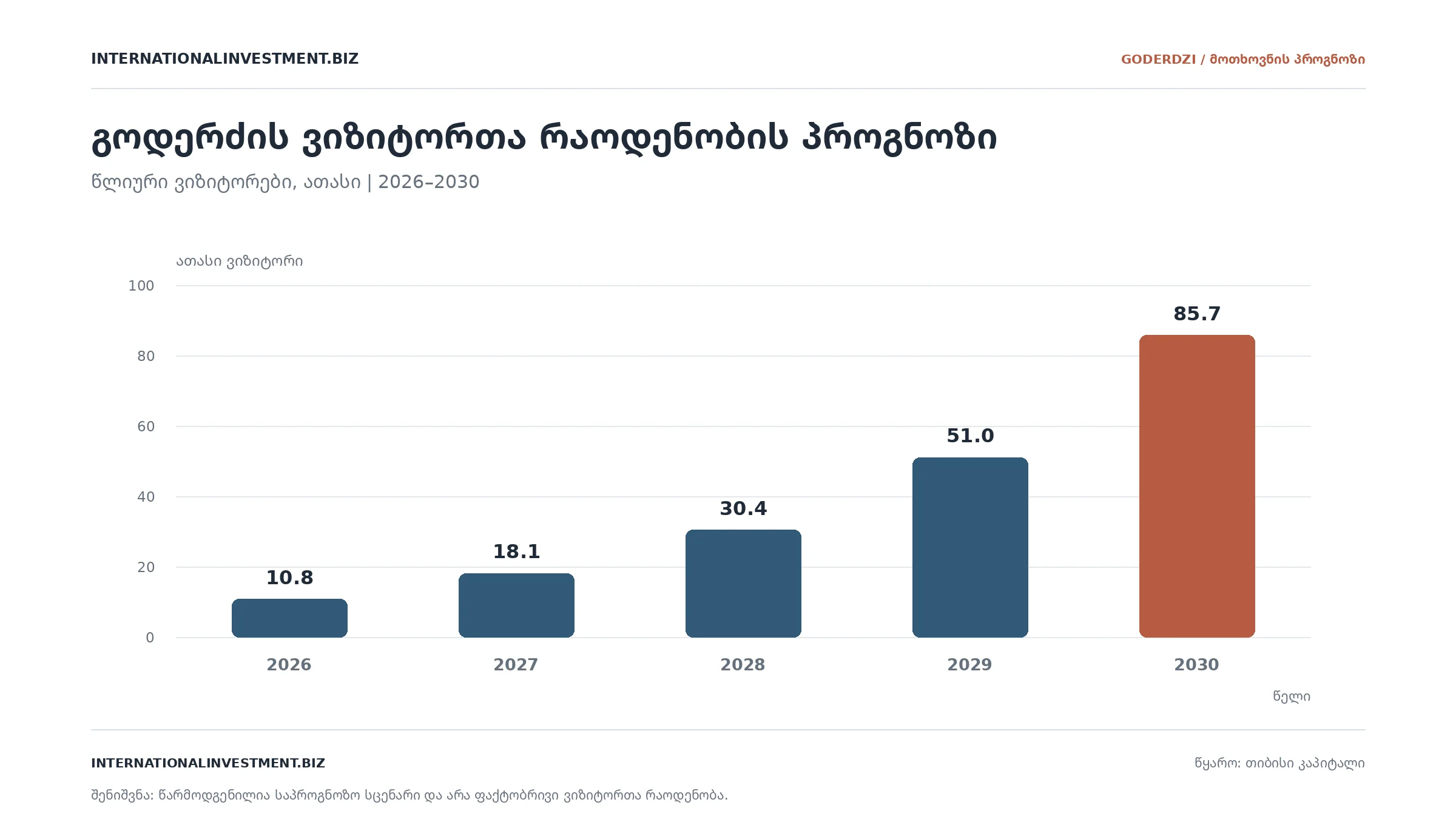
This implies an almost eightfold surge in tourist numbers over four years. Such an expansion will require not only the opening of new hotels and lifts, but also extensive marketing abroad along with continuous elevation of service standards.
In parallel, dynamic revenue growth is anticipated: under TBC Capital's scenario, tourist spending at the resort will reach approximately 9.5 million US dollars in 2026, 15.3 million in 2027, 25.6 million in 2028, 43.3 million in 2029, and reach 72.8 million US dollars by 2030.
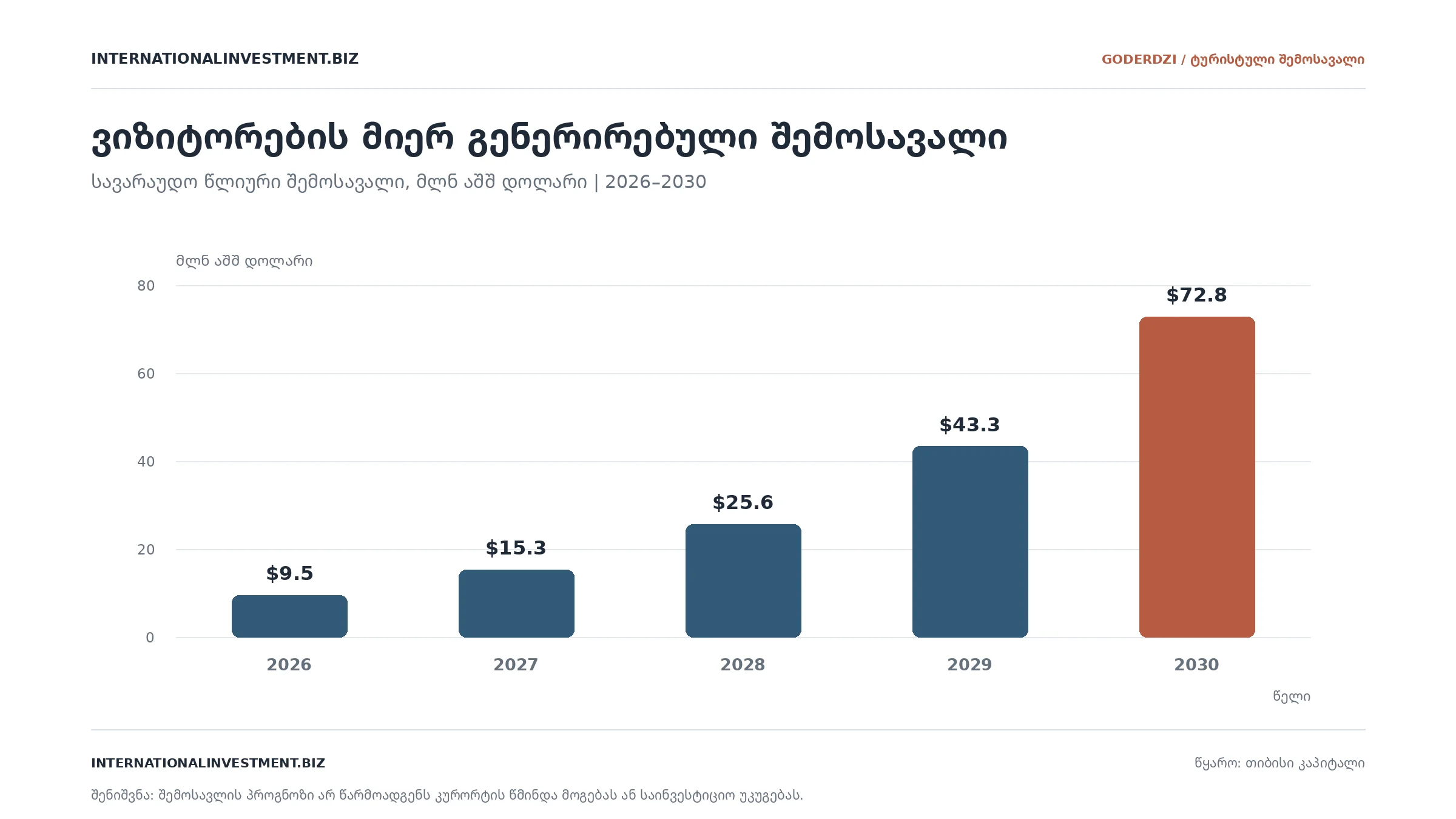
Between 2026 and 2030, Goderdzi's revenues are expected to equal an average of 0.6% of Georgia's total receipts from international tourism.
When analyzing these figures, two aspects should be kept in mind: official statistical data collection for Goderdzi only began in 2026, meaning benchmark metrics are estimates. Furthermore, any such forecasts represent a development scenario dependent on numerous external variables.
The timely delivery of roads, utilities, new hotels, and efficient room capacity utilization will be determining factors in hitting the 2030 target.
Investment Niches and Core Challenges
The Goderdzi cluster concept opens several promising niches for private capital:
First niche — the hotel sector and accommodation units. The second development phase envisions building detached chalets, apart-hotels, and traditional hotel properties.
Second niche — tourist and leisure services. The year-round model drives demand for restaurants, gear rental shops, ski schools, guide services, spa centers, and family entertainment amenities.
Third niche — commercial and municipal infrastructure: transportation, logistics, maintenance services, public spaces, and operational infrastructure required for day-to-day life in a mountain village.
However, unlocking this potential comes with major challenges.
First and foremost, access roads and the internal street network require fundamental improvement. An uninterrupted supply of water, electricity, and other utilities is vital for launching new facilities. Managing seasonality is equally critical: if the resort generates traffic for only a few winter months, hotel yields and return on investment will face pressure.
Preserving the unique ecosystem warrants special care. Relict forests, alpine lakes, and highland landscapes represent Goderdzi's greatest asset, requiring all new developments to adhere to strict environmental standards.
Goderdzi — A New Mountain Investment Hub in Adjara
Goderdzi's prospects offer an exceptional opportunity to diversify Adjara's tourism economy. Alongside the established Black Sea market of Batumi, expanding this highland destination can draw fresh investment capital into the region and cultivate year-round traveler interest.
The resort's trump cards include unique natural attributes, a four-season concept, and proximity to major transit hubs. Plans for 2026–2028 clearly demonstrate the ambition of public authorities and private enterprise not merely to expand existing infrastructure, but to build an international-standard resort from the ground up.
TBC Capital's forecast of reaching 85.7 thousand tourists and around 72.8 million dollars in revenue by 2030 solidifies "Goderdzi's" standing as a primary engine for mountain tourism growth in Georgia.
The success of this strategy will depend on prompt infrastructure delivery, attracting hospitality operators, international market recognition, and preserving the regional natural heritage.
Today, Goderdzi can be described as an early-stage investment destination whose primary value lies in converting abundant natural assets into a modern, competitive, and year-round tourism product.
Source: TBC Capital — "Georgia, Adjara, Goderdzi: Macro Environment and Resort Potential"; Georgian National Tourism Administration; Geostat; resort development master plans according to the presented study.
InternationalInvestment.biz - English edition