













China Money Market Signals Weak Credit Demand
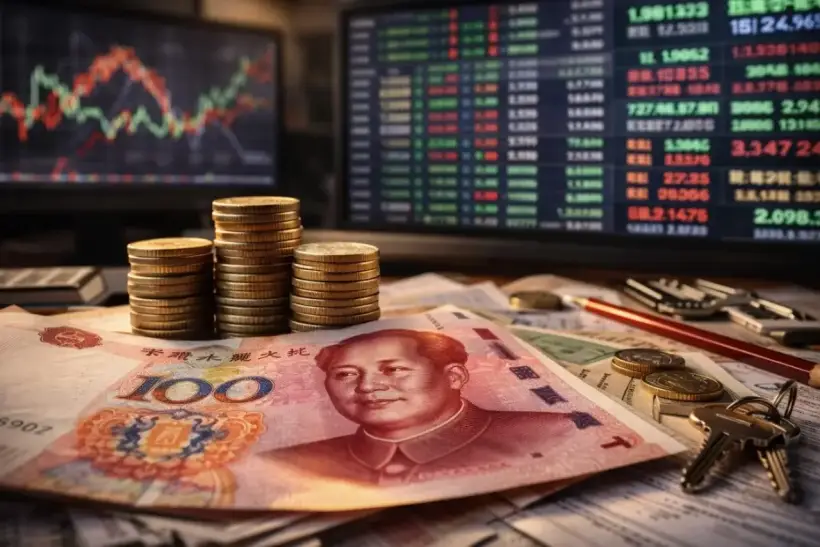
Cash glut deepens concern over China credit demand
China’s money market points to excess liquidity and weak loan appetite
China’s money market sent one of its clearest warning signals in months at the start of April: short-term interbank rates fell sharply even after the People’s Bank of China drained liquidity from the financial system in March. Bloomberg reported that the overnight repo rate dropped to near a three-year low, while the gap between that rate and the PBOC’s de facto seven-day policy rate widened to the largest since September 2024. For markets, that divergence suggests banks are flush with cash but are struggling to translate that liquidity into stronger credit growth in the real economy.
Why falling money-market rates worried investors
A drop in short-term funding rates is not always negative. What unsettled investors this time was the combination of lower repo rates and recent central-bank liquidity withdrawals. Bloomberg said traders and analysts were caught off guard because the normal expectation after cash drainage would be firmer short-term funding costs, not softer ones. That is why the market’s interpretation shifted away from liquidity management alone and toward a broader conclusion: underlying loan demand is weak.
What the PBOC did in March
The People’s Bank of China drained liquidity on a net basis in March for the first time in about a year. According to Bloomberg calculations based on official data, it withdrew 890 billion yuan through short-term open-market operations and absorbed another 250 billion yuan through longer-term tools including outright reverse repurchase agreements and the medium-term lending facility. Taken together, that likely amounted to the first net repayment of PBOC funds by commercial banks since last May. The move was interpreted as a cautious signal that Beijing wanted to preserve policy flexibility while higher oil prices and external uncertainty fed through the economy.
Why excess cash is not turning into stronger lending
Bloomberg directly linked the market dislocation to slowing credit growth. Banks appear well supplied with liquidity, but demand from private companies, property-related borrowers, local governments and parts of industry remains uneven. In China, money-market conditions often act as an early indicator of turning points in the credit cycle before official lending statistics fully reflect them. When short-term repo rates sink because cash is piling up inside the banking system, it often means that new loans are being extended more slowly or are failing to generate a broad-based impulse across the economy.
What the latest economic data say
Official data for the first two months of 2026 still looked reasonably solid. China’s National Bureau of Statistics said the economy got off to a “robust and promising start,” with exports and industrial activity continuing to grow. But that does not resolve the problem of domestic demand. Even with acceptable headline macro numbers, money markets can still signal that internal credit momentum remains fragile and uneven. That divergence between relatively steady macro data and soft internal financial demand is now a central concern for investors watching China.
Why DR001 and DR007 matter so much
For China’s financial markets, repo rates remain among the most important real-time indicators of liquidity conditions. Platforms linked to ChinaMoney and CFETS publish data on overnight and seven-day pledged repo rates used by banks and other financial institutions. These rates reflect the cost of very short-term money in the interbank market and help investors judge whether the system is short of liquidity or saturated with cash. In early April, market data showed DR001 around 1.22%, well below the seven-day level and low by the standards usually seen when loan demand is healthier.
Why this complicates Beijing’s policy stance
The money-market signal makes policy calibration harder for Beijing. On one hand, the central bank had earlier suggested that reserve-requirement and interest-rate cuts remained possible in 2026. On the other, the March liquidity withdrawal showed that policymakers did not want to pivot too quickly into aggressive easing while the external backdrop remained unstable and higher commodity prices could revive inflation concerns. If falling repo rates really do reflect weak loan appetite rather than temporary technical factors, Beijing may have to return to the familiar balancing act between supporting growth and containing financial risks.
What it means for banks and investors
For banks, the current setup points to pressure on margins and weaker returns from credit expansion. For investors, it raises the risk that the credit impulse many had hoped to see in the second quarter may prove softer than expected. If banks cannot find enough creditworthy borrowers, money remains trapped in the interbank system rather than flowing into corporate investment, construction or consumer demand. That matters for equities, bonds and commodities alike, because expectations around China are still heavily shaped by whether domestic credit can re-emerge as a driver of growth.
Why the rest of the world is watching
China’s credit cycle matters far beyond its borders. Weaker lending usually implies more cautious domestic demand, less support for commodity imports and a softer contribution to the global industrial cycle. At the same time, easier short-term funding conditions can increase expectations of further monetary easing, with implications for the yuan, bond markets and capital flows across Asia. That is why the current dislocation in China’s money market is not just a technical domestic story but an early signal about how durable the country’s economic growth may be in the second quarter and beyond.
As International Investment experts note, the current conditions in China’s money market show that the economy’s problem is shifting from the availability of cash to the scale and quality of demand for credit. When short-term rates continue to fall even after liquidity has been drained, the market is effectively saying that the banking system has funding, but the wider economy still lacks enough confidence to borrow and invest more aggressively.
FAQ
What does the fall in China’s money-market rates signal in April 2026?
It points to excess liquidity in the banking system and, according to analysts, slowing credit growth.
Why is this considered unusual?
Because the PBOC drained liquidity in March, yet short-term repo rates still moved lower, suggesting weak demand for funds from banks and borrowers.
How much liquidity did the PBOC withdraw in March?
Bloomberg calculations based on official data showed 890 billion yuan withdrawn through short-term operations and another 250 billion yuan through longer-term tools.
What are DR001 and DR007?
They are China’s overnight and seven-day interbank pledged repo rates, widely used as indicators of short-term liquidity conditions.
Why is excess liquidity not always a positive sign?
Because it can mean banks have cash but cannot find enough demand for new, good-quality loans from businesses and households.
Could this lead to more support measures from Beijing?
Yes. Persistent weak loan demand could strengthen expectations of reserve-ratio cuts or interest-rate reductions later in 2026.