







 How Ukraine’s New-Build Housing Market Has Changed Over Four Years
 European Prime Rents Rise as Property Yields Turn Higher
 The Most Expensive Airlines in Europe in 2026
 Housing Prices in Italy Reach a Two-Year High
 Travellers Increasingly Choose Cooler Scandinavia
 Serbia Property Sales Decline as Transaction Value Rises
What the Ultra-Wealthy Invest In: The Capital Structure of Ultra-High-Net-Worth Individuals
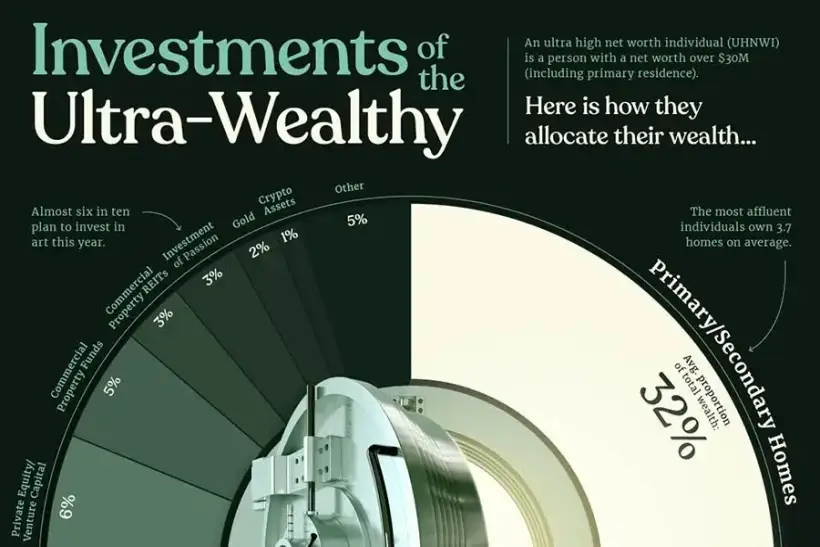
Ultra-wealthy investors allocate capital very differently from the mass market. Their portfolios combine real estate, equities, and luxury assets, which serve not only financial but also status functions, according to Visual Capitalist based on data from Knight Frank.
How Ultra-Wealthy Individuals Structure Their Investments
The analysis is based on a global survey of more than 500 wealth managers, family offices, and private bankers, collectively overseeing around $2.5 trillion in assets. Ultra-high-net-worth individuals are defined as people with a net worth starting from $30 million, including their primary residence.
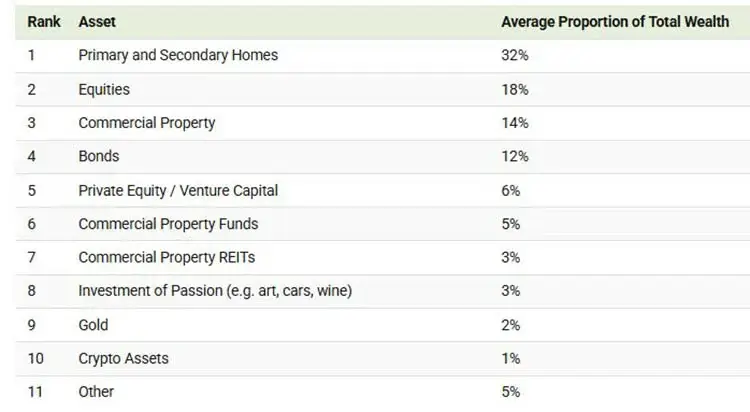
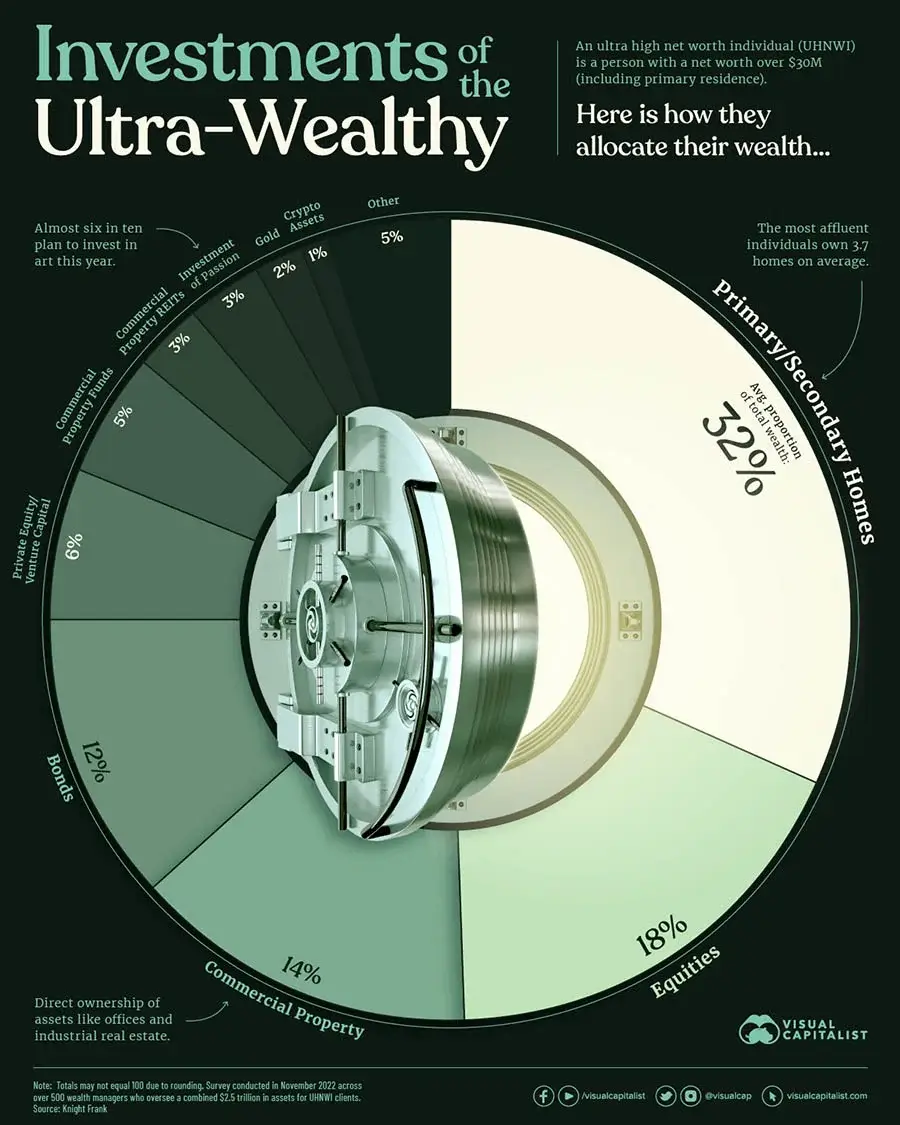
The key feature of capital allocation in this group is the high share of real estate alongside significant diversification into financial instruments and alternative assets. The largest share is allocated to primary and secondary homes, averaging 32% of total wealth. The study shows that, on average, such investors own 3.7 properties.
Equities rank second, accounting for around 18% of portfolios. However, regional differences are notable: in the Americas, equities reach 33%, in Europe 28%, and in Asia 26%. Commercial real estate accounts for 14% of capital, while bonds make up 12%. Together, traditional financial instruments represent nearly a quarter of the portfolio.
Private investments, including direct equity investments in companies and venture capital financing, account for around 6%. Within this category, the average investment size in private companies among such investors ranges from $1.8 million to $6.9 million.
Alternative Assets and “Passion Investments”
A separate category is formed by so-called passion investments—assets that combine investment and collectible value. They account for approximately 3% of portfolios and include artworks, cars, wine, and other luxury goods.
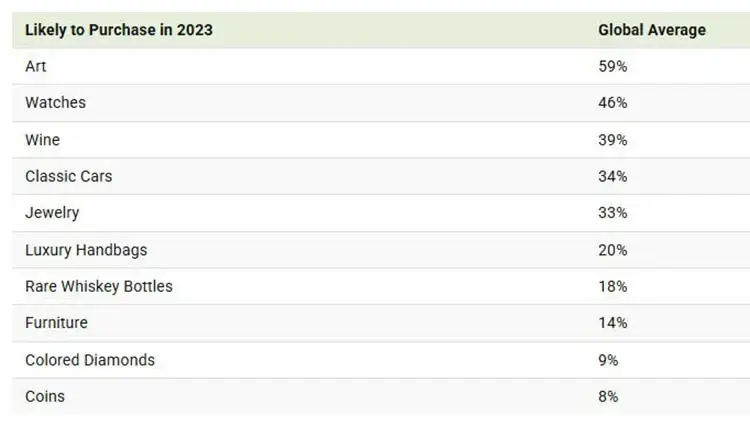
Nearly 60% of ultra-wealthy individuals planned to purchase art in 2023. Strong interest was also observed in watches, wine, classic cars, and jewelry. Less widespread but still popular categories include luxury handbags, rare whiskey, furniture, colored diamonds, and collectible coins.
The overall economic downturn and the S&P 500 decline of more than 19% in 2022 did not prevent most of these categories from increasing in value. The art market led with price growth of around 29%, followed by classic cars at 25% and watches at 18%.
Gold accounts for about 2% of ultra-wealthy portfolios, while cryptocurrencies represent 1%. Other and unclassified investments make up roughly 5%. Despite its relatively small share, crypto remains part of diversified strategies, while gold continues to serve as a defensive asset.
Growth of Ultra-Wealthy Individuals and Global Wealth Geography
In 2022, there were about 579,000 individuals worldwide with wealth above $30 million. The largest concentrations were in New York, Tokyo, and San Francisco. Projections suggest that within five years this number could rise to 744,000, an increase of approximately 29%.
In 2024, nearly 39% of dollar millionaires with wealth above $10 million lived in the United States (905,400), exceeding the combined totals of China (471,600) and Japan (122,100), according to Knight Frank. India (85,700) moved up to fourth place for the first time, surpassing Germany.
In Asia, China played a key role with 854,500 millionaires. Europe showed weaker momentum at 343,200. Other regions recorded significantly lower figures: the Middle East 47,400, Latin America 57,100, and Africa 19,500.
Final Trends
Analysts at International Investment note that the growth of the ultra-wealthy directly affects demand in key segments such as real estate, equity markets, and luxury goods. This leads to increased pressure on premium assets and stronger competition for limited investment opportunities.
The capital structure of the ultra-wealthy demonstrates a balance between traditional real estate, financial markets, and alternative investments. At the same time, there is a clear and sustained interest in assets with emotional and collectible value, which are gradually becoming a separate asset class. In the coming years, the expansion of the ultra-wealthy population may further strengthen existing trends, especially in premium real estate and alternative assets.