







 How Ukraine’s New-Build Housing Market Has Changed Over Four Years
 European Prime Rents Rise as Property Yields Turn Higher
 The Most Expensive Airlines in Europe in 2026
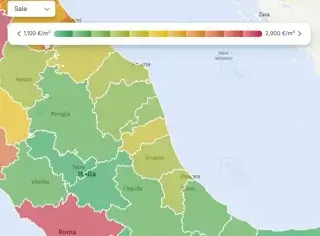 Housing Prices in Italy Reach a Two-Year High
 Travellers Increasingly Choose Cooler Scandinavia
 Serbia Property Sales Decline as Transaction Value Rises
Ruble strengthens to its highest level since 2023, falling below 70 rubles per dollar
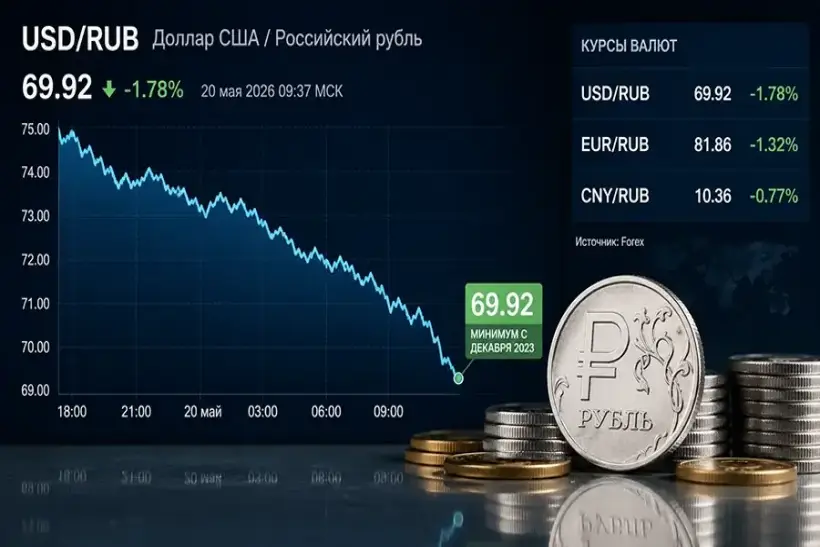
The U.S. dollar on the Forex market dropped below 70 rubles on the morning of May 20, 2026, for the first time since December 2023. A decline against the euro was also recorded. Experts attribute the movement to inflows from oil revenues. The Russian currency has outpaced others in terms of growth against the U.S. dollar. This is seen as a positive image factor, although it puts pressure on profits, dividends, and tax revenues to the budget.
Exchange rate dynamics and ruble leadership in the market
Frank Media reports that during trading, the dollar hit a low of 69.92 rubles at 9:37 Moscow time on May 20. This is 1.78% lower than the previous day’s closing level. An hour later, the currency partially recovered and stabilized around 70.89 rubles. At the same time, the euro fell to 81.86 at its lowest point, while the Chinese yuan declined by 0.77% to 10.36 rubles.
Bloomberg noted that the ruble has become the strongest currency in terms of performance against the dollar in the current quarter. Since the beginning of April, it has strengthened by approximately 12%. Analysts say that for the second consecutive year, the Russian currency is showing dynamics that diverge from official and market forecasts, which had expected depreciation. Against this backdrop, some market participants consider the ruble potentially overvalued relative to current economic conditions.
Reasons behind ruble strengthening
The ruble’s appreciation is driven by a combination of factors. After a period of decline linked to tighter sanctions on Russian oil, foreign currency inflows recovered due to rising energy prices.
High interest rates and limited imports have reduced demand for dollars and euros. Around 60% of imports are now paid in rubles, reflecting an adaptation of trade flows to the sanction environment.
A high key interest rate and controlled inflation support the attractiveness of ruble assets and limit capital outflows. Oil market dynamics remain an additional driver.
According to the Central Bank of Russia, net foreign currency sales by major exporters in April rose to $7.3 billion, nearly tripling. This coincided with rising prices for Urals crude oil: in February the average price was $44.6 per barrel, in March $77, and in April $94.9.
Analyst views and exchange rate forecasts
Analysts note that the current ruble dynamics remain stable but depend heavily on the persistence of the existing balance of factors in the foreign exchange market.
Senior portfolio manager at Istar Capital, Iskander Lutsko, believes that under current conditions the ruble could strengthen into the 65–70 rubles per dollar range. He also notes that monetary policy from the Bank of Russia could further influence the exchange rate.
If geopolitical tensions persist, including developments in the Middle East, the regulator may pause interest rate cuts. According to Lutsko, such a scenario could support the ruble but also limit the easing of financial conditions for the broader economy.
At the same time, some experts believe that current ruble levels may reflect a temporary market imbalance caused by trade flows and capital movement restrictions. In this context, forecasts remain range-bound and depend on changes in export revenues and regulatory policy.
Government stance and economic impact
Finance Minister Anton Siluanov stated that ruble strengthening is not a concern as long as oil export revenues remain sufficient. He emphasized that the exchange rate remains comfortable for the budget as long as oil prices in ruble terms allow planned revenues to be met.
Earlier, Russian authorities revised the average exchange rate forecast for the current year from 92.2 rubles to 81.5 per dollar, reflecting the stronger-than-expected currency performance.
Current ruble levels remain significantly stronger than official forecasts. The appreciation has a dual impact on the economy: it reduces inflationary pressure and makes imports cheaper, but also lowers exporters’ ruble-denominated revenues and may reduce tax inflows and dividends to the budget.
Downward revisions in Russia’s economic growth forecasts
The Ministry of Economic Development has lowered its growth forecasts for the Russian economy in the coming years, despite pressure from President Vladimir Putin, who had previously expressed dissatisfaction with slowing growth.
According to updated estimates, GDP growth in 2026 is expected at 0.4%, down from a previous forecast of 1.3%. The 2027 forecast was reduced to 1.4%, while the 2028 estimate fell from 2.55% to 1.9%. By 2029, the ministry still expects growth to return to an average level of around 2.4%.
Deputy Prime Minister Alexander Novak pointed to disruptions in supply chains for goods, services, and capital due to sanctions, as well as labor shortages and shifting budget priorities as factors worsening the situation.
Military spending has become the largest item in the Russian budget, accounting for roughly one-third of total expenditures. Rising oil exports driven by conflict in the Middle East benefit the state budget, but are unlikely to stimulate broader economic recovery if hostilities continue.