







 Covivio Hotels Revenue Grows 4.7% as European Markets Split
 Lithuanian Apartment Prices Accelerate Across Major Cities
 Georgia's Tourism Revenue Hits Record High
 Norway's Sovereign Fund Commits €1.5bn to European Warehouses
 Market Rout of October 2026: Can Branded Hotels Protect Capital?
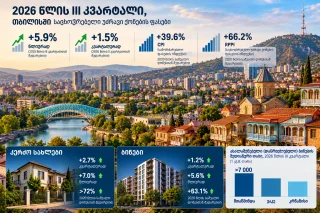 Residential Property Prices in Tbilisi Rise by 5.9% Year-on-Year
Czechia Could Face a 500,000-Worker Gap

Czechia is approaching a demographic turning point in its labour market. Moore Czech Republic estimates that the accumulated gap between people entering employment and those reaching statutory retirement age could total 499,000 between 2027 and 2045. This is not a forecast of half a million unfilled vacancies: the actual workforce will depend on migration, retirement behaviour, participation among older people and parents, productivity and automation.
The gap starts widening rapidly after 2033
Around Prague highlighted the forecast as the result of two demographic waves moving in opposite directions. Relatively small generations born after 2000 are entering the labour market as the much larger cohorts born in the 1970s approach retirement.
The underlying calculation comes from Moore Czech Republic. It compares the number of people expected to enter employment after completing education with the number reaching statutory retirement age. The model uses an average labour-market entry age of approximately 21.
An average of just under 118,000 people a year are expected to enter the workforce between 2027 and 2046. Inflows and exits remain broadly balanced through 2031 before the gap begins to widen. Moore estimates a cumulative shortfall of approximately 37,000 over 2027–2036 and 499,000 over 2027–2045. The largest annual imbalance comes in 2043, when about 63,000 more people could reach retirement age than enter the labour market.
The 499,000 figure is not a vacancy forecast
The estimate should not be interpreted as the number of job advertisements that will remain unfilled in 2045.
Moore is accumulating annual demographic differences between potential new workers and people reaching retirement age. Not everybody stops working immediately at the statutory age, while some people leave the labour force earlier.
Migration, education, parental employment, the economic cycle and productivity will also change the result.
A company may produce the same output with fewer employees after automating part of its operations. In another sector, a lack of staff may instead lead to higher wages, lost contracts or postponed investment.
The figure is therefore a potential demographic labour-supply gap under a set of assumptions, not a prediction of exactly 499,000 vacancies.
Czechia already has very high employment
The domestic pool of unused labour is relatively small.
In 2025, 82.9% of Czech residents aged 20–64 were employed, the third-highest rate in the European Union after Malta and the Netherlands. Unemployment was 2.8%, compared with an EU average of 6%.
There are still substantial differences between population groups. Only 7.9% of children under three were in formal childcare in 2025, compared with 40.5% across the EU. The employment gap between men and women aged 25–34 was 32.8 percentage points. An estimated 66% of economically active Ukrainian refugees were employed in 2024, but around half reported working in jobs that did not match their qualifications.
That leaves some scope to increase labour supply through better childcare and fuller use of migrants’ qualifications, but there is no simple pool of hundreds of thousands of unemployed workers waiting to be hired.
Unemployment has risen but remains relatively low
The labour market softened during 2026.
The Labour Force Survey unemployment rate was 3.3% in June, while 75.5% of people aged 15–64 were employed. The employment rate was 0.2 percentage point lower than a year earlier.
Administrative data produce a higher figure because they use a different definition. At the end of August, the Czech Labour Office registered 373,891 jobseekers and a registered unemployment rate of 5%. Its database contained 99,274 vacancies.
The government vacancy register does not cover the entire market, as companies also recruit through commercial websites, agencies and their own channels.
The coexistence of substantial numbers of jobseekers and vacancies points to another problem: workers’ skills and locations do not always match employers’ needs.
Births have fallen to a 240-year low
Demography is the main driver of the longer-term workforce problem.
Only 77,636 children were born in Czechia in 2025, the lowest number in the country’s statistical records dating back to 1785.
Births fell by 8%, or 6,700, in a year and were 31% lower than in 2021. The total fertility rate dropped from 1.83 children per woman in 2021 to 1.28 in 2025.
Even a sharp recovery in births would do little to resolve labour shortages in the 2030s and early 2040s because children born today will generally not enter full-time employment for around two decades.
The cohorts moving toward retirement are far larger. In parts of the 1970s, annual births reached as many as 194,000, which is the central demographic imbalance behind Moore’s model.
The over-65 population is heading toward 29%
Czechia had 2.273 million residents aged 65 or older at the end of 2025, equivalent to 20.8% of the population.
Official population projections put the share close to 29% by mid-century. By 2040, the country is expected to have more than 200 people aged 65 or over for every 100 children under 15.
Ageing creates pressure on both sides of the labour market. Businesses need to replace retiring staff, while healthcare and long-term care will require more employees to serve an older population.
A smaller number of working-age people relative to retirees also puts greater pressure on pensions and public finances.
Foreign workers already form a major part of the workforce
Migration is already offsetting part of the domestic demographic decline.
Expert estimates by the Czech labour and industry ministries put the number of foreigners legally working in the country at about 1.08 million at the end of 2025, including roughly 935,000 employees and 146,000 self-employed people.
Their role has expanded sharply over the past decade. Czech statistical analysis describes foreign workers as having moved from a supplementary source of labour to a fundamental component of the economy. Ukrainians and Slovaks are among the largest groups. (statistikaamy.csu.gov.cz)
Migration is also sustaining Czechia’s population. Natural change reduced the population by 35,700 in 2025 as deaths exceeded births, while net migration added 42,000 people. The total population therefore increased by 6,300.
Czechia recorded 110,600 immigrants and 68,600 emigrants during the year. Ukrainians, Slovaks and Filipinos made the largest contributions to positive net migration.
Migration alone will not close the gap
An additional migrant worker is not automatically a replacement for a particular retiring employee.
Businesses need the right qualifications, and some jobs require Czech-language ability or formal recognition of professional credentials.
The challenge already affects migrants living in Czechia. When a trained engineer, healthcare professional or other specialist works below their qualification level, the economy gains an employee but does not necessarily fill the occupation for which that person was trained.
The impact of migration therefore depends on more than arrivals. Retention, skills recognition, access to regulated occupations and labour mobility all matter.
Retirement age is another important variable
The length of working lives will also affect future labour supply.
Under the current pension reform, statutory retirement age is gradually increasing above 65. For people born after 1965, one month is added for every later year of birth, eventually reaching 67 for those born after 1988.
Measures introduced from 2025 also provide a social-contribution discount for working pensioners, designed to make continued employment after retirement more attractive. (mpsv.gov.cz)
Even a modest increase in the actual age at which people leave work can have a material effect when applied to large generations.
Longer careers can also give employers more time to transfer skills and experience before older employees leave.
Automation can change how many workers are needed
A smaller workforce does not automatically imply an equivalent decline in economic output.
Manufacturers can increase automation and robotics, while service companies can use software and artificial intelligence to reduce the amount of routine work required from each employee.
The relevant economic question is not simply how many occupations disappear, but how much output one worker can produce with technology.
Automation can nevertheless create a new skills mismatch. It may reduce demand for some jobs while increasing the need for engineers, technicians, software specialists and workers able to operate more advanced systems.
Czechia may therefore experience labour shortages at the same time as some occupations shrink.
The fiscal impact is estimated at 3.3% of GDP
Moore also modelled the potential impact of the demographic gap on public finances.
Using today’s prices and current tax and contribution rates, it estimates an annual effect equivalent to about 3.3% of GDP in 2045. Roughly 1.86% of GDP represents foregone taxes and social and health-insurance contributions, while another 1.46% reflects additional pension spending.
This is a scenario produced by a consulting firm, not an official government budget forecast.
Over the next two decades, wages, productivity, taxation, pension rules, migration and the structure of the Czech economy will all change.
The figure therefore illustrates the possible scale of the challenge under the model’s assumptions rather than a fixed future cost.
As International Investment experts report, the central risk for Czechia is not whether exactly 499,000 vacancies will exist in 2045. The country is entering a period in which large cohorts are likely to leave the workforce faster than younger generations can replace them. With employment already high, no single source of labour can close that gap. Productivity, managed migration, better use of existing migrants’ qualifications, higher parental employment and longer working lives will all matter. For investors, labour scarcity is likely to appear primarily through wage, training and automation costs and through a region’s ability to provide enough staff for new projects.
FAQ: Czechia’s labour shortage
Will Czechia really be short 500,000 workers?
The 499,000 figure is Moore Czech Republic’s estimate of the accumulated demographic gap over 2027–2045. It is not a forecast of the number of unfilled vacancies on a single date.
When does the problem become more serious?
Moore’s model remains broadly balanced through the early 2030s. The gap begins widening rapidly from 2033.
What happens in 2043?
It is the most difficult single year in the model, with roughly 63,000 more people reaching retirement age than entering the labour market.
Why is the shortage developing?
Large generations born in the 1970s are approaching retirement, while younger cohorts are much smaller. Births have also continued to decline.
How many children were born in Czechia in 2025?
There were 77,636 live births, the lowest number in the statistical record dating back to 1785.
How many foreigners work in Czechia?
Expert estimates put the number of foreigners legally working in the country at about 1.08 million at the end of 2025, including employees and self-employed workers.
Can immigration solve the problem?
It can offset a substantial part of the gap, but the outcome depends on qualifications, recognition of credentials, retention and access to occupations where workers are actually needed.
What is Czechia’s current unemployment rate?
Registered unemployment was 5% in August 2026. The Labour Force Survey measure was considerably lower at 3.3% in June because the two indicators use different methodologies.
Can automation compensate for the workforce decline?
Partly. Automation and AI can raise output per employee, but they also change skill requirements and may increase demand for technical occupations.
Why does the forecast matter for investors?
Labour shortages can raise wages, recruitment and training costs, delay projects and increase spending on automation. Access to skilled workers is therefore becoming a more important factor in investment-location decisions.