







 Egypt Prepares New Law for Property Developers
 Young Japanese Buyers Turn to 50-Year Mortgages
 Argentina Narrows Tourism Gap as Arrivals Rise
 Seattle Luxury Housing Loses Its Former Momentum
 The World’s Strongest Passports for Travel, Living and Investment
 Russian Developers’ Debt Nearly Doubled in a Year
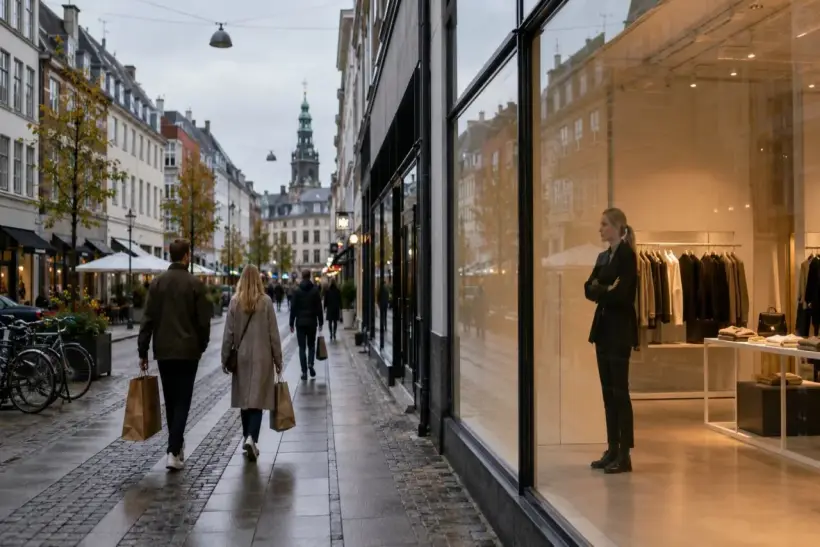
Consumer confidence in Denmark fell to a six-month low in May, even as the economy remains resilient, inflation is low and public finances are strong. For the government and retailers, the signal is uncomfortable: rising income does not automatically become spending when households expect tougher conditions and choose to save more.
Danish consumer confidence weakened in May
Denmark’s consumer confidence indicator fell to minus 19.8 in May 2026, according to national statistical data. The index captures households’ views of their own financial situation, the current state of the Danish economy and expectations for the future; it ranges from 100 to minus 100, with negative readings showing that pessimistic responses outnumber optimistic ones.
Yahoo Finance, citing MT Newswires, reported that the reading was the weakest in six months. That matters beyond a monthly sentiment move: in a small open economy with strong exports, weak household confidence can still restrain domestic demand, retail sales and service consumption.
What the household sentiment index measures
Consumer confidence is not a direct measure of spending. It is an early signal of how families see their financial future. When people expect conditions to worsen, they are more likely to postpone large purchases, borrow more cautiously, delay replacing furniture, cars and appliances, and put spare income into savings.
In Denmark, the survey is conducted monthly among a representative sample of residents aged 16 to 74. Respondents are asked about family finances, the national economy and expectations; the results are then adjusted so they can be compared with the adult population and Danish households as a whole.
The economy looks stronger than consumers feel
Weak sentiment stands out because Denmark’s macroeconomic outlook remains relatively solid. The European Commission expects Danish GDP to grow by 1.9% in 2026 and 1.8% in 2027 after a 2.9% expansion in 2025; inflation is forecast at 1.8% in 2026 and 1.9% in 2027, unemployment at around 6.5%, and public debt is expected to fall from 27.9% of GDP in 2025 to 26.2% in 2027.
That picture shows a gap between macro data and household behavior. On paper, Denmark still has low debt, a budget surplus, moderate inflation and a strong external position. Inside households, however, caution remains after several years of price shocks, higher interest rates and geopolitical uncertainty.
Savings are slowing the consumption rebound
The core problem for domestic demand is not the absence of income, but the reluctance to spend. The spring economic forecast says real wages, employment and policy measures should support household income, but private consumption growth is expected to remain subdued because of a jump in household savings in 2026; the move toward saving reflects weak confidence and continuing economic and geopolitical uncertainty.
For retailers, this creates a more difficult environment than headline growth figures suggest. Consumers may keep paying for groceries, housing, transport and utilities, while cutting discretionary spending. Furniture, electronics, clothing, home improvement, restaurants, domestic travel and other deferrable categories are likely to face more pressure.
Inflation is low, but price memory remains
Formally, Denmark’s inflation environment looks controlled. The country’s central bank explains that consumer inflation measures the rise in prices of goods and services purchased by households, while the consumer price index is based on about 25,000 prices collected from roughly 1,800 shops, companies and institutions.
Consumers, however, do not react only to the latest annual inflation rate. Families also remember the cumulative rise in the cost of living: food, rent, mortgages, energy, transport and services compared with the period before the price shock. That is why households can still feel poorer even when inflation is close to target.
Denmark needs domestic demand as exports slow
In recent years, Denmark’s economy relied heavily on exports, including pharmaceuticals and strong external earnings. In 2026 and 2027, growth is expected to become more balanced, with domestic demand, investment and consumption taking on more of the burden. Weak household confidence makes that transition less secure.
If families keep saving instead of spending, companies face a less reliable home market. That affects orders, inventories, hiring, retail space demand and small-business plans. For a country with strong public finances, this is not a crisis scenario, but it is a risk of slower and more uneven growth.
The labor market still anchors demand
Denmark’s labor market remains one of the main stabilizers. As long as employment grows and real wages recover, consumption should not collapse. But the expected slight rise in unemployment to around 6.5% matters psychologically: even a modest softening can reinforce household caution, especially among young families, mortgage borrowers and workers in consumer-facing sectors.
For banks and developers, this means closer attention to credit risk. If consumers are less confident about future income, demand for mortgages, renovation, furniture purchases and moves may grow more slowly than models based only on wages and interest rates would imply.
Europe’s wider mood reinforces caution
Denmark’s problem is not isolated. In May 2026, the flash estimate of consumer confidence improved by 1.7 points in the European Union and by 1.6 points in the euro area, but both indicators remained well below their long-term averages; the EU reading stood at minus 18.2 and the euro-area reading at minus 19.0.
That means Danish households are acting inside a broader European environment of anxious expectations. Even if the national economy is relatively strong, news about wars, trade tensions, energy prices and weak growth in neighboring economies affects family spending decisions.
What it means for investors and companies
For investors, the Danish signal matters because it shows a limit to a growth model that depends more on domestic demand. A strong budget, low debt and moderate inflation make Denmark resilient, but retailers, consumer services, shopping centers and companies tied to discretionary spending may still face a cautious buyer.
For businesses, the response is to work harder on price, product mix and trust. The consumer has not disappeared, but is more calculating. Companies that offer clear value, flexible terms, energy-efficient products, essential services and goods that help households reduce costs will be better positioned.
As experts at International Investment report, the May drop in Danish consumer confidence does not look like a recession signal, but it exposes a vulnerability in Europe’s recovery model: the economy can be statistically strong while the consumer remains psychologically weak. The critical risk for Denmark is that rising income goes into savings rather than spending; if that happens, domestic demand will not fully replace the export impulse, and retail and services will recover more slowly than macro forecasts imply.