







 Latvia’s Residence Permits for Real Estate to Be Abolished from September 15
 Egypt Prepares New Law for Property Developers
 Young Japanese Buyers Turn to 50-Year Mortgages
 Argentina Narrows Tourism Gap as Arrivals Rise
 Seattle Luxury Housing Loses Its Former Momentum
 The World’s Strongest Passports for Travel, Living and Investment
Denmark Sees Housing Overheating Risk
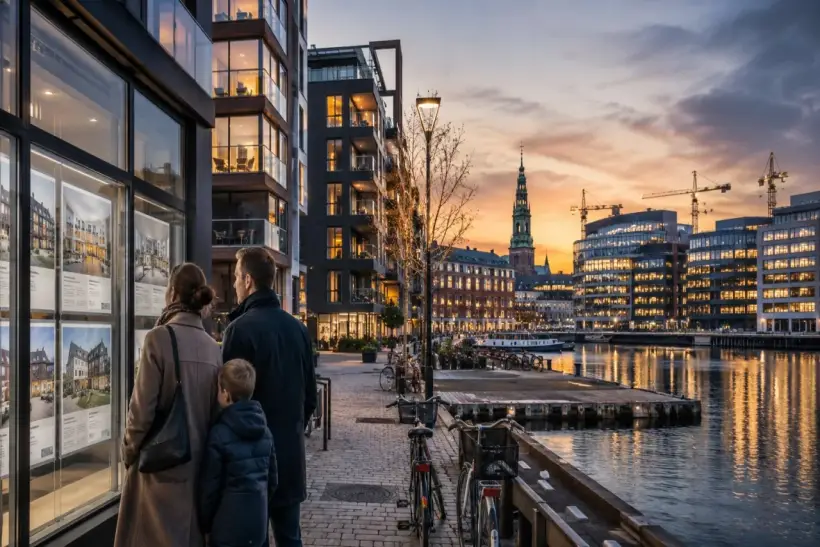
Denmark’s housing market has returned as a financial-stability concern: price gains that started in Copenhagen are spreading to other regions, while the central bank warns that expectations of further increases could amplify overheating risks if buyers and lenders begin to treat rising home values as guaranteed.
Home-price gains move beyond Copenhagen
Denmark is entering a new phase of its housing cycle. After a period of sharp price increases in the capital region, the momentum is spreading more broadly across the country. Bloomberg reported on May 26 that Danmarks Nationalbank warned of rising housing risks as price gains spread. For the regulator, this is not only an affordability issue; housing affects consumption, household debt and the quality of banks’ mortgage books.
Danmarks Nationalbank says housing-market developments are central to the Danish economy and financial stability because they influence household consumption and debt. That explains why the central bank watches not only average prices, but also buyer behavior, lending standards and the regional spread of price increases.
Denmark is not a classic case of high inflation and rapidly rising rates. Inflation remains moderate: consumer prices rose 1.4% year on year in April 2026, up from 1.2% in March. But low inflation does not remove housing risk if home prices rise faster than incomes and buyers begin to price future capital gains into current transactions.
The capital market set a risky benchmark
The most sensitive area is Copenhagen and the capital region. In late 2025, Danmarks Nationalbank Governor Christian Kettel Thomsen warned that the capital-area market was moving quickly: an 80-square-meter apartment in Copenhagen had become about 1.5 million kroner more expensive since February 2023. He also pointed to the risk of self-reinforcing expectations that prices will keep rising.
That mechanism is especially important in Denmark because the mortgage market is deep, liquid and closely linked to the bond market. When homes rise in value, households feel wealthier, may spend more and can borrow more easily against property. If the market turns, the same mechanism reverses: collateral values fall, debt remains and banks become more cautious.
The key point is that the current risk is no longer limited to expensive Copenhagen. As price gains spread to other cities and regions, the issue becomes national. That makes the regulatory challenge harder, because targeted measures aimed only at the capital may be insufficient if demand strengthens in more affordable areas as well.
The mortgage system increases market sensitivity
Denmark has one of Europe’s most developed mortgage systems. A large share of housing credit is funded through covered bonds, meaning debt securities backed by mortgage loans. This structure supports transparency and relatively efficient funding, but it also makes the housing market sensitive to expectations for interest rates, incomes and prices.
Finance Denmark publishes statistics on prices, transactions, mortgage offers, arrears and properties taken over by lenders, showing the level of institutional monitoring in the market. For the Danish model, that is essential: housing risk is assessed not only through sales, but also through borrower behavior, lending activity and collateral quality.
Danish households remain among the most indebted in Europe, even though the ratio has fallen from historical highs. Trading Economics, citing Eurostat, shows household debt to income falling to a series low of 165.12% in 2025, while the average since 2000 still exceeded 218%. That means families remain sensitive to rates, home values and income changes even after balance-sheet improvement.
Rates follow the euro, while housing follows expectations
Danish monetary policy has a special feature: the central bank’s main goal is to keep the krone fixed against the euro. As a result, Danish interest rates usually follow the European Central Bank, limiting the room for an independent response to local housing overheating. Trading Economics describes the policy aim as keeping the krone within a narrow band around 7.46038 kroner per euro.
That makes housing risks more complicated. If euro-area rates fall, Danish financial conditions can also ease even if the domestic property market is already running hot. For buyers, that means more affordable mortgages. For sellers, it supports high asking prices. For regulators, it means relying not only on rates, but also on lending standards, borrower requirements and macroprudential rules.
Macroprudential rules are measures designed to limit systemic financial risks. In housing, they can include down-payment requirements, debt-to-income limits, affordability tests under higher interest rates and restrictions on the riskiest loan structures.
Income and employment support the market
Denmark’s housing market is not rising in isolation. The economy remains resilient, the labor market is strong and household purchasing power is recovering after the inflation shock. The OECD’s 2026 economic survey of Denmark points to a strong labor market, sound public finances and a two-speed economy in which multinational firms drive exports while domestic demand and productivity remain weaker.
For housing, this creates a mixed backdrop. Strong employment and wage growth support demand. But if prices rise faster than incomes, affordability weakens and the market becomes more dependent on credit conditions and expectations of future appreciation.
The European Commission said in its May forecast that Denmark’s public debt is low and is projected to fall from 27.9% of gross domestic product in 2025 to 27.2% in 2026 and 26.2% in 2027. That fiscal strength sets Denmark apart from many European economies, but it does not remove private-sector debt risk concentrated in households and mortgages.
Tax changes altered buyer behavior
Another factor is Denmark’s housing-tax reform, which redistributed the burden across properties and regions. For some buyers, it created incentives to accelerate transactions or rethink purchase budgets, especially in the apartment and urban-home segments.
Nykredit, in its analysis of Danish covered bonds, noted that housing-market growth has historically started in Copenhagen and other major cities before spreading to the rest of the country. It cited rising real wages, a strong labor market, lower interest rates and lower housing taxes as drivers of market growth.
This spread of price momentum is what makes the central bank’s warning important. When growth is concentrated in the capital, it can be explained by land scarcity, high incomes and the city’s international appeal. When it moves into a wider geography, the risk changes: buyers across the country may start treating past price gains as a forecast of the future.
Europe’s affordability pressure adds context
Denmark is not alone. Europe is facing a broader housing challenge: in large cities, supply has struggled to keep up with migration, household formation and lifestyle changes. The Council of the European Union says housing takes up almost one-fifth of the average EU household’s income, while one in ten urban residents spends more than 40% of income on rent or mortgage payments.
Against that backdrop, Denmark looks relatively resilient, but not cheap. Copenhagen competes for workers, students, international companies and capital. New districts such as Nordhavn help expand supply, but development does not always reduce price pressure quickly, especially when demand rises from local buyers, investors and high-income workers at the same time.
The long-term issue is not only the price level, but the distribution of risk. Homeowners benefit from asset appreciation. New buyers enter the market with more debt. Renters face limited supply and competition for quality homes. Banks enjoy strong collateral while prices rise, but carry revaluation risk if the cycle turns.
The main risk is faith in endless gains
Danmarks Nationalbank is warning less about today’s price level than about market psychology. If buyers start to treat rising home values as normal, they may take on more debt, accept weaker financial buffers and justify high prices by expecting future resale gains. That is a classic overheating mechanism.
Denmark has already experienced a painful housing cycle before and after the global financial crisis. At that time, optimism, low bank losses and the popularity of risky mortgage products increased vulnerability. Today, banks are better capitalized and lending rules are stricter, but the basic risk remains: property markets rarely correct gently when expectations have drifted too far from incomes.
For regulators, the task is to avoid choking off sustainable demand while preventing credit and expectations from turning price gains into a self-reinforcing spiral. For banks, it means maintaining strict borrower assessment. For buyers, it means evaluating mortgages based not on hoped-for capital gains, but on the ability to service debt under adverse conditions.
As experts at International Investment report, Denmark’s main risk is not an immediate housing crash but the normalization of overly optimistic expectations. If price gains outside Copenhagen are treated as a new safe trajectory, households may again buy homes based on expected capital appreciation rather than real incomes. In a country with a deep mortgage culture and high private-sector debt, that mistake could become a financial-stability risk faster than national average indexes suggest.
FAQ
Why is Danmarks Nationalbank warning about housing risks?
Because home-price growth affects household debt, consumption and bank stability. If buyers begin to believe prices will always rise, the market can overheat.
Why is Copenhagen important?
Copenhagen showed sharp price gains first. The capital market often sets the tone for the rest of Denmark, so the spread of gains beyond it increases systemic risk.
What are covered bonds in the mortgage market?
Covered bonds are debt securities backed by mortgage loans. In Denmark, they are central to housing finance and connect the property market closely with financial markets.
Why can’t Denmark simply raise rates to cool housing?
Danish monetary policy is focused on maintaining the krone’s fixed exchange rate against the euro. As a result, rates largely follow the European Central Bank, making lending rules more important for housing risk.
Does Denmark have a housing bubble?
Authorities are not formally declaring a bubble. The concern is rising risk, especially from expectations of further price gains, high household debt and the spread of price growth beyond the capital.
What does this mean for buyers?
Buyers need to assess not only current prices and rates, but also whether they can handle payments if conditions worsen. Buying solely on the assumption of future price gains increases risk.