







 Australia’s Spring Auctions Rise but Remain Well Below 2025
 Number of Foreigners Holding Turkish Residence Permits Exceeds 1.27 Million
 Demand from Russian Tourists for Holidays in Georgia Rises by 20–25%
 Montenegro Property Buying Costs in 2026
 Four in Ten Companies Would Not Choose Slovakia
 Gulf Countries Prepare Unified Tourist Visa
Northern Europe Speeds Up Tourism
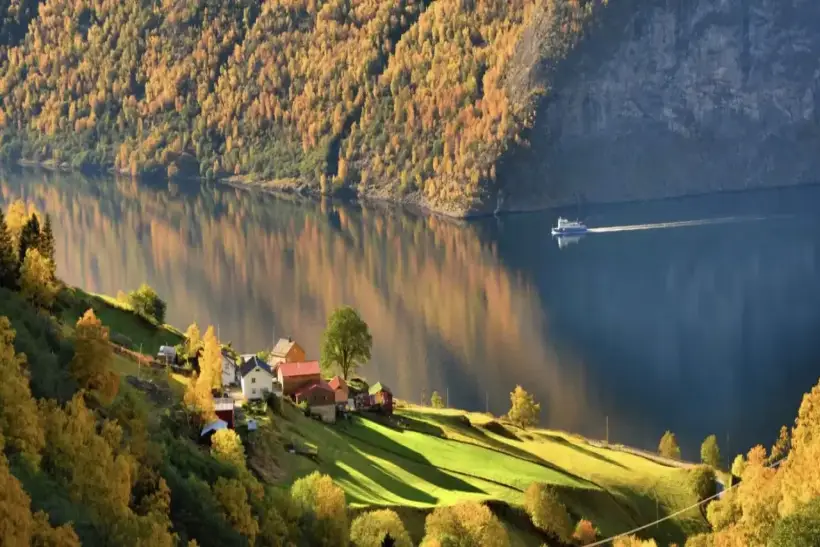
Finland and Norway have emerged among the fastest-growing tourism destinations in the OECD. In 2025, international arrivals to Finland rose by 16.5%, while Norway posted a 12.5% increase. The growth confirms rising demand for Nordic travel, nature, winter experiences, cooler summers and multi-country itineraries — but it also raises questions about infrastructure pressure and local communities.
Finland and Norway outperformed many OECD markets
NordicMarketing, citing the OECD Tourism Trends and Policies 2026 report, says international tourism in OECD countries reached a new high in 2025, with Finland and Norway standing out among the fastest-growing destinations. Finland recorded a 16.5% increase in international arrivals compared with 2024, while Norway posted 12.5% growth. Both markets joined the group of double-digit performers, alongside Japan and Korea.
The OECD report itself describes tourism as a sector that now needs more than post-pandemic recovery. It stresses resilience, policy coordination, competitiveness, the social benefits of tourism and the sector’s capacity to adapt to extreme weather-related events.
For Northern Europe, this is a major shift. Finland and Norway have long been seen as expensive, seasonal and relatively niche destinations. They are now increasingly competing not only for winter travellers and northern lights visitors, but also for tourists seeking safe, nature-based, less overheated and less crowded routes.
OECD arrivals reached a record
International arrivals across OECD countries increased by 3.4% in 2025 to reach a record 847 million, after 8.1% growth in 2024. Performance varied widely: some markets continued to recover from the pandemic, some moved to new records, and others remained below pre-pandemic levels.
Northern Europe was among the winners. Finland, Japan, Korea and Norway recorded double-digit growth and reached record inbound levels. In the same comparison, several major markets, including Canada, Germany, Ireland and the United States, saw inbound tourism decline or remain below pre-pandemic levels.
That makes Finland’s and Norway’s performance especially visible. This is not only recovery from a low base; it also points to a redistribution of travel demand, with some travellers moving away from overheated southern markets and choosing northern destinations instead.
Finland is growing through winter, nature and cities
The OECD estimates that tourism directly accounted for EUR 5.8 billion in gross value added in Finland in 2023, or 2.4% of GVA. The sector provided 122,800 full-time-equivalent jobs, equal to 5.3% of total employment. Inbound tourism expenditure reached EUR 4.6 billion, but was still only 83% of the 2019 peak.
That means Finland’s strong 2025 growth came in a sector that had not fully regained its previous level of international demand. The country still has significant room to grow: Helsinki as a city destination, Lapland as a winter brand, the lake regions, cultural tourism, fishing tourism, nature routes and eastern regions that lost Russian visitors.
Finland’s 2025–2028 national tourism strategy explicitly aims for sustainable growth, reduced seasonality, social responsibility, better accessibility and stronger regional tourism organisations. In 2024, the government launched a programme for Eastern Finland and allocated EUR 3 million to Visit Finland to coordinate marketing and promotional activities with the regions.
Finnish overnight stays confirm demand
Statistics Finland showed rising foreign demand throughout 2025. In August 2025, accommodation establishments recorded 2.36 million overnight stays; residents accounted for 1.60 million and non-residents for 0.76 million. Overnight stays by foreign tourists rose by 13% year on year, with Germany, Sweden and the United States as the largest foreign source markets.
The hotel market also benefited: room occupancy reached 61% in August, two percentage points higher than a year earlier, while the average hotel-room price rose to EUR 121.
For tour operators, this points to a broader demand funnel. Finland is no longer selling only Rovaniemi and Santa Claus. Interest is rising in nature products, city breaks, short combined itineraries, cultural programmes and travel outside the classic winter peak.
Norway combines volume with strong domestic demand
In Norway, tourism contributed NOK 128.1 billion, or 3.6% of GDP, before the pandemic and supported more than 182,900 full-time jobs, or 7.3% of national employment. In 2024, travel exports accounted for 13.9% of service exports, compared with 13.5% in 2019.
Norway differs from Finland because it has a very strong domestic base. In 2025, domestic travel generated 26.4 million nights in commercial accommodation, accounting for 65% of all nights. That was 8% above the 2019 level.
The overall accommodation statistics confirm the record. In 2025, Norwegian commercial accommodation establishments recorded 40.6 million guest nights, up 5.2% from 2024, with foreign guests contributing most to the growth.
The North sells cool weather and nature
Finland’s and Norway’s acceleration coincides with changing traveller behaviour. Tourists are increasingly choosing familiar and safe destinations, planning shorter trips, watching budgets more closely and reacting to heat, air-service disruption and geopolitical risks. The OECD notes that safety, affordability and cancellations are influencing travel behaviour.
For Northern Europe, this creates an opportunity. Summer heat in southern Europe is strengthening demand for cooler destinations. Northern lights, fjords, Arctic routes, lakes, forests and national parks are becoming not just exotic travel products, but alternatives to crowded cities and beaches.
But this attractiveness has limits. Natural destinations cannot absorb unlimited growth without investment in trails, toilets, cleaning, parking, safety, transport and visitor-flow management. The more popular Lofoten, Tromsø, Lapland or Finnish lake regions become, the more important it is not only to sell the destination, but to manage it.
Norway introduces a visitor fee
Norway is already translating tourism growth into a new management model. Parliament adopted the Act on Visitor Fees on June 10, 2025, giving municipalities a tool to finance tourism infrastructure in high-pressure areas. The law enters into force on July 1, 2026.
The key element is a voluntary municipal accommodation fee of 3% excluding VAT. It can be adjusted seasonally and introduced for all or only some months of the year. All revenue must return to municipalities and fund tourism-related public goods such as waste disposal, public toilets, signage, hiking trails and other infrastructure used by both residents and visitors.
This is an important signal for the whole region. Norway is recognising that tourism growth cannot be left only to the private sector. If visitors create pressure on a destination, municipalities need a dedicated revenue source to manage that pressure.
Finland focuses on sustainable growth
Finland is moving in a similar direction, but through a broader strategy. Its 2025–2028 national tourism strategy strengthens the focus on seasonality, social responsibility, sustainable growth, accessibility, skills and impact measurement. The OECD specifically notes the growing role of regional tourism organisations and the expansion of quantitative indicators to assess economic, environmental and social effects.
Another priority is a nature-positive approach, where tourism aims to minimise harm and invest in ecosystem restoration. Visit Finland’s Sustainable Travel Finland programme and related tools help tourism businesses assess biodiversity impacts and avoid conflicts with nature and local communities.
This is especially important for Lapland and eastern Finland. Fast winter-tourism growth can bring income and jobs, but without visitor-flow management it also increases pressure on nature, housing, transport and local services.
Tour operators get a stronger Nordic product
For tour operators, the growth of Finland and Norway creates a more interesting product than a single-country trip. NordicMarketing notes that improved air connections, cross-border rail links and stronger cooperation between Nordic destinations make it easier to create multi-country itineraries.
In practice, this means routes such as Helsinki — Lapland — Tromsø, Oslo — fjords — Northern Norway, Finland — Sweden — Norway, winter northern-lights trips and summer “coolcation” itineraries as an alternative to southern European heat.
Competition will also intensify. If Finland and Norway become fashionable destinations, suppliers need to explain their differences more clearly: not just “nature”, but a specific experience, convenient logistics, environmental responsibility, quality accommodation, safety and a real connection with local communities.
Growth alone is not sustainable success
The OECD’s central message is that visitor numbers alone are no longer a sufficient measure of success. The sector needs resilience, adaptation to uncertainty, crisis preparedness and better management of benefits for local residents.
For Finland and Norway, this is especially relevant. Their advantages are nature, safety, trust, infrastructure and northern distinctiveness. Their risks are high costs, limited capacity in specific areas, labour shortages, seasonality and tension between visitor growth and local quality of life.
If growth is spread across seasons and regions, it strengthens the economy. If it concentrates in a few destinations and months, it quickly becomes a problem: housing becomes more expensive, roads, trails and public services are overloaded, and residents begin to see tourism as external pressure.
As International Investment experts report, Finland’s and Norway’s success in the OECD report marks a new stage for Nordic tourism: demand is shifting toward destinations that are cooler, safer and closer to nature. But record arrivals are not a final victory; they are a test of management. The critical takeaway is simple: Northern Europe will benefit from the tourism boom only if it sells not mass volume, but quality flows, longer seasons and direct value for local communities.