







 Covivio Hotels Revenue Grows 4.7% as European Markets Split
 Lithuanian Apartment Prices Accelerate Across Major Cities
 Georgia's Tourism Revenue Hits Record High
 Norway's Sovereign Fund Commits €1.5bn to European Warehouses
 Market Rout of October 2026: Can Branded Hotels Protect Capital?
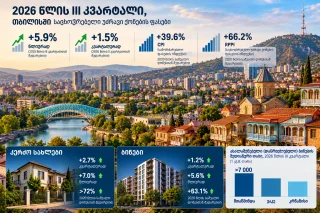 Residential Property Prices in Tbilisi Rise by 5.9% Year-on-Year
Lapland Holiday Home Demand Has Quadrupled

Northern Finland’s holiday-home market has expanded sharply over the past decade. Bookings in Levi, Ylläs and Ruka have tripled or quadrupled since 2016, travellers are reserving accommodation further in advance and demand has shifted toward more expensive properties. Levi has recorded the strongest price growth, with its median price per square metre almost doubling and the median transaction price rising above €300,000. International tourism is supporting the market, with passenger traffic at northern airports continuing to grow in 2026.
Holiday Home Bookings Have Tripled or Quadrupled
Holiday-home booking volumes in Levi, Ylläs and Ruka are now three to four times higher than in 2016. Ruka recorded the largest number of bookings among the three destinations in 2025, with around 7,000 reservations.
Levi generated the highest average value per booking. The figure reached €1,353 in 2025, compared with €857 in 2017, an increase of 58%. The average length of stay changed little over that period, meaning that the rise largely reflects higher accommodation prices rather than longer trips.
Demand has also shifted upmarket. The share of bookings in the cheapest category has declined across all three destinations. In Levi, premium accommodation accounted for 19% of reservations in 2025, up from 7% in 2017.
Travellers are booking earlier as well. The average lead time in Levi increased from 80 to 107 days. In Ylläs it rose from 96 to 104 days, while Ruka moved from 63 to 81 days. Week-long holidays remain particularly common in Levi and Ylläs, while an average stay in Ruka lasts about 5.5 nights.
The figures were published by Alma Media using data from its Nettimökki and Etuovi.com platforms. Its dataset also shows the number of properties represented in Levi rising from 382 in 2022 to 592 in 2024. Alma Media owns 10% of premium holiday-home rental service Hilla Villas, meaning the figures are best treated as a view of activity on the group’s platforms rather than a complete census of Finland’s holiday-home market.
Levi Property Prices Have Almost Doubled
Levi has recorded the clearest increase in property values. The median price per square metre for holiday homes rose from €2,421 in 2016 to €4,694 in 2025, an increase of almost 94%.
The median transaction price climbed even faster, from €155,000 to €329,000 over the same period.
Prices have also risen in Ylläs, where the median price per square metre moved above Ruka’s for the first time in 2025. Median transaction prices were approximately €243,000 in Ylläs and €188,000 in Ruka. Ruka’s median square-metre price has increased by around 17% since 2016.
The differences underline how segmented the northern holiday-property market has become. Levi has increasingly moved into a higher price bracket, supported by ski infrastructure, services and demand for short-term accommodation.
There is an important geographical distinction. Levi and Ylläs are within Finland’s administrative region of Lapland, while Ruka is part of Kuusamo in North Ostrobothnia, although it is frequently grouped with northern Finnish tourism destinations. Kuusamo’s official municipal information confirms that the city is part of the North Ostrobothnia region.
International Tourism Is Supporting the Property Market
The rise in holiday-home demand has coincided with strong growth in northern tourism. Rovaniemi Airport handled 1.12 million passengers in 2025, an increase of 18.4%. Kittilä recorded 445,911 passengers, up 8.3%, while Ivalo handled 249,056 and Kuusamo 129,373.
International traffic grew substantially faster in several locations. Rovaniemi recorded 603,838 international passengers, up 44.3%, while Kittilä’s international traffic rose 20.9% to 256,722. International passenger volumes increased by 11.8% in Ivalo and 7.3% in Kuusamo.
During the first half of 2026, airports in Lapland handled about 1.1 million passengers, compared with around 1 million in the same period a year earlier. Finavia said growth was particularly strong on international routes and highlighted expanding international connections at Rovaniemi, Kittilä, Ivalo and Kuusamo.
For holiday-home owners, better international air access expands the potential short-term rental market and reduces dependence on Finnish domestic travellers.
Foreign Visitors Drive Much of Winter Demand
Lapland recorded about 550,000 overnight stays by foreign visitors in December 2025, 6% more than a year earlier. Hotel room occupancy reached 79%, while the average room price was €356, the highest among Finland’s regions.
Across Finland, foreign visitors generated 7.2 million registered overnight stays in 2025, an increase of 13%. Domestic overnight stays declined by 1%, while total registered stays reached 23.3 million.
Statistics Finland cautions that the 2025 accommodation figures are not fully comparable with earlier years because classification data for accommodation establishments were revised. That methodological change should be considered when assessing longer-term growth.
The winter season remains particularly important. Finland recorded around 2.4 million foreign overnight stays between December 2025 and February 2026, with roughly 1.5 million, or about 60%, registered in Lapland.
Across the broader Lapland area of Finland, Sweden and Norway, foreign visitors generated 2.2 million overnight stays during the same winter. Finnish Lapland accounted for 71%, according to Visit Finland.
Foreign Buyers Are Also Looking at Cheaper Areas
International buyer interest extends beyond expensive ski resorts. In southwestern Lapland, overseas buyers are targeting houses and cottages at prices far below those seen in Levi.
In the Sea Lapland area around Kemi and Tornio, properties below €100,000 attract particularly strong demand, especially homes with their own land and locations close to water. The value of real-estate transactions involving foreign buyers across Finnish Lapland has increased from about €1.5 million to €15 million over 15 years.
Yle reported that foreign buyers account for almost 15% of property transactions in Kemi, with buyers from Central Europe increasingly active in the area. Many acquire properties for private holiday use, while some rent them to tourists when they are not using them themselves.
This is a very different segment from Levi, where the median transaction price has reached €329,000. Parts of Lapland still offer houses priced in the tens of thousands of euros.
Buyers Need to Account for Finnish Property Taxes
The advertised purchase price is only one part of the cost of acquiring property in Finland. A direct purchase of real estate, including land and buildings, is generally subject to a 3% transfer tax.
Shares in housing or real-estate companies are generally taxed at 1.5%. In such transactions, the taxable amount can also include the buyer’s allocated share of outstanding housing-company debt.
Direct property owners are also liable for annual real-estate tax. In 2026, municipalities can set the rate for buildings used as leisure properties between 0.93% and 2% of their taxable value. Land is taxed separately at a general municipal rate between 1.3% and 2%.
These rules are set out by the Finnish Tax Administration, while the final annual cost depends on the ownership structure, municipality and assessed value of the property.
Some Foreign Buyers Need an Acquisition Permit
A buyer’s nationality can also affect the transaction. Finland operates a permit system for certain direct real-estate acquisitions by buyers from outside the European Union and European Economic Area.
Applications are handled by the Ministry of Defence and require information about the buyer, the property and its intended use, together with a sale agreement, draft agreement or accepted purchase offer. The permit system relates to direct real-estate acquisitions; housing-company shares are structured differently.
Investors therefore need to establish the legal form of a property before buying. A unit in a resort development may be held through company shares, while a detached holiday home with its own plot may constitute direct ownership of real estate. Tax and permit requirements can differ substantially.
Booking Growth Does Not Equal Investment Yield
A three- or fourfold increase in bookings demonstrates stronger tourism demand, but it does not show the net return generated by an individual property.
Levi’s average booking value of €1,353 represents the amount paid for accommodation, not the owner’s profit. Management and platform fees, cleaning, electricity, heating, insurance, maintenance, repairs, taxes and periods without tenants all reduce net income.
Operating costs are particularly relevant in northern Finland. Properties used throughout the winter require continuous heating, snow management and regular maintenance. The higher the purchase price, the more occupancy and net rental income matter to the investment calculation.
Seasonality also remains significant. International demand peaks during the winter months. Growth in summer and shorter off-season stays may reduce that dependence, but it does not yet imply uniform occupancy throughout the year.
As International Investment experts report, the figures confirm a substantial strengthening of the holiday-home market in northern Finland: booking volumes have risen, visitors are spending more and reserving earlier, while Levi’s median square-metre price has almost doubled in nine years. Those trends should not be treated as a guarantee of future investment returns. Much of the detailed resort-level data comes from platforms controlled by a single commercial group, while an owner’s actual return depends on the purchase price, monthly occupancy, management and maintenance costs, taxes and ownership structure. For an individual investment, net income after all expenses is more informative than headline growth in tourist bookings.
FAQ: Lapland Holiday Homes
How much has holiday-home demand increased?
Bookings through Nettimökki in Levi, Ylläs and Ruka have roughly tripled or quadrupled since 2016.
How much does property cost in Levi?
The median transaction price was around €329,000 in 2025, while the median price per square metre reached €4,694.
Which destination is cheaper: Levi, Ylläs or Ruka?
Ruka had the lowest median transaction price in the 2025 dataset at around €188,000. Ylläs stood at approximately €243,000 and Levi at €329,000.
Why are holiday-home prices increasing?
The market is supported by growing international tourism, more direct air connections, earlier reservations and increasing demand for higher-priced accommodation. Supply constraints can also affect individual resorts.
Is Ruka in Lapland?
Administratively, no. Ruka is part of Kuusamo in the North Ostrobothnia region, although it is frequently grouped with northern Finnish tourism destinations.
Can foreigners buy property in Finland?
Yes. Buyers from outside the EU and EEA may need Ministry of Defence approval for certain direct acquisitions of real estate. The rules differ for housing-company shares.
What transfer tax applies when buying property?
Direct real-estate acquisitions are generally taxed at 3%. Purchases of housing-company and real-estate-company shares are generally subject to a 1.5% transfer tax.
Is there an annual tax on Finnish holiday homes?
Yes. Municipalities set the tax rate for leisure-property buildings. In 2026 the permitted range is 0.93% to 2% of the taxable value of the building, while land is taxed separately.
How early do travellers book accommodation in Levi?
The average booking lead time has increased to around 107 days, compared with 80 days in 2017.
Does tourism growth guarantee a high rental yield?
No. Returns depend on the acquisition price, actual occupancy, seasonality, management fees, utilities, maintenance and taxation.