







 Australia’s Spring Auctions Rise but Remain Well Below 2025
 Number of Foreigners Holding Turkish Residence Permits Exceeds 1.27 Million
 Demand from Russian Tourists for Holidays in Georgia Rises by 20–25%
 Montenegro Property Buying Costs in 2026
 Four in Ten Companies Would Not Choose Slovakia
 Gulf Countries Prepare Unified Tourist Visa
France Housing Market Finds Balance
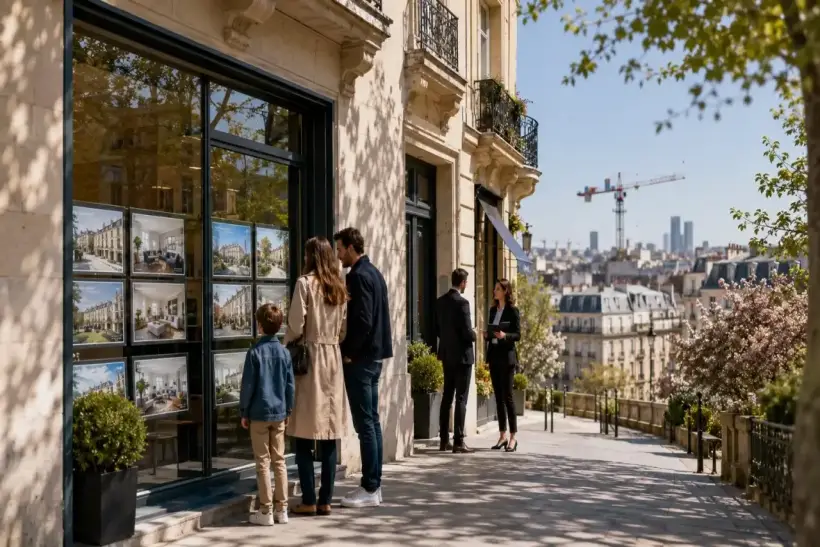
France’s real estate market in spring 2026 has moved from a sharp slowdown to cautious stabilization. Transactions are recovering, prices are rising moderately again, mortgages remain much more expensive than before the 2022–2024 shock, and buyers are paying closer attention to budgets, energy performance and local liquidity. Optimhome’s April review describes a fragmented market: large cities continue to command high prices, mid-sized cities and rural areas offer more room for negotiation, and the recovery depends mainly on credit access and the quality of each property.
Mortgage rates have stabilized, but credit is no longer cheap
The central factor for French housing in April 2026 is the stabilization of mortgage rates after the surge of 2023–2024. According to Optimhome, the average 20-year mortgage rate is around 3.20% to 3.25%, excluding insurance, bank fees and guarantees. Ten-year loans are quoted around 2.80% to 3.10%, 15-year loans around 2.95% to 3.15%, and 25-year loans around 3.30% to 3.45%. This is no longer the shock market of 2023, but neither is it the near-free-money environment that supported record demand in 2020–2021.
The European Central Bank, the euro area’s monetary authority, left its three key rates unchanged at its March 2026 meeting and said future decisions would depend on the inflation outlook, incoming economic data and the strength of monetary-policy transmission. That matters for housing because French lenders price mortgages not only from central-bank rates but also from long-term funding costs, including the yield on 10-year French government bonds.
For households, this creates a limited but real relief. A couple with net monthly income of €4,500 and a maximum debt-service ratio of 35% can devote about €1,575 a month to loan repayment. At a 3.20% rate over 25 years, that translates into borrowing capacity of about €290,000, excluding down payment and insurance. At 2.70%, the same household could have borrowed close to €310,000. The €20,000 gap explains why even small rate changes now reshape demand.
Transactions are recovering after the 2024 slump
France’s housing market is gradually emerging from a steep decline in activity. Optimhome, citing notarial data, says existing-home transactions reached about 945,000 over 12 months at the end of 2025, up 12% year on year. That marks a clear recovery from 2024, when sales fell below 800,000. Still, the market remains well below the 2021 peak of about 1.2 million transactions.
The national picture in April 2026 is normalization, not a new boom. Optimhome estimates that total transactions reached about 250,000 in the first quarter of 2026, compared with roughly 228,000 a year earlier. Existing homes rose from 210,000 to 230,000 transactions, while new homes increased from 18,000 to 20,000. The rebound is supported by clearer lending conditions, expanded support schemes and the return of buyers who postponed purchases during the price correction.
French notaries continue to publish quarterly indices and price maps for existing homes, while the official notarial and cadastral transaction database remains a key reference for local market valuation. The public “Demande de valeurs foncières” service provides access to real estate transactions over the past five years, which is especially useful in a market where national averages increasingly fail to describe the price of a specific address.
Prices are rising again, but France is an address-by-address market
The average property price in France in April 2026 is about €3,140 per square meter, according to Optimhome. Apartments average around €3,920 per square meter, while houses average about €2,540. National price growth is estimated at around 1.7% year on year, but the figure masks sharp geographic differences, from expensive capital and coastal markets to rural municipalities where buyers have more negotiating power.
Paris remains in a category of its own. The April review puts the average price of older apartments in the capital at about €9,720 per square meter, up 1.9% year on year. This is not a return to the boom years but rather a sign that the correction that began after mortgage rates rose has largely ended. For buyers, Paris remains a high-entry-price market; for sellers, liquidity increasingly depends on district, building condition and the home’s energy rating.
In Lyon, apartments average around €4,510 per square meter and houses around €6,010. Bordeaux is showing moderate growth of about 1.2%, Nantes has stabilized after several years of strong gains, Nice remains high at around €4,800 per square meter because of residential and tourism demand, and Rennes is up about 2.1% over 12 months. In major cities, well-located properties still sell faster, but even there marketing times lengthen when pricing is not aligned with the local market.
Le Monde previously reported that large French cities began posting price increases again in 2025 after the declines of 2023–2024, with recoveries visible in Marseille, Toulouse, Lille, Bordeaux and Rennes, while Lyon and Nantes remained weaker despite signs of stabilization. That confirms the main 2026 shift: buyers are back, but growth is no longer uniform.
Mid-sized cities benefit from affordability and yield
Mid-sized cities are becoming one of the main areas of interest in 2026. Angers, Clermont-Ferrand, Tours and Nîmes are attracting buyers with lower entry prices, established urban infrastructure and potential rental returns. Prices in these cities often range from €1,500 to €3,500 per square meter, well below Paris, Lyon, Nice or Bordeaux.
Rural areas and small municipalities show an even wider spread. The average rural price is estimated at about €1,500 per square meter, with some regions offering properties from around €1,200. Demand is supported by remote work, the search for larger homes with gardens and the desire to reduce living costs. But this segment requires closer due diligence: transport access, schools, healthcare, utilities and energy performance can matter more than the headline price.
For investors, mid-sized cities are attractive not only because of purchase prices but also because of rent-to-price ratios. Optimhome estimates the average rental yield in France at around 5.2% in 2026, compared with 4.6% in 2022. Yet after the rate increase, net yield depends more heavily on financing costs, taxation, renovation and vacancy periods.
Buyers have returned, but banks remain selective
The key buyer in 2026 is not a speculator but a household purchasing a primary residence. The market has become more user-driven: deals are increasingly made for long-term occupation rather than quick capital gains. That makes the recovery more stable but also slower, because demand depends on income, employment, down payments and the ability to pass bank underwriting.
Banks continue to demand strong borrower profiles. A down payment of 10% to 20%, stable employment, controlled debt levels and clean banking behavior remain important. High-quality borrowers can still obtain better-than-average rates, while weaker applications face surcharges or rejection.
For first-time buyers, the zero-interest loan, known in France as prêt à taux zéro, remains a major support instrument. Since its expansion in April 2025, it can finance up to 50% of the transaction cost for lower-income households, subject to income, zoning and eligibility rules.
Energy performance has become a pricing factor
France’s housing market in 2026 is increasingly shaped by energy diagnostics. The diagnostic de performance énergétique, or energy performance diagnosis, affects negotiations, rental eligibility and the expected cost of future renovation. Since January 1, 2026, the calculation method has changed: the electricity conversion coefficient has fallen from 2.3 to 1.9, improving the rating of many electrically heated homes.
Since April 1, 2025, mandatory energy audits have applied in certain cases to sales of properties rated E, F or G. For buyers, the audit provides an estimate of required work and cost; for sellers, it becomes a negotiation factor. Homes rated F and G, often called “energy sieves” in France, are gradually facing rental restrictions, changing investor calculations.
Requirements for apartment buildings are also tightening. In 2026, collective energy performance diagnosis became mandatory for co-owned buildings with fewer than 50 lots. This is especially important for older housing stock, where renovation costs may be shared among owners and affect apartment values before a transaction is even signed.
A national crash is not the base case
A nationwide French housing crash in 2026 is not supported by the current data. The market lacks the usual signs of a classic speculative bubble: demand is rooted in real housing needs rather than only price expectations; banks remain selective; and sellers are adjusting more through negotiations and longer marketing periods than through broad headline price cuts.
The base case for the coming months is moderate stabilization, with national price growth around 1% to 2% for the year. Stronger recoveries are possible in cities with resilient employment, transport access and tight supply. Local corrections of 3% to 5% remain possible in weaker areas if French bond yields stay elevated and banks tighten lending again.
The main indicators to watch are 10-year French government bond yields, European Central Bank decisions, new mortgage production, transaction volumes, building permits and household confidence. For buyers and investors, this means the national average is no longer a sufficient guide. In 2026, France has become a market of neighborhoods, energy ratings and financing quality.
As International Investment experts report, France’s real estate market in spring 2026 is not a recovery-at-any-price market but a selection market. Buyers have more time and stronger negotiating arguments; sellers can still close deals if valuations are realistic; and investors must calculate not only the purchase price but also credit, tax treatment, renovation and future energy-performance restrictions. The main risk for 2026 is not a national collapse, but that weak locations and energy-inefficient properties continue to lose value even while average indicators stabilize.
FAQ in English
What is happening to the French real estate market in 2026?
The market is gradually recovering after the 2023–2024 slowdown. Transaction volumes are rising, average prices are moderately increasing, but performance varies sharply by city, neighborhood, property type and access to credit.
How much does property cost in France in April 2026?
The national average is about €3,140 per square meter. Apartments average around €3,920 per square meter and houses around €2,540. In Paris, older apartments average about €9,720 per square meter.
What are mortgage rates in France in April 2026?
The average 20-year mortgage rate is around 3.20% to 3.25%, excluding insurance and related costs. The 25-year range is about 3.30% to 3.45%. Strong borrowers may obtain better terms.
Will French house prices crash in 2026?
A nationwide crash is not the base case. Moderate stabilization is more likely, with sharp local differences. Strong markets may hold prices, while weaker locations and energy-inefficient properties may face further discounts.
Where is it better to buy property in France in 2026?
Balanced opportunities are often found in mid-sized cities where entry prices are lower and rental yields may be higher. Angers, Clermont-Ferrand, Tours and Nîmes are frequently cited, but the final decision depends on neighborhood, rental demand and property condition.