







 Australia’s Spring Auctions Rise but Remain Well Below 2025
 Number of Foreigners Holding Turkish Residence Permits Exceeds 1.27 Million
 Demand from Russian Tourists for Holidays in Georgia Rises by 20–25%
 Montenegro Property Buying Costs in 2026
 Four in Ten Companies Would Not Choose Slovakia
 Gulf Countries Prepare Unified Tourist Visa
China’s return to luxury: stock market rally revives demand for premium brands
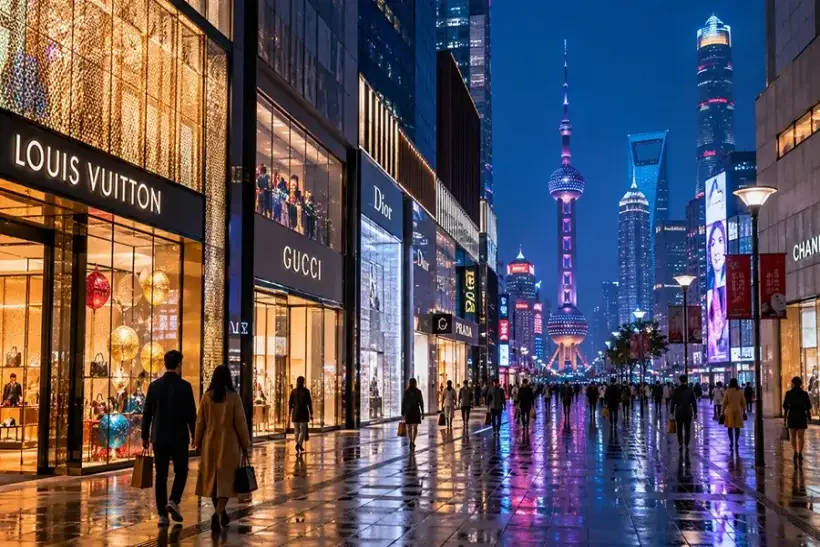
After several years of weak demand, Chinese consumers have started buying luxury goods more actively again, Bloomberg reports. Improved sales are being recorded by fashion, accessories, and cosmetics companies. Analysts point to the rise in China’s stock market as one of the key drivers, as it boosts the wealth of affluent households and improves consumer sentiment.
Luxury brand sales show positive momentum
Results from L’Oréal, LVMH Moët Hennessy Louis Vuitton, and Ralph Lauren, along with industry data, indicate a renewed appetite for high-end goods in China. For the global luxury industry, this is especially significant, as China has long been one of the main growth engines.
In the first quarter, in-store sales of Louis Vuitton and Burberry in mainland China returned to growth, according to BigOne Lab. Gucci stores reduced the pace of their sales decline, while Coach accelerated its growth.
A similar positive trend is visible in cosmetics. On Tmall and Taobao, combined sales of ten major brands with an average product price above 200 yuan ($29) rose by 39% in the first four months of 2026. More affordable brands showed a slight decline over the same period.
Senior partner at McKinsey & Co. in Shenzhen, Daniel Zipser, noted that for the first time in several years there are encouraging signals in Chinese consumption, pointing to movement in the right direction.
China’s stock market rally
For many years, consumer sentiment in China was closely tied to the real estate market, which accounted for the bulk of household wealth. However, a prolonged downturn in the sector has significantly changed savings patterns.
According to McKinsey estimates based on official statistics, the share of Chinese household savings allocated to real estate has fallen from more than 90% in 2016 to about one-third in 2025. More funds are now being directed into equities and other financial assets.
In this context, the performance of the ChiNext index—often referred to as China’s Nasdaq equivalent—has become particularly important. In May, the index surpassed its peak from the 2015 market boom. Since the start of 2026, it has gained 26%.
Chief investment officer at Shanghai Chengzhou Investment Management, Fu Zhifeng, said luxury spending is closely linked to income expectations among wealthy families. “Strong stock market performance can create a wealth effect that supports further improvement in data,” he noted.
Discounts on premium goods in China are fading
The recovery in demand is allowing luxury and cosmetics companies to gradually scale back heavy discounting, which had been used to stimulate sales in recent years but hurt profitability.
Executives at Estée Lauder said during their February earnings call that discount levels in China are declining. The company continues to support sales through a more personalized approach to customers. Data from Hangzhou Zhiyi Tech shows that in April, the share of higher-priced products sold by several premium cosmetics and fashion brands was higher than two to three years ago, despite reduced promotional activity.
Jessica Gleason, CEO of consulting firm BrighterBeauty, said the market has moved beyond the era of mass discounting. Premium brands are shifting away from margin-eroding discounts and focusing on exclusive offers for high-value product sets as well as offline client events.
Early signs of recovery
Early recovery signals are gaining importance amid weaker conditions in other regions. In particular, conflict in the Middle East is putting pressure on regional demand and worsening global economic prospects.
One of the clearest examples is Ralph Lauren. The company’s sales in China grew by more than 50% in the last quarter, driven by strong Lunar New Year demand and an influx of new customers. LVMH also reported stronger-than-expected regional results for the quarter ending in March, supported by Chinese holiday spending.
L’Oréal posted mid-to-high single-digit growth in China in the first quarter compared with the same period last year, marking an acceleration from the second half of 2025. CEO Nicolas Hieronimus said improving consumer sentiment and a stronger stock market are helping revive demand.
China’s economy: April slowdown
In April, China’s economy slowed across nearly all key indicators. Fixed-asset investment fell by 1.6% in the first four months of 2026 compared with the same period in 2024. Industrial production grew by only 4.1%, the weakest pace in nearly three years. Retail sales rose just 0.2%, the worst performance since late 2022. Economists note that exports are no longer able to offset weakening domestic demand.
China’s exports remain resilient due to strong demand for tech products, semiconductors, electronics, and green energy goods. However, consumers continue to cut spending. In April, car sales dropped by 15%, while demand for furniture, home appliances, jewelry, and other durable goods declined sharply. Households are also actively repaying debt, reflecting continued caution.
GDP growth in the second quarter is projected to slow to 4.1–4.7%, down from 5% at the start of the year.
Conclusion
Analysts at International Investment note that improvements in the luxury segment do not yet signal a full recovery in China’s consumer economy. The April slowdown has intensified doubts about the effectiveness of existing measures to support domestic demand. Weak retail growth, declining investment, and cautious household behavior point to ongoing structural challenges, suggesting that additional stimulus may be needed.
Rising equity markets and gradual stabilization in the real estate sector are creating a wealth effect that supports sentiment among affluent consumers and boosts demand for premium goods. However, both markets remain volatile, and the recovery is uneven.
Early signs of recovery in luxury consumption can be seen as a positive signal, but it is still too early to say that China has fully emerged from its economic difficulties. A sustained recovery in consumer demand will require time, as well as further steps to support the economy and household incomes.