







 Development Is Rewriting Southeast Asia’s Historic Districts
 How Ukraine’s New-Build Housing Market Has Changed Over Four Years
 European Prime Rents Rise as Property Yields Turn Higher
 The Most Expensive Airlines in Europe in 2026
 Housing Prices in Italy Reach a Two-Year High
 Travellers Increasingly Choose Cooler Scandinavia
Budapest Narrows Airbnb Market
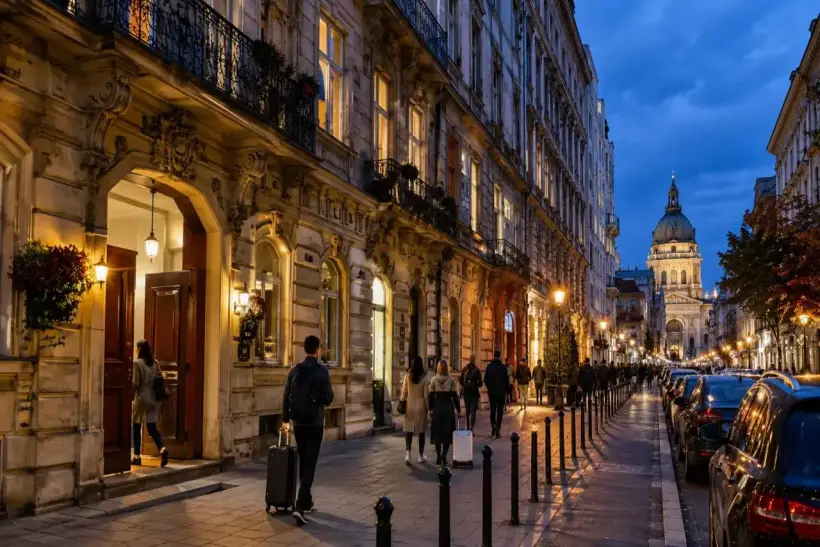
Budapest is tightening its short-term rental regime as District VIII, Józsefváros, prepares new limits after District VI, Terézváros, imposed a full ban from January 2026. The emerging model is not a citywide prohibition, but a layered system of district, neighbourhood and building-level caps designed to reduce pressure on long-term housing.
Józsefváros moves toward short-term rental caps
Budapest’s District VIII, Józsefváros, has opened a public consultation on new rules for short-term apartment rentals, commonly referred to as Airbnb after the largest platform in the sector. The local authority defines the activity as renting out a flat or room for a few days or weeks to tourists or temporary visitors; the category also includes listings on Booking.com, Szallas.hu and other online platforms. Residents can submit comments until May 31, 2026, with public forums scheduled for May 20 and May 26.
According to the Józsefváros municipality, the district had 1,760 registered short-term accommodation units in March 2026. Of those, 53 were hotels, guesthouses or hostels, while 1,707 were private and other apartment-style accommodation units. Short-term rentals accounted for about 3.5% of the district’s 48,444 homes, with the highest concentrations in the Palace Quarter and Corvin Quarter.
A 4% ceiling creates a new regulatory model
Józsefváros is not proposing to replicate the full ban adopted in Terézváros. Instead, it is drafting a three-tier system with limits at district, neighbourhood and condominium level. The proposed district-wide cap is 4% of the housing stock, while neighbourhood limits would range from 1% to 6% and building-level limits from 10% to 20%, depending on the area.
The aim is to prevent individual streets and buildings from becoming tourist accommodation clusters while preserving some room for legal short-term rentals. The proposal would also require condominium approval for new short-term rental units. Operators would have to display a notice at the entrance of the property, including contact information and official details.
Daily News Hungary reported that existing, properly authorised rentals in inner neighbourhoods such as the Palace Quarter and Corvin Quarter would not be shut down retroactively, though no new units would be allowed once local caps are reached. The outlet also noted that District V already has a rule limiting Airbnb-style rentals to no more than 20% of apartments in any residential building.
Terézváros set the precedent for Budapest’s centre
The toughest measure so far came from District VI, Terézváros, where the operation of private and other apartment-style accommodation has been prohibited since January 1, 2026. Municipal regulation 26/2024 entered into force after a local vote in 2024 and subsequent legal review. Terézváros states that from the start of 2026 such private and other accommodation operations are banned within the district.
The Terézváros municipality later described the ban’s entry into force as the start of a new era for the district, saying the legal possibility of operating Airbnb-style rentals had ended after the court confirmed the legality of the local regulation. The decision became a signal for other central districts because it marked the first case in Budapest where short-term rentals were not merely restricted but removed from the residential housing stock of a major tourist area.
That precedent increased political pressure on neighbouring districts. Józsefváros has chosen a more cautious approach: quotas and condominium consent rather than a blanket ban. The model reduces the risk of an immediate clash with owners, but it still changes the investment economics of tourist apartments.
Moratorium and higher tax weaken returns
District-level restrictions now coincide with citywide measures. Since January 1, 2025, Budapest has been under a two-year moratorium on new short-term rental registrations, running until December 31, 2026. The tax burden has also risen sharply: the annual flat tax per room increased from HUF 38,400 to HUF 150,000.
These measures change the calculation for owners. Short-term rentals were previously often viewed as a higher-yielding alternative to long-term leases. Investors now face several barriers at once: no new registrations until the end of 2026, higher taxes, district-level caps and, in some areas, a requirement to secure condominium approval.
Hungary’s Ministry of National Economy estimated that about 140,000 Budapest households, or almost 18% of the total, live in long-term rental housing. The city also had almost 26,000 rooms offered as short-term rentals. These figures explain why policymakers link tourist accommodation with rental affordability, even though the direct effect of restrictions on prices remains contested.
Rental prices may not fall quickly
The main policy risk is that Airbnb restrictions do not automatically translate into lower rents. Daily News Hungary noted that rents in the capital have continued to rise even as many former short-term rentals entered the long-term rental market.
That makes the situation more complicated for Budapest. On one hand, the authorities gain a tool to limit the concentration of tourist apartments in the historic centre. On the other, strong housing demand, limited new supply, owners’ rising costs and investment-driven purchases may keep long-term rents elevated even if the number of tourist apartments declines.
The impact on tourism will also be uneven. Terézváros includes Andrássy Avenue, the Hungarian State Opera and part of the city’s cultural core, making it one of the areas where apartment-style visitor accommodation is likely to shrink most sharply. Travellers will be redirected toward hotels, hostels, serviced apartments and neighbouring districts where short-term rentals remain possible under existing rules.
What investors should watch next
For residential property investors in Budapest, the new regulatory wave means lower visibility on returns. Buying an apartment for tourist rental in central districts has become less predictable: even if a unit is already registered, local caps, condominium rules, taxes and future political decisions can alter its economics.
Strategies based on acquiring multiple apartments in the same building or in high-pressure tourist neighbourhoods are particularly exposed. Local governments are increasingly focused not only on citywide figures but also on concentration at building level. That means the yield of a specific apartment will depend not only on location and visitor demand, but also on owner meetings, existing short-term rental density and the stance of the condominium.
As reported by experts at International Investment, Budapest is moving from a liberal short-term rental model to fragmented district-level regulation, where investors can no longer rely solely on strong tourist demand. The critical issue is that Airbnb restrictions are politically visible but do not replace a systemic housing policy: without more long-term rental supply and a larger municipal housing stock, the city may end up with fewer tourist apartments but not necessarily more affordable homes for residents.
What is changing for Airbnb in Budapest?
Budapest already has a moratorium on new short-term rental registrations until December 31, 2026, while individual districts are adding their own restrictions. Terézváros banned apartment-style short-term rentals from January 1, 2026, and Józsefváros is discussing a system of caps.
What is Józsefváros proposing?
Józsefváros proposes a 4% district-wide cap on short-term rentals, with additional limits by neighbourhood and residential building. New units may also require approval from the condominium.
Will Airbnb be banned across Budapest?
There is currently no citywide full ban. Budapest is using a mix of tools, including a registration moratorium, higher taxes, district-level caps and local prohibitions.
Why is Budapest restricting short-term rentals?
The main reason is pressure on long-term housing and complaints from residents in central districts. Authorities argue that high concentrations of tourist apartments reduce housing availability and change the character of residential buildings.
Will rents become cheaper?
That is not guaranteed. Restrictions may return some apartments to the long-term rental market, but rents also depend on income levels, new construction, inflation, mortgage conditions and investment demand.
What does this mean for property buyers in Budapest?
Investors need to examine district rules, the registration status of the property, condominium decisions and tax costs. Buying an apartment for tourist rental in central Budapest has become more regulated and riskier.