







 Vietnam Mortgage Surge Pushes Homes Out of Reach
 Lithuanian Apartment Prices Accelerate Across Major Cities
 London Flats Lose Value Ahead of Leasehold Reform
 Construction of the Batumi–Sarpi Highway Begins in Georgia
 Baltic Property Investment Accelerates in 2026
 Hong Kong and Singapore Renew Their Expat Rivalry
Foreign Direct Investment in Georgia Rises 19.3%

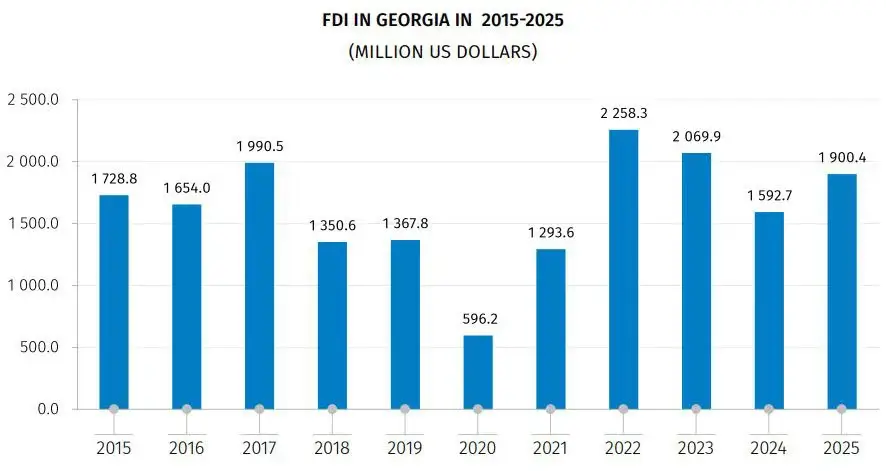
Foreign direct investment in Georgia reached $1.9 billion in 2025, up 19.3% from 2024. Following revisions, the total was 12.5% higher than the preliminary estimate, according to adjusted data from the National Statistics Office of Georgia (Geostat).
FDI Trends in Georgia
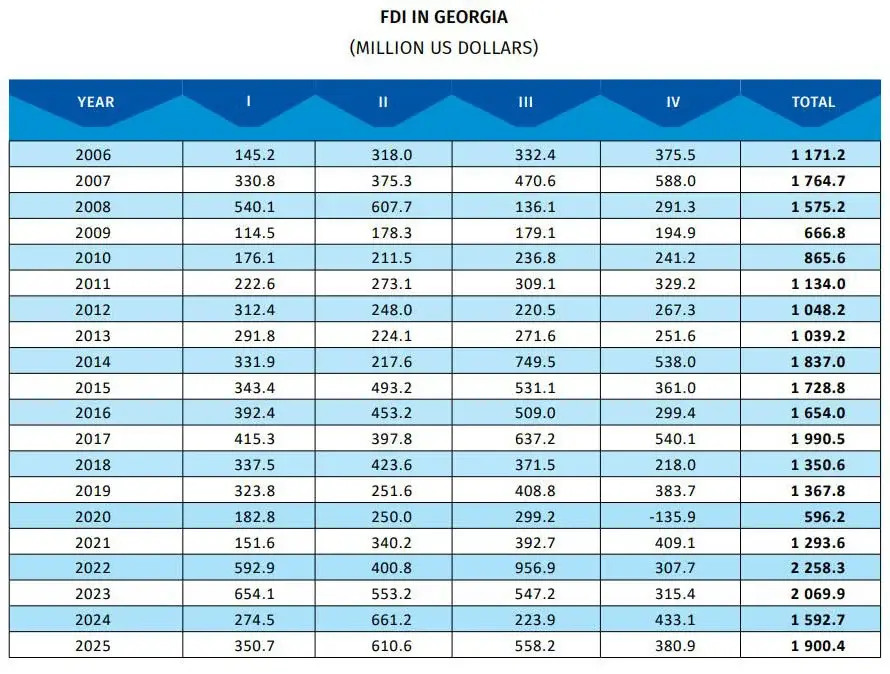
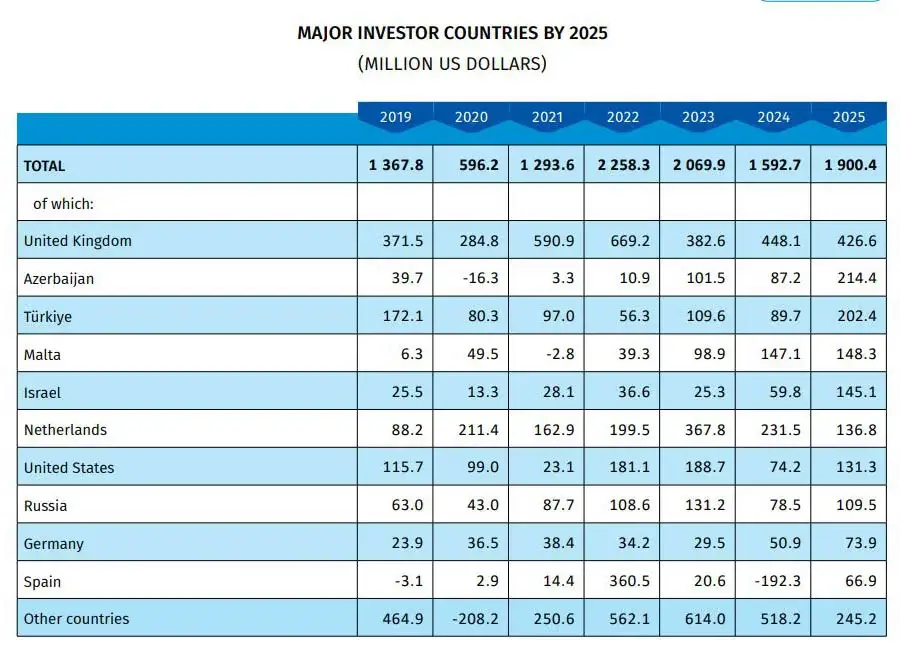
Geostat revised its statistics for 2021–2024. The most significant adjustment concerned 2023, with the estimate raised by $141.4 million. Changes for the other periods were considerably smaller. According to the updated figures, FDI peaked at $2.258 billion in 2022 before declining to $2.07 billion in 2023 and $1.593 billion in 2024.
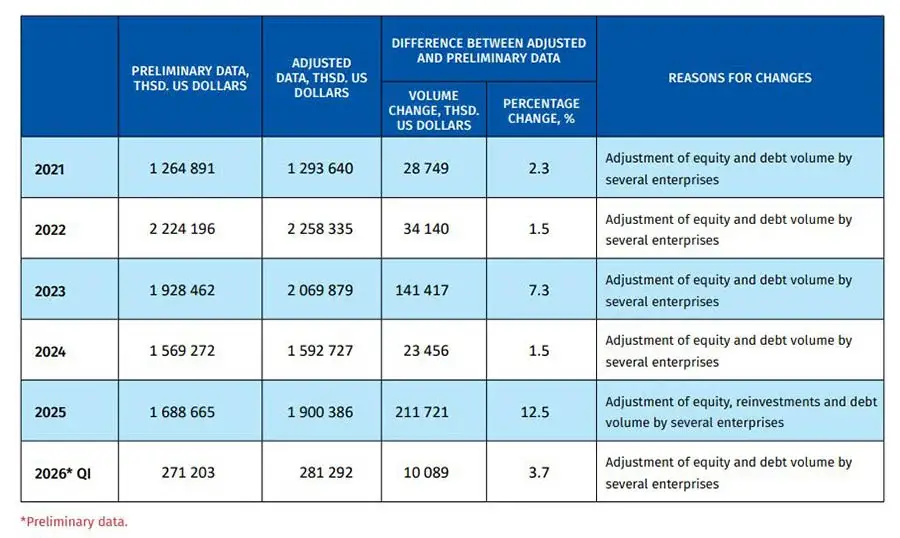
In 2025, FDI increased by 19.3% to $1.9 billion. The preliminary estimate stood at $1.689 billion, but Geostat raised it by $211.7 million, or 12.5%, after receiving updated information from businesses. The revisions affected equity, reinvested earnings, and debt instruments.
Georgia attracted $350.7 million in the first quarter of 2025. Inflows reached an annual high of $610.6 million in the second quarter before declining to $558.2 million in the third and $380.9 million in the fourth. The preliminary estimate for the first quarter of 2026 was also revised upward by 3.7% to $281.3 million.
Reinvested Earnings Dominate Georgia’s FDI Structure
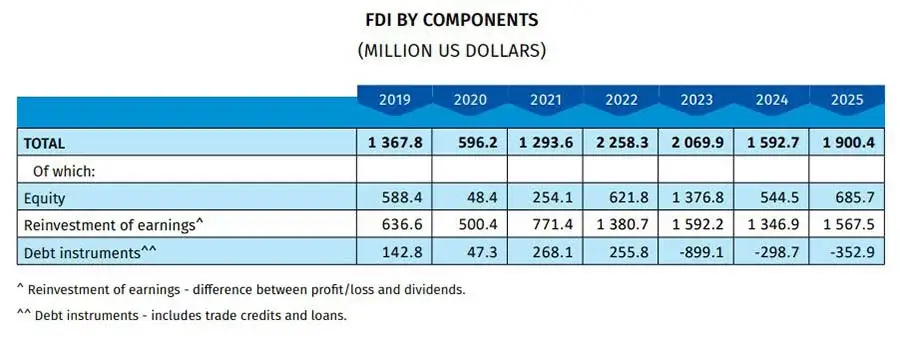
Reinvested earnings reached $1.568 billion in 2025, up from $1.347 billion a year earlier. They accounted for 82.5% of total FDI. The share edged down from 84.6% in 2024 but remained above the 76.9% recorded in 2023. Geostat defines this component as the difference between companies’ profit or loss and dividends paid.
Equity investment increased from $544.5 million to $685.7 million. The balance on debt instruments, including trade credits and loans, remained negative at $352.9 million, compared with a negative $298.7 million in 2024.
Which Countries Invest in Georgia
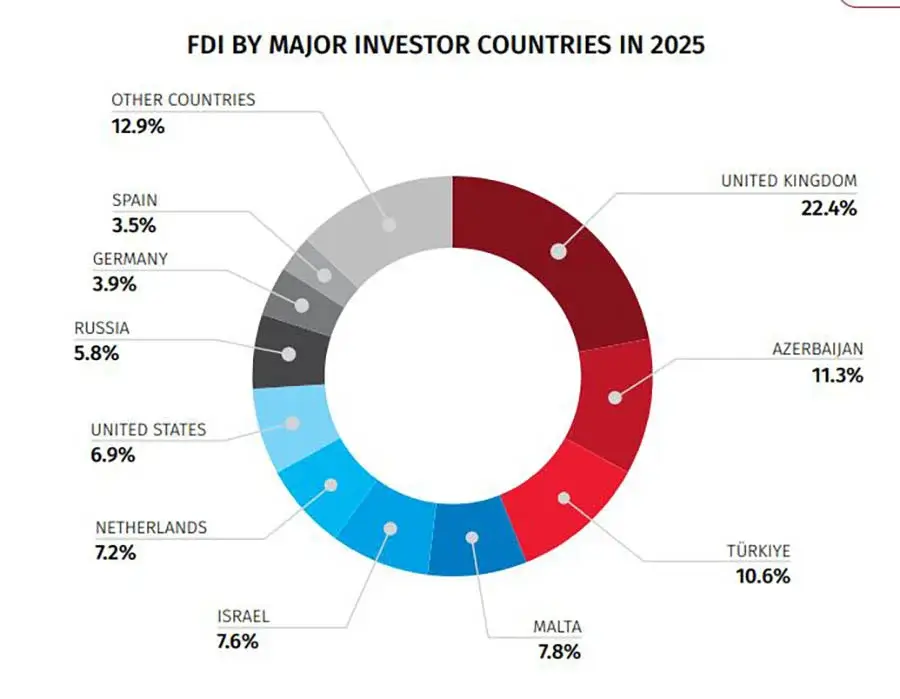
The United Kingdom remained the largest investor, accounting for $426.6 million, or 22.4% of total FDI in Georgia. However, inflows from the country declined from $448.1 million in 2024. Azerbaijan ranked second with $214.4 million. The amount more than doubled over the year, while the country’s share reached 11.3%. Türkiye placed third with $202.4 million, up 125.6%, and accounted for 10.6% of total FDI.
Maltese investors contributed $148.3 million, up 0.8%. Israeli investment more than doubled, rising 142.6% to $145.1 million. The Netherlands accounted for $136.8 million, down 40.9%, while the United States provided $131.3 million, up 77%.
Russian investment reached $109.5 million, 39.5% more than a year earlier. Germany invested $73.9 million, an increase of 45.2%. Spain returned to positive territory with $66.9 million, compared with a negative balance of $192.3 million a year earlier. Other countries accounted for $245.2 million, or 12.9% of total FDI.
Where Foreign Investors Are Investing in Georgia
Financial and insurance activities attracted the largest amount of capital at $633.2 million, or 33.3% of total FDI. The sector received $533.5 million a year earlier.
Real estate activities ranked second with $254.7 million and a 13.4% share, up from $191.5 million in 2024. Trade placed third, with investment increasing from $163.5 million to $191.1 million and accounting for 10.1% of the total. Together, the three leading sectors attracted 56.8% of FDI.
Manufacturing received $169.7 million, compared with $191.1 million a year earlier. Investment in transport increased from $119 million to $168.4 million, while information and communication rose from $70.1 million to $120.3 million. Energy attracted $97.8 million, up from $78 million.
Water supply and sewerage received $71.8 million, compared with $0.4 million in 2024. Professional, scientific, and technical activities attracted $47.2 million, while arts, entertainment, and recreation received $42.9 million. Other sectors accounted for $103.2 million.
Investment Outlook for Georgia
International Investment analysts note that Georgia remains highly attractive to foreign businesses. Reinvested earnings indicate that companies already operating in the country are interested in maintaining their presence and expanding their projects. This strengthens confidence in the market and sends a positive signal to new participants.
Finance and real estate remain the main draws for foreign capital. Interest in Georgian properties supports development activity, while the widening geographic base of investment reduces dependence on investors from any single country. At the same time, returns in the residential property market are declining, making hospitality a more resilient segment, particularly premium hotels. Professionally managed income-producing properties are emerging as one of the most promising niches for investors.