







 Vietnam Mortgage Surge Pushes Homes Out of Reach
 Lithuanian Apartment Prices Accelerate Across Major Cities
 London Flats Lose Value Ahead of Leasehold Reform
 Construction of the Batumi–Sarpi Highway Begins in Georgia
 Baltic Property Investment Accelerates in 2026
 Hong Kong and Singapore Renew Their Expat Rivalry
Iran War Shakes Emerging Markets and Investor Confidence

Escalating military tensions around Iran have triggered a sharp selloff across global emerging markets, raising concerns about the stability of economies that had recently attracted strong investor inflows. The conflict has rapidly shifted sentiment in financial markets as rising oil prices and a strengthening US dollar threaten the outlook for many fast-growing developing economies.
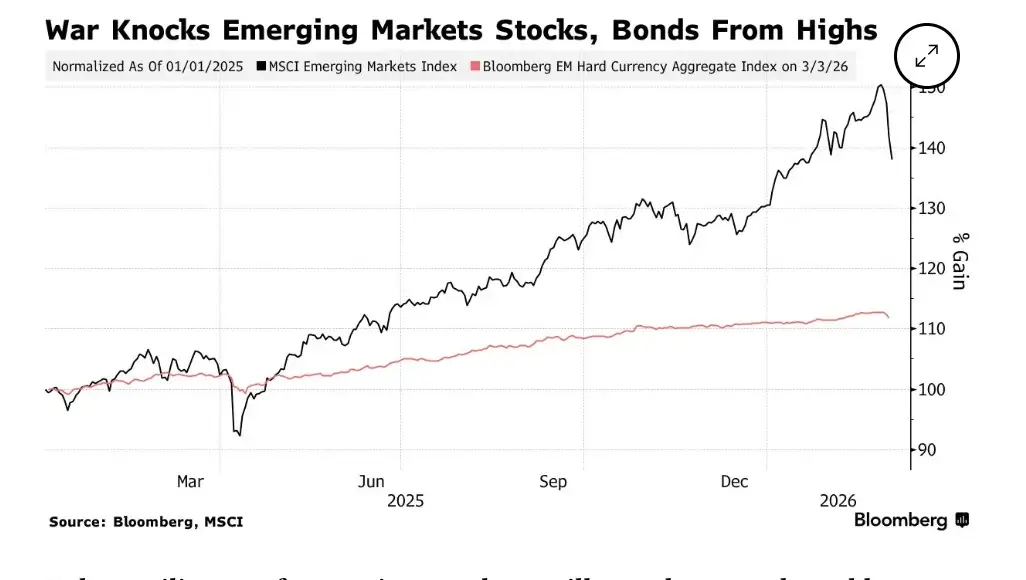
Only days earlier, stocks and bonds across emerging markets were trading near record highs, supported by expectations of slowing inflation and potential monetary easing. However, the geopolitical shock has prompted investors to reassess risk exposure and move capital toward safer assets.
Oil price surge raises risks for energy-importing economies
One of the most immediate consequences of the conflict has been a surge in global oil prices amid fears of supply disruptions in the Strait of Hormuz. Crude oil prices climbed to around $76 per barrel, creating serious challenges for economies heavily dependent on energy imports.
Asian markets have been particularly vulnerable. Countries such as South Korea, Thailand and India rely heavily on imported energy, and higher fuel costs could push up inflation and complicate monetary policy decisions.
South Korean equities have fallen sharply this week, dropping about 18% as investors reacted to the worsening geopolitical environment. Technology-focused markets such as Taiwan have also experienced significant declines.
Stronger US dollar tightens financial conditions
At the same time, the US dollar has strengthened significantly. Bloomberg’s dollar index rose roughly 1.5% during the week, increasing the financial burden for emerging markets with large amounts of dollar-denominated debt.
Several currencies across the developing world have come under pressure. India’s rupee fell to a record low, prompting the central bank to intervene by selling dollars to stabilize the currency.
Authorities in other countries, including Indonesia and Turkey, have also stepped into currency markets to limit volatility. In China, the central bank unexpectedly set a stronger yuan reference rate after previously signaling tolerance for currency weakness.
Capital outflows accelerate across emerging markets
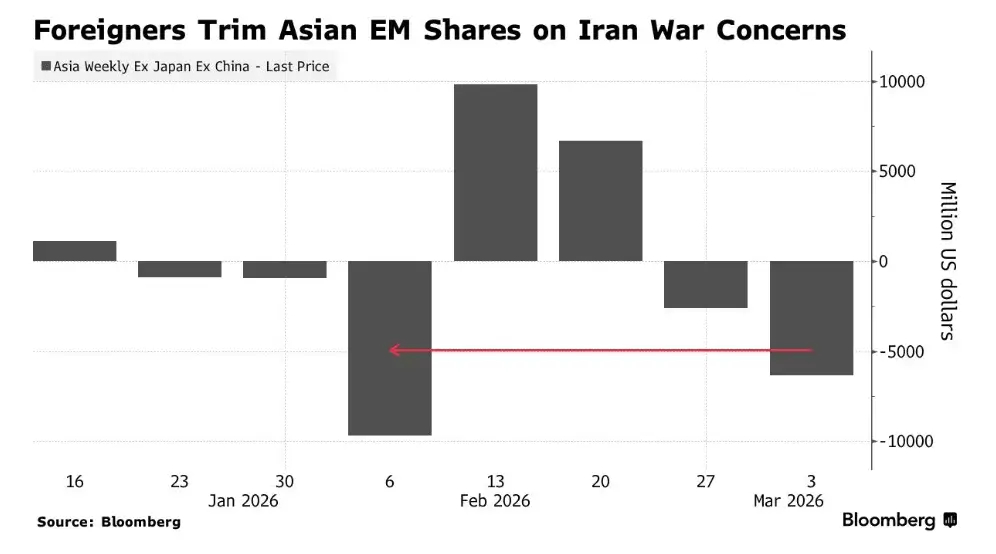
Global investors have started withdrawing capital from emerging market assets. According to Bloomberg data, about $6.3 billion was pulled from Asian emerging-market equities excluding China during the week, marking the largest weekly outflow in about a month.
The MSCI emerging markets equity benchmark dropped as much as 4.4%, approaching technical correction territory. By comparison, global and developed market equities declined by less than 1% during the same period.
Emerging market debt also faced pressure. A benchmark of dollar-denominated EM bonds recorded its largest two-day decline since April, while a currency index tracking developing economies fell about 1.7% since the start of the week.
Investors rotate toward oil exporters
In response to the changing macroeconomic environment, investment managers are adjusting portfolio strategies. One of the key trends is rotating away from oil-importing economies toward oil exporters that may benefit from higher energy prices.
Countries with significant oil exports could see short-term gains. In Latin America, for example, Colombia and Mexico may benefit from higher crude prices, although fiscal policies such as fuel subsidies could limit the positive impact.
Market strategists say investors are now trying to determine whether the current selloff represents a temporary reaction to geopolitical risk or the beginning of a more prolonged shift in global capital flows.
Geopolitical tensions raise global inflation concerns
Another concern among economists is the possibility of a renewed wave of global inflation. Higher energy costs could feed through to transportation, manufacturing and logistics, increasing price pressures worldwide.
US President Donald Trump said the United States would provide insurance guarantees and naval escorts for oil tankers passing through the Strait of Hormuz in an effort to prevent a major energy crisis caused by the conflict.
Analysts at Goldman Sachs note that geopolitical shocks typically weigh on markets in the short term but tend to fade over time. However, the current conflict comes at a moment when many emerging markets were already vulnerable after strong gains earlier in the year.
Georgia’s economy shows resilience amid global volatility
Despite global financial turbulence, some fast-growing economies continue to demonstrate resilience. Georgia is among the countries maintaining strong economic momentum.
According to official data, Georgia’s economy expanded by 7.9% year-on-year in January 2026. Growth has been driven by services, tourism, transportation, trade and continued investment activity.
The European Bank for Reconstruction and Development also recently upgraded its economic outlook for the country. The EBRD raised its forecast for Georgia’s economic growth in 2026 from 5% to 5.5%.
As International Investment experts note, despite global geopolitical tensions and financial market volatility, Georgia continues to demonstrate economic resilience. The country remains attractive for international investors due to its liberal economic policies, improving infrastructure and growing role as a regional hub connecting Europe and Asia.