







 Vietnam Mortgage Surge Pushes Homes Out of Reach
 Lithuanian Apartment Prices Accelerate Across Major Cities
 London Flats Lose Value Ahead of Leasehold Reform
 Construction of the Batumi–Sarpi Highway Begins in Georgia
 Baltic Property Investment Accelerates in 2026
 Hong Kong and Singapore Renew Their Expat Rivalry
Iran War Shakes Market Stability
Geopolitical conflict exposes limits of traditional market hedges
Escalating conflict involving Iran has delivered a major shock to global financial markets this week, revealing vulnerabilities in long-standing investment strategies designed to protect portfolios during crises.
In a highly unusual market reaction, both stocks and government bonds declined simultaneously. Traditionally, bonds act as a safe haven during market turmoil, rising when equities fall. But this time the opposite dynamic unfolded.
The surge in oil prices became the main driver of the shift. Crude climbed above $90 per barrel amid fears of supply disruptions in the Middle East, fueling inflation concerns and pushing US Treasury yields higher instead of lower.
As a result, the traditional diversification strategy built on balancing equities with bonds temporarily failed to shield investors from losses.
The combined decline marked the worst week for stocks and bonds since April last year’s tariff turmoil. The S&P 500 also posted its largest weekly drop since October.
Oil surge and labor shock raise stagflation fears
Market anxiety intensified after a surprising deterioration in the US labor market. Payroll data showed an unexpected drop of 92,000 jobs, one of the largest contractions since the pandemic era.
The combination of rising energy prices and weakening employment data amplified fears of stagflation — an economic scenario in which inflation remains high while growth slows.
Higher oil prices increase inflationary pressure while simultaneously eroding consumer purchasing power. This dynamic threatens economic expansion and complicates monetary policy decisions for central banks.
Traditional diversification strategies under pressure
The core assumption behind diversified portfolios is that stocks and bonds move in opposite directions, offsetting losses and smoothing volatility.
However, supply-driven inflation shocks can disrupt this balance. When rising commodity prices push yields higher, bonds may fall alongside equities rather than acting as a hedge.
According to Que Nguyen, chief investment officer at Research Affiliates, geopolitical conflicts rarely create clear winners in financial markets. During the current turmoil, energy assets have been among the few sectors showing relative resilience.
Some research firms are already questioning whether bonds can continue serving as reliable shock absorbers in investment portfolios. Analysts at Gavekal Research have argued that in a world of supply-driven inflation, commodities and precious metals may play a more effective stabilizing role.
Market losses spread across asset classes
The latest selloff has affected nearly every major asset class. US Treasuries recorded their steepest weekly decline since last year’s tariff-driven market stress.
Emerging-market equities posted their biggest weekly drop since 2020, while US stocks also experienced significant volatility.
Credit markets reflected growing investor caution as well. The spread between investment-grade corporate bonds and US Treasuries widened to its highest level in three months.
At the same time, the Cboe Volatility Index, commonly known as the VIX or Wall Street’s fear gauge, surged toward the 30 level, marking one of the strongest spikes in market volatility over the past year.
Even traditional safe havens struggled
Unexpectedly, several assets typically viewed as safe havens also performed poorly during the week.
Gold, shares of consumer-staples companies and several defensive investment strategies ranked among the weakest performers.
Risk-management funds built around risk-parity models were also hit. The RPAR Risk Parity ETF fell roughly 4%, marking its worst performance in more than three years.
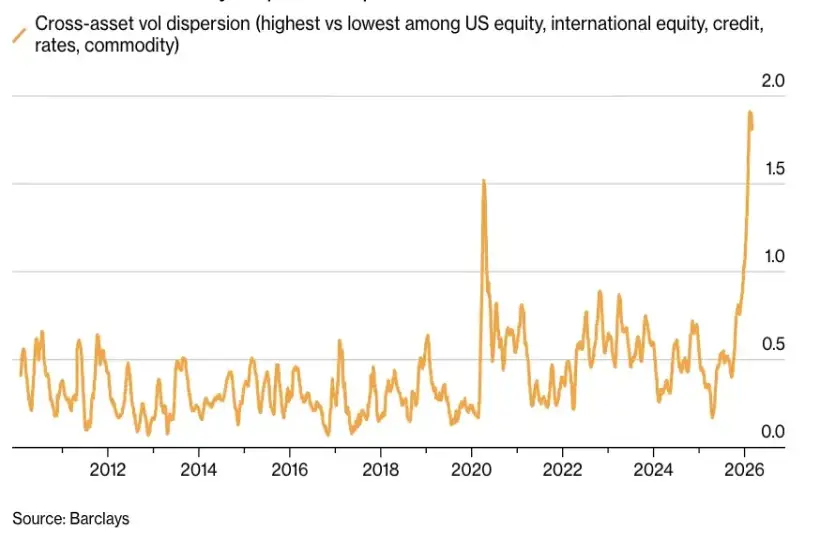
Barclays strategists note that the gap in volatility across asset classes has reached its widest level since at least 2010, highlighting the unusual nature of current market conditions.
Investors reconsider defensive strategies
Despite the turbulence, US equities have shown relative resilience. The S&P 500 remains within roughly 3% of the all-time high reached earlier this year.
However, if oil prices remain above $90 and disruptions around the Strait of Hormuz persist, inflation pressures could intensify and undermine expectations of interest-rate cuts.
In response, some investors are increasing cash positions, reducing exposure to cyclical sectors and emerging markets, and shifting allocations toward real assets such as commodities and energy companies.
As experts at International Investment note, the latest market turmoil illustrates that traditional correlations between asset classes can break down during geopolitical shocks. In an environment shaped by supply disruptions and inflation risks, investors may increasingly need to rethink diversification strategies and explore new approaches to protecting capital.
Investors look toward stable markets such as Georgia
Amid growing geopolitical tensions and market volatility, investors are increasingly exploring alternative destinations for capital allocation. In recent years, Georgia has emerged as one of the jurisdictions attracting attention due to its strong safety indicators, stable economic growth and investor-friendly environment.
According to international rankings, the country consistently performs well in measures of public safety and ease of doing business. Georgia is regularly ranked among the safest countries in Europe and Eurasia based on crime statistics and global safety indexes.
At the same time, the government has pursued a liberal economic policy aimed at attracting foreign investment and improving the business climate. This strategy has contributed to steady economic growth in recent years.
International financial institutions have repeatedly noted that Georgia remains one of the fastest-growing economies in the wider region. Economic expansion has been supported by infrastructure development, tourism growth, digital services and an expanding real estate market.
The combination of public safety, economic stability and openness to international capital increasingly positions Georgia as an attractive option for investors seeking diversification amid global uncertainty.
As experts at International Investment note, during periods of geopolitical instability and market turbulence, capital often gravitates toward jurisdictions with predictable economic policies and strong security indicators, and Georgia has increasingly appeared on the radar of international investors in recent years.