










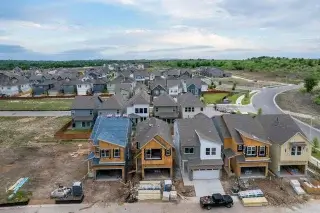
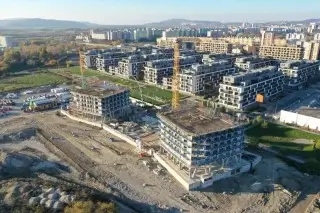

Israel’s Housing Market Shows Strain

Israel’s new-build housing market is flashing risk signals as developer credit rises sharply while sales slow, unsold apartments reach record levels and deferred-payment deals leave banks more exposed to a deeper real estate downturn.
Developer credit rises faster than home sales
The Bank of Israel said credit for residential construction projects at the country’s five largest banking groups rose by about 40% in 2025, from NIS 49 billion to NIS 69 billion. The increase came as demand for new homes declined, unsold new-home inventory reached a record high and several credit-risk indicators weakened. The central bank linked developers’ growing financing needs to slower transactions, higher construction costs and sales campaigns that in some cases allowed buyers to defer a substantial share of the apartment price.
That is a crucial shift for the market. Developers are continuing to build and draw bank credit faster than they are selling apartments. The model can survive while banks keep financing projects and buyers expect future price gains. But when sales slow, mortgage costs stay high and construction costs rise, unsold units become a financial burden rather than a reserve of future profit.
Ynet says banks are propping up builders
Ynet, citing Bank of Israel data, reported that credit to residential developers jumped 40% in 2025, while bank financing for land purchases rose only 6% and credit for income-producing real estate increased 11%. The outlet said the additional credit helped builders absorb rising costs and continue offering financing deals to buyers, including deferred-payment plans.
Those plans are often called 80/20 or 90/10 deals. They allow buyers to pay only 10% or 20% of the purchase price upfront and the rest when the apartment is delivered. For developers, the model helps show sales and keep projects moving. For buyers, it postpones the mortgage burden. For banks, it raises the risk that some customers will be unable to complete the purchase when the final payment comes due.
Record unsold inventory weighs on prices
By the end of 2025, contractors were holding about 83,400 unsold new apartments, a record level. Ynet reported that apartment purchases fell 12% in 2025 after rising 44% the previous year, while the growing stock of unsold homes pushed prices down by an average of 0.9%.
This matters most for the new-build segment. Developers must finance projects until completion, paying interest, contractors, materials, taxes, marketing and site costs. The longer an apartment remains unsold, the greater the pressure on cash flow. Large developers with equity and bank access can wait longer. Smaller builders, especially those dependent on one or two projects, are more exposed.
Home prices have already started falling
Times of Israel reported that, based on the latest Central Bureau of Statistics data, Israeli home prices fell 0.1% year over year in January-February 2026 for a second consecutive month. Average home prices declined in 10 of the previous 12 months, bringing the annual drop to 1.7%. During the two-month period, prices fell 0.7% in both Tel Aviv and Jerusalem, while over 12 months Tel Aviv was down 5.1% and the central district was down 3.1%.
The price decline changes buyer behavior. If households and investors expect further weakness, they delay purchases. Developers respond with promotions, payment deferrals and indirect discounts rather than always cutting list prices. As a result, the official sale price may remain high while the economic price of the transaction is lower.
Deferred payments become a systemic risk
The Bank of Israel began restricting aggressive new-home financing offers in 2025. Times of Israel reported that the central bank’s Banking Supervision Department moved to limit contractors’ ability to offer deferred-payment and balloon-loan arrangements through the end of 2026. The regulator said such deals had risen to about 50% of new-home purchases, up from 20% before the war that began on October 7, 2023.
The risk is that some deals may be recorded as sales without being fully supported by the buyer’s future ability to pay. If mortgage rates remain high, incomes fail to rise enough or home prices fall, a buyer may be unable to secure financing at delivery. The developer then faces a returned apartment, the bank faces a riskier project and past sales data may prove less reliable than it appeared.
Banks see risk but not panic
The Bank of Israel said construction and real estate credit accounts for a large share of the banking system’s balance sheet: about 39% of balance-sheet business credit and about 21% of total balance-sheet credit to the public for activity in Israel. In 2025, total credit to construction and real estate at the five largest banking groups continued to grow at a high rate of about 14%, while the regulator also noted higher credit risk and the need for exacting risk management.
The system does not yet look like it is on the edge of an immediate crisis. The average absorption capacity ratio in residential construction projects fell by about 12 percentage points to roughly 58%, which still indicates a meaningful safety margin. But the direction is unfavorable. The share of projects where construction progress outpaced sales rose by about 9 percentage points to around 44% by the end of 2025.
High rates keep buyers on hold
The pressure is not only about war or housing inventory. The cost of money is central. When interest rates are high, mortgages become more expensive, monthly payments rise and the safe borrowing capacity of households falls. Developers try to offset that with payment deferrals, but those offers often move the problem into the future rather than solve it.
For investors, the deal has also become less obvious. If prices are falling, rents are not rising fast enough and financing remains expensive, buying a pre-completion apartment for resale becomes riskier. Some investors may walk away from deals or try to sell their contractual rights at a discount. That adds pressure on developers already sitting on record inventory.
Central Israel is the pressure point
The weakness is especially visible in central Israel, where prices were highest and buyers were most dependent on mortgage leverage and expectations of capital gains. During booms, central locations tend to rise faster because land is scarce, demand is deep and jobs are nearby. During slowdowns, they are the first to test whether buyers will still pay peak prices under a new rate environment.
For Tel Aviv and nearby cities, the market is entering a more complicated phase. Long-term land scarcity and strong demand remain. But expensive new apartments, high monthly mortgage payments and growing inventory give buyers more negotiating power than they had during the overheated years.
The market moves from scarcity to balance-sheet risk
The main change in Israeli housing is that the market can no longer be judged only by demographics and housing shortages. Developer balance sheets, bank exposure, deferred-payment shares, sales velocity and buyers’ ability to complete transactions now matter just as much. A signed contract does not always mean durable demand.
This is not necessarily a crash scenario. Israel still has long-term support from population growth, limited land supply, urbanization and persistent demand in major cities. But the current phase shows that even a structurally undersupplied housing market can correct when prices are high, credit is expensive and developers use financial promotions to preserve the appearance of normal demand.
As reported by International Investment experts, the main danger for Israel’s housing market is not a single month of falling prices, but the accumulation of hidden risk inside new-build projects. If banks keep financing projects where construction runs ahead of sales and developers keep supporting transactions with large payment deferrals, the market may look stable for longer than it really is. The critical test will come at delivery, when it becomes clear how many buyers can close the remaining 80% or 90% of the price without new discounts, restructuring or cancellations.
FAQ: Israel’s housing market and developer risk
Why are analysts warning about a housing bubble in Israel?
The warning comes from the combination of record unsold inventory, falling sales, rising bank credit to developers and widespread deferred-payment deals. These factors can preserve the appearance of market activity even as underlying demand weakens.
What is an 80/20 or 90/10 apartment deal?
It is a deferred-payment structure where the buyer pays 20% or 10% of the apartment price at signing and the rest close to delivery. It lowers the initial cash burden but creates a risk that the buyer will not be able to secure financing later.
Why do banks keep lending to developers?
Banks have an incentive to keep projects alive because a wave of construction stoppages or developer failures could increase credit losses. Continued lending can reduce immediate stress, but it may also extend the risk.
Does this mean Israeli home prices will crash?
Not necessarily. Israel still has strong long-term housing demand, population growth and limited land supply. But the risk of further price declines has increased, especially in new-build markets with high inventory and heavy use of financing incentives.
What is the risk for buyers?
A buyer may enter a deal with a small upfront payment but later face high mortgage rates, a lower bank valuation or a market price below the contract price. That can make completion much harder than it appeared at signing.
What will be the key indicators in 2026?
The main indicators will be unsold new-home inventory, actual sales without aggressive financing incentives, mortgage-rate trends, deal cancellations and the share of projects where construction progress is ahead of sales.