







 Vietnam Mortgage Surge Pushes Homes Out of Reach
 Lithuanian Apartment Prices Accelerate Across Major Cities
 London Flats Lose Value Ahead of Leasehold Reform
 Construction of the Batumi–Sarpi Highway Begins in Georgia
 Baltic Property Investment Accelerates in 2026
 Hong Kong and Singapore Renew Their Expat Rivalry
Italy’s Demographic Decline Threatens Growth
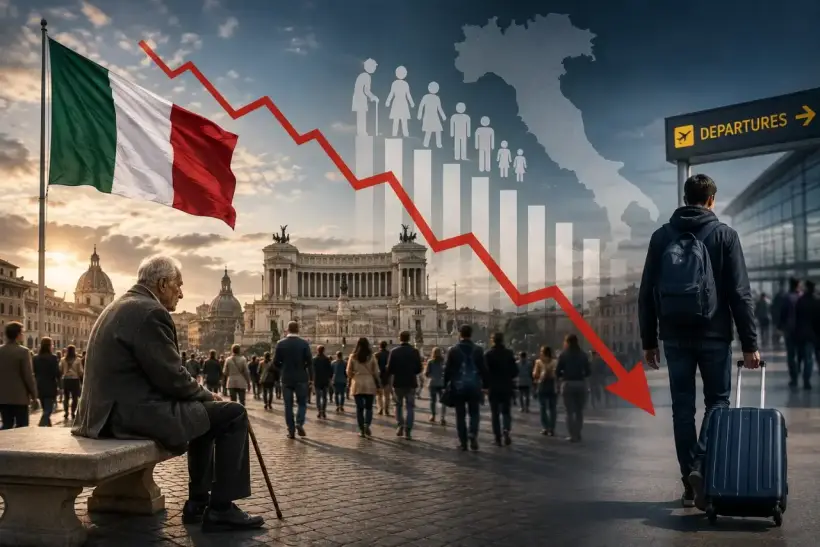
Italy’s population continues to shrink
Italy remains one of Europe’s fastest-aging countries. The International Monetary Fund estimates that the country’s working-age population could decline by nearly 30% over the next 25 years if current trends persist.
Birth rates have fallen to historic lows. Italy recorded about 370,000 births in 2024, the lowest level since national unification in the 19th century.
The fertility rate remains around 1.2 children per woman, far below the replacement level of 2.1.
Aging population pressures the economy
The demographic shift is increasing pressure on pensions, healthcare and long-term care systems while reducing the size of the workforce.
French Treasury analysis notes that Italy’s shrinking and aging population is already constraining GDP growth and raising concerns about debt sustainability.
The Bank of Italy estimates that the country’s working-age population could shrink by more than 7 million people by 2050 even with higher labor participation.
Brain drain worsens structural weakness
Italy is also struggling with a persistent outflow of young skilled workers. Analysts note that many graduates leave for Germany, France and other EU countries in search of better wages and career opportunities.
Bank of Italy Governor Fabio Panetta said young graduates in Germany earn on average about 80% more than Italian peers.
The trend weakens Italy’s innovation capacity and labor market competitiveness.
Economic growth remains weak
Italy’s economy continues to post low growth rates. ISTAT data shows GDP growth around 0.5% in 2025, with only moderate improvement expected in 2026.
Economists link the weak performance to low productivity, limited domestic demand and demographic decline.
Le Monde described Italy’s trajectory as a shift from a growth-oriented economy toward a model focused primarily on stability management.
Government seeks to support families
Prime Minister Giorgia Meloni’s government has introduced measures aimed at supporting families and women’s employment, including tax incentives and childcare-related support.
However, analysts argue that broader labor-market and housing reforms are needed to reverse demographic trends.
Immigration becomes increasingly important
European analysts increasingly view immigration as the only factor capable of partially offsetting demographic decline. Eurostat data indicates migration remains the key element slowing Europe’s population contraction.
For Italy, this creates a politically sensitive challenge as labor shortages intensify.
Demographics become a macroeconomic issue
Demographic decline is increasingly viewed as a structural economic risk rather than solely a social issue. A shrinking workforce limits growth potential, reduces productivity and complicates debt sustainability.
As experts at International Investment report, Italy’s demographic crisis is becoming a long-term structural constraint on the country’s economy. Even if short-term macroeconomic indicators improve, population decline and brain drain are likely to continue limiting growth potential and increasing pressure on public finances.
FAQ
Why is Italy’s population shrinking?
Due to low birth rates, aging demographics and youth emigration.
How does this affect the economy?
It reduces the workforce and increases pension and healthcare costs.
What is Italy’s fertility rate?
About 1.2 children per woman.
Why are young Italians leaving?
For higher salaries and better career opportunities abroad.