







 Vietnam Mortgage Surge Pushes Homes Out of Reach
 Lithuanian Apartment Prices Accelerate Across Major Cities
 London Flats Lose Value Ahead of Leasehold Reform
 Construction of the Batumi–Sarpi Highway Begins in Georgia
 Baltic Property Investment Accelerates in 2026
 Hong Kong and Singapore Renew Their Expat Rivalry
Oil Surge and Weak Yen Raise Japan Stagflation Risk

Rising oil prices and currency weakness pressure Japan’s economy
A sharp rise in global oil prices combined with a weakening Japanese yen is increasing the risk that Japan could slide into stagflation, a scenario characterized by slowing economic growth and persistent inflation.
Oil prices climbed above $100 per barrel amid escalating tensions in the Middle East and growing stress on global energy infrastructure and shipping routes. At the same time the yen weakened toward 160 per dollar, a level that previously triggered currency intervention by Japanese authorities in 2024.
Financial markets reacted sharply to the deteriorating outlook. Japan’s Nikkei 225 index dropped about 6.9% early in the trading session while long-term government bond yields increased.
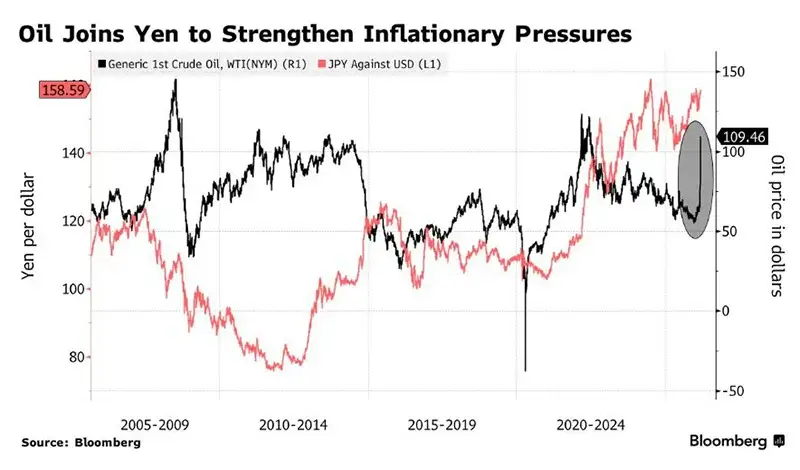
Japan’s heavy energy import dependence amplifies inflation risks
Japan’s economy is particularly vulnerable to changes in energy prices because the country imports the vast majority of its fuel needs. According to Japan’s trade ministry, around 90% of the country’s oil imports come from the Middle East, with the share reaching 95.1% in January.
Much of that oil travels through the Strait of Hormuz, one of the most critical shipping routes for global energy supplies. Rising geopolitical tensions in the region are increasing concerns about potential disruptions to energy flows.
Higher oil prices combined with a weaker yen intensify inflationary pressure in Japan. Currency depreciation raises the cost of imported commodities and energy, pushing domestic prices higher.
Consumer spending remains fragile
Economic data also suggest that Japanese households remain cautious. Upcoming statistics are expected to confirm that private consumption barely grew in the fourth quarter of 2025 as consumers restrained discretionary spending in an environment of elevated living costs.
Cost-of-living concerns have become a significant political issue. Prime Minister Sanae Takaichi recently secured a strong election victory partly due to expectations that her expansionary fiscal policies would support households facing rising prices.
If inflation accelerates further due to energy costs, the government may consider additional fiscal stimulus to cushion the economic impact.
Bank of Japan faces a policy dilemma
The changing global environment complicates the Bank of Japan’s efforts to normalize monetary policy after decades of ultra-loose settings.
Policymakers have signaled that interest rates should rise only in a favorable economic environment supported by sustainable wage growth and consumption. However the current energy shock could slow economic momentum.
Yuichi Kodama, chief economist at Meiji Yasuda Research Institute, described the situation as a double shock for Japan.
He noted that the combination of expensive oil and a weak yen could weigh heavily on economic activity. Much will depend on how long oil prices remain elevated. If the surge persists, the government may need to introduce a new fiscal stimulus package to support households and businesses.
Geopolitical tensions intensify market uncertainty
Global energy markets have become highly volatile following the escalation of tensions in the Middle East. Brent crude briefly surged to around $111 per barrel after rising about 28% during the previous week.
At the same time investors increased demand for the US dollar as a safe-haven asset, pushing the yen weaker to around 158–159 per dollar.
Under these conditions the Bank of Japan may refrain from raising its benchmark interest rate in the near term. Economists suggest policymakers will first need to assess the potential economic impact of geopolitical tensions and higher energy prices.
Economic data expected this week may show that Japan’s economy grew about 1% on an annualized quarter-on-quarter basis in the final three months of 2025 after contracting 2.6% in the previous quarter.
As experts at International Investment note, the combination of rising oil prices, a weak yen and geopolitical tensions is creating one of the most challenging macroeconomic environments for Japan in recent years. If the energy shock persists, the country could face a prolonged period of inflationary pressure combined with weaker growth, increasing the likelihood of stagflation and forcing policymakers to balance fiscal support with long-term financial stability.