







 Vietnam Mortgage Surge Pushes Homes Out of Reach
 Lithuanian Apartment Prices Accelerate Across Major Cities
 London Flats Lose Value Ahead of Leasehold Reform
 Construction of the Batumi–Sarpi Highway Begins in Georgia
 Baltic Property Investment Accelerates in 2026
 Hong Kong and Singapore Renew Their Expat Rivalry
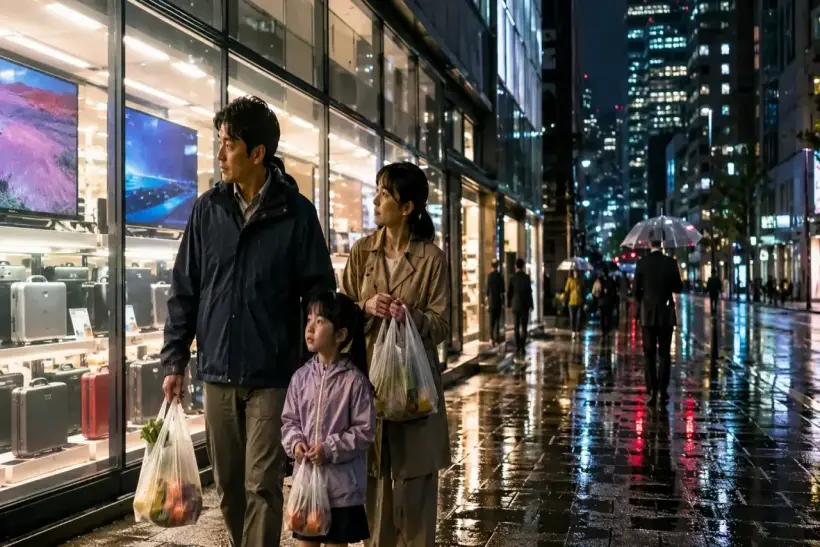
Japanese households reduced real spending again in March even as wages and worker incomes continued to rise, underscoring a fragile recovery in domestic demand and raising questions over how quickly pay gains can translate into stronger consumption in the world’s third-largest economy.
Household spending falls more than expected
Average monthly consumption spending by Japanese households with two or more people stood at 334,701 yen in March 2026. That was down 1.3% in nominal terms and 2.9% in real terms from a year earlier, meaning households bought fewer goods and services after adjusting for price changes. Japan’s Statistics Bureau, part of the Ministry of Internal Affairs and Communications, released the figures on May 12, 2026.
Bloomberg framed the data as part of a broader contradiction in Japan’s recovery: wages are rising, but consumers remain cautious. Trading Economics data showed the 2.9% fall was deeper than the market consensus for a 1.3% decline and marked a sharper deterioration after a 1.8% drop in February.
Income rises but consumption lags
The contrast was clearest among working households. Their average monthly income reached 557,663 yen in March, up 6.4% in nominal terms and 4.7% in real terms from a year earlier. Normally, such income growth would support consumption, but Japanese households appear to be treating higher pay as a buffer rather than a signal to spend more aggressively.
The labor market data also looked positive on the surface. Japan’s Monthly Labour Survey, administered by the Ministry of Health, Labour and Welfare, is classified as fundamental statistics covering wages and working conditions. Aggregated data from Trading Economics showed average cash earnings rose 2.7% year on year in March, while inflation-adjusted real wages increased 1%, their third consecutive monthly gain.
Spring wage talks keep pay momentum alive
The wage backdrop has been supported by Japan’s annual spring labor negotiations. JILAF reported that, as of April 2026, 2,311 unions had reached settlements, with the average wage increase for full-time employees at 5.09%, including base-pay increases and regular pay-scale increments. It was the third straight year in which the figure exceeded 5%.
Yet the benefits are uneven. Large companies tend to pass wage increases through more quickly, while smaller firms, service providers and low-margin businesses often move more cautiously. For households, that means headlines about wage gains do not always match the lived experience of financial security.
Consumer confidence weakens
The spending decline coincided with weaker sentiment. Japan’s consumer confidence index fell to 32.2 in April 2026 from 33.3 a month earlier. The Cabinet Office also recorded a decline in the overall livelihood index to 28.2 and in willingness to buy durable goods to 23.2. The latter is particularly important for retailers, car dealers, furniture sellers, home-appliance companies and housing-related demand.
The weak appetite for big-ticket purchases suggests that households do not yet see wage gains as a durable improvement in financial conditions. After years of higher food, utility and import prices, many consumers may prefer rebuilding savings over expanding discretionary spending.
Inflation still shapes household behavior
Inflation has eased from earlier peaks, but prices remain central to consumer decisions. Japan’s annual inflation rate rose to 1.5% in March 2026 from 1.3% in February, with transport costs accelerating, according to Trading Economics.
For households, the composition of inflation matters as much as the headline rate. If food, energy, transport or rent rise faster than a specific household’s income, an official increase in real wages may still fail to produce stronger consumption. Japan’s demographics reinforce that effect, as older households and a deeply rooted savings culture can slow the pass-through from income growth to spending.
The Bank of Japan gets a mixed signal
For the Bank of Japan, the March data complicate the policy picture. Rising real wages support the case that a wage-price cycle is forming, a condition policymakers have long viewed as necessary for normalizing monetary policy. Falling household spending, however, shows that domestic demand remains fragile.
As of May 12, 2026, the Bank of Japan said it would encourage the uncollateralized overnight call rate to remain at around 0.75%, while the interest rate applied to the complementary deposit facility had been 0.75% since December 22, 2025. That already marks a clear shift away from years of ultra-loose policy, but weak consumption may strengthen the case for caution before further moves.
Private consumption remains the main risk
Private consumption is central to Japan’s growth outlook. The Bank of Japan’s materials on the Consumption Activity Index state that private consumption accounts for roughly 50% of gross domestic product, making timely assessment of household demand important for judging the business cycle.
That makes the March decline more than a narrow data point. If households keep cutting purchases, companies focused on domestic demand may face softer sales even as payroll costs rise. For an economy exposed to global trade, exchange-rate swings and imported price pressures, the resilience of household demand is critical.
Japan entered 2026 with an unusual combination of stronger wage settlements, moderate inflation and a central bank gradually exiting ultra-loose policy. But the March numbers show that household confidence is recovering more slowly than incomes. As International Investment experts report, the key risk for Japan is not the absence of wage growth, but the possibility that consumers will continue to treat higher pay as compensation for past inflation rather than the start of a new spending cycle.
FAQ on Japan’s household spending and wages
Why are Japanese households cutting spending despite wage growth?
Because higher wages have not fully restored confidence after years of price increases. Many households may be saving more, repaying debt or offsetting earlier losses in purchasing power.
What does real household spending mean?
Real household spending is consumption adjusted for inflation. When it falls, households are effectively buying fewer goods and services, even if nominal spending appears more stable.
Why does Japan’s spending data matter to investors?
Private consumption accounts for about half of Japan’s gross domestic product. Weak spending can affect growth forecasts, Bank of Japan policy, the yen, bond yields and shares of companies exposed to domestic demand.
What are real wages?
Real wages are wages adjusted for inflation. They show whether workers’ purchasing power is rising or falling.
Could the Bank of Japan raise rates further?
It could if inflation and wage growth remain durable, but weak consumption may encourage policymakers to proceed carefully to avoid putting more pressure on domestic demand.