












Almost 24% of asylum seekers in the EU are children: 2025 statistics
Eurostat
In 2025, nearly one in four people who applied for asylum for the first time in the European Union were minors. More than 119,000 children and teenagers were granted protection. The number of pending applications exceeded 254,000, according to Eurostat.
Trends in asylum applications by people under 18
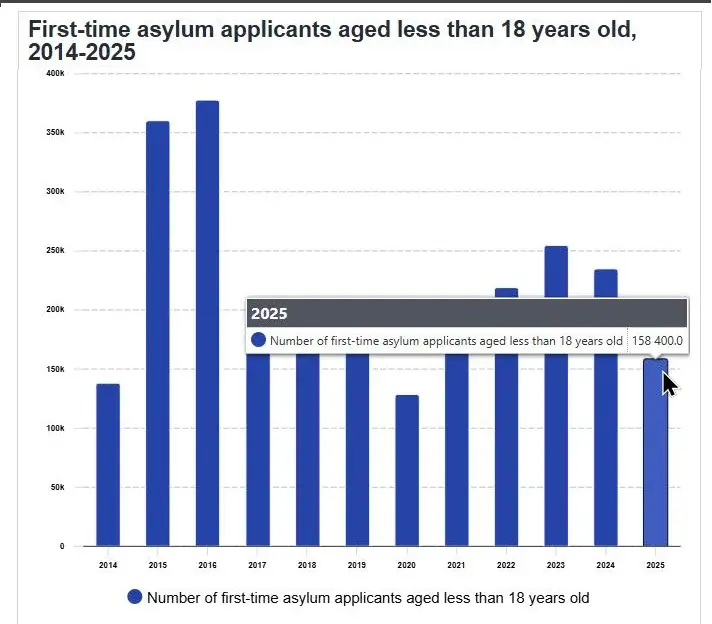
The number of minors (under 18) applying for asylum for the first time in the EU began to decline after the peak of the migration crisis in 2016, when the figure reached 377,100, or 32.3% of the total. The lowest level was recorded in 2020 at 128,320, mainly due to the COVID-19 pandemic, mobility restrictions and border closures.
After that, the numbers increased again, reaching 254,725 in 2023, before slightly decreasing to 234,825 in 2024. In 2025, the number of applicants fell to 158,400 (23.7%): 119,435 minors were granted protection status, while 20,970 were rejected. At the end of December, 254,625 applications submitted by minors were still pending. Most applicants were boys — 55.4%. Unaccompanied minors accounted for 13.3% of all applicants under 18. In total, around 2.6 million applicants under the age of 18 applied for asylum in EU countries between 2014 and 2025.
Between 2014 and 2025, the approval rate for asylum applications at first instance was 1.5 times higher for minors than for adults. Even after appeals, the gap remained, with children being about 1.2 times more likely to receive a positive decision. Applications submitted by minors are also processed faster on average.
Leading EU countries for asylum applications
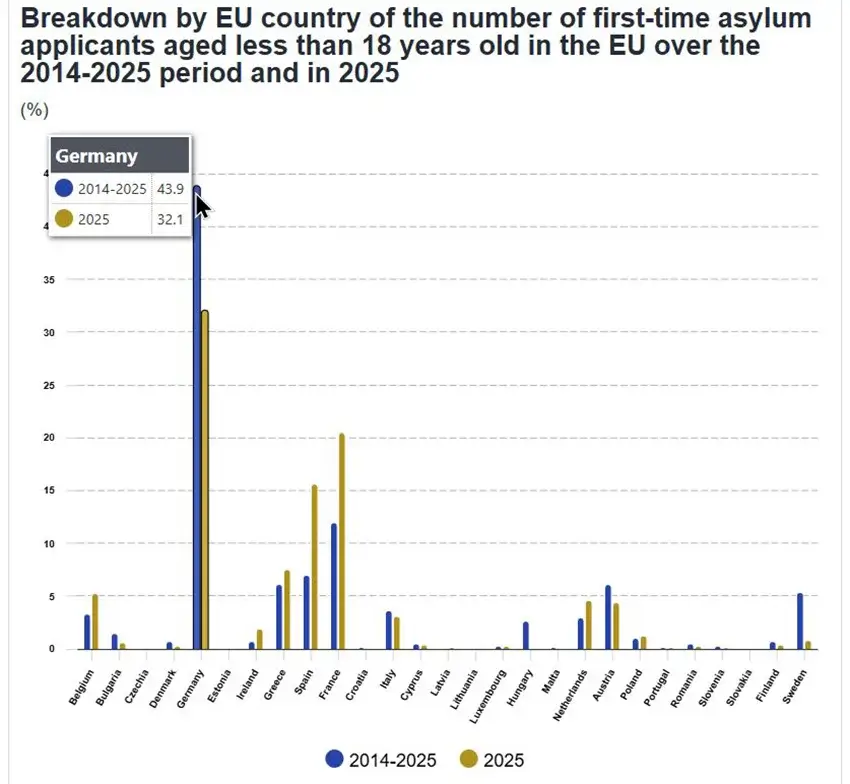
Between 2014 and 2025, Germany accounted for 43.9% of all asylum applications submitted by minors, followed by France (12.0%) and Spain (6.9%). In 2025, these countries also remained the main destinations: Germany (32.1%), France (20.5%) and Spain (15.7%), followed by Greece (7.5%). A shift in distribution is also observed.
A comparison between the 10-year period and 2025 shows a noticeable increase in the shares of Spain and France, and a significant decline in Hungary and especially Germany.
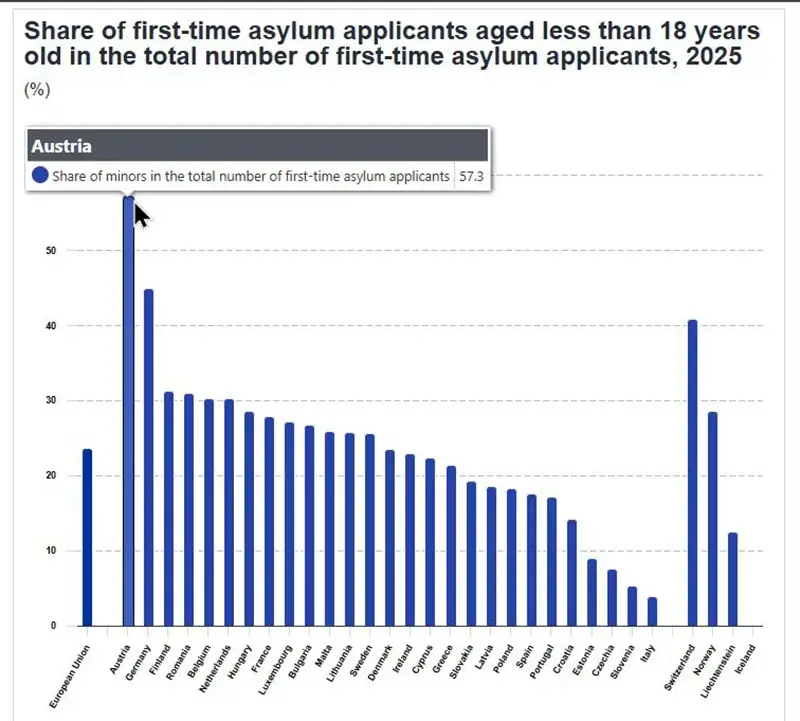
Eurostat also reports a separate indicator — the share of minors among all first-time asylum applicants within each country. According to this measure, the highest values in 2025 were recorded in Austria (57.3%), Germany (44.9%) and Finland (31.2%).
Countries of origin
In 2025, most underage asylum seekers came from Asia (39%), followed by Africa (27.3%), the Americas (18.2%) and non-EU European countries (13.9%).
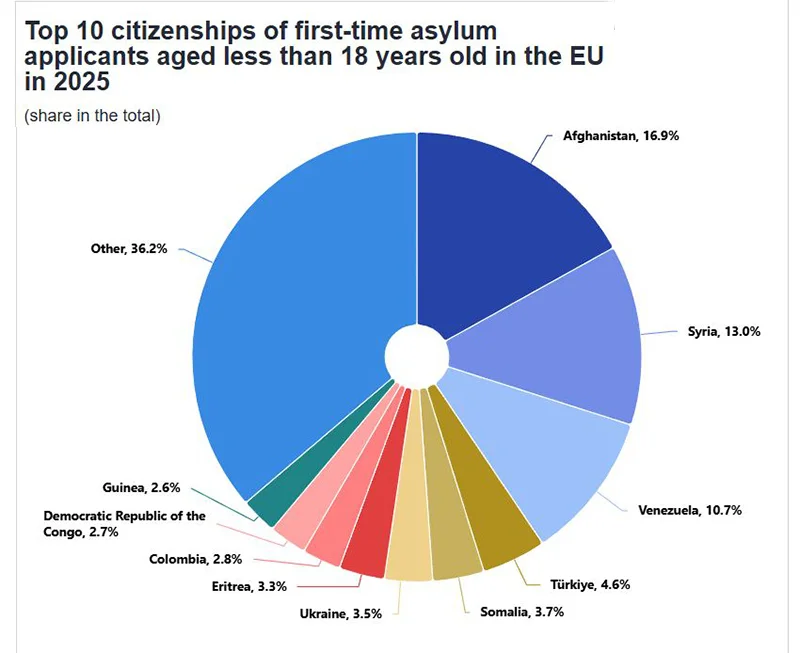
The largest nationality groups were Afghans (16.9%), Syrians (13%) and Venezuelans (10.7%), followed by citizens of Türkiye and Somalia.
The share of unaccompanied minors varied by region of origin: 27.4% for Africa, 9.4% for Asia, 8.1% for the Americas and 3.1% for non-EU Europe. Among unaccompanied minors, Afghans (12.3%), Eritreans (11.6%) and Syrians (11.5%) were the most represented groups.
Temporary protection for Ukrainians
Eurostat also reports data on temporary protection for people who fled Ukraine after the start of the war. As of 31 December 2025, around 1.3 million minors from non-EU countries who fled Ukraine were under temporary protection in the EU.
Poland hosted the largest number of children (447,180, or 46.1% of the total), followed by Germany (328,410) and Czechia (89,335).
In Spain, 74,415 minors had this status in 2025, in Romania 52,690, and in Slovakia more than 41,000. Relatively high shares of minors were also recorded in Hungary (32.5%) and Belgium (30.4%), despite lower absolute numbers. The EU average stood at 30.2%.
Conclusion
Analysts at International Investment note that EU countries are tightening migration policy. Measures include faster asylum rejection procedures and deportations, as well as proposals for processing centers in neutral territories. Overall, EU policy is increasingly focused on limiting the inflow of foreign asylum seekers, including stricter rules for Ukrainian nationals.
At the same time, the need to maintain safeguards for vulnerable groups remains, making the system more complex and less uniform in practice. For children, however, more lenient procedures and a higher likelihood of protection are still in place, partially balancing the broader tightening trend.