







 Vietnam Mortgage Surge Pushes Homes Out of Reach
 Lithuanian Apartment Prices Accelerate Across Major Cities
 London Flats Lose Value Ahead of Leasehold Reform
 Construction of the Batumi–Sarpi Highway Begins in Georgia
 Baltic Property Investment Accelerates in 2026
 Hong Kong and Singapore Renew Their Expat Rivalry
Indonesia Faces Growing Credit Rating Pressure
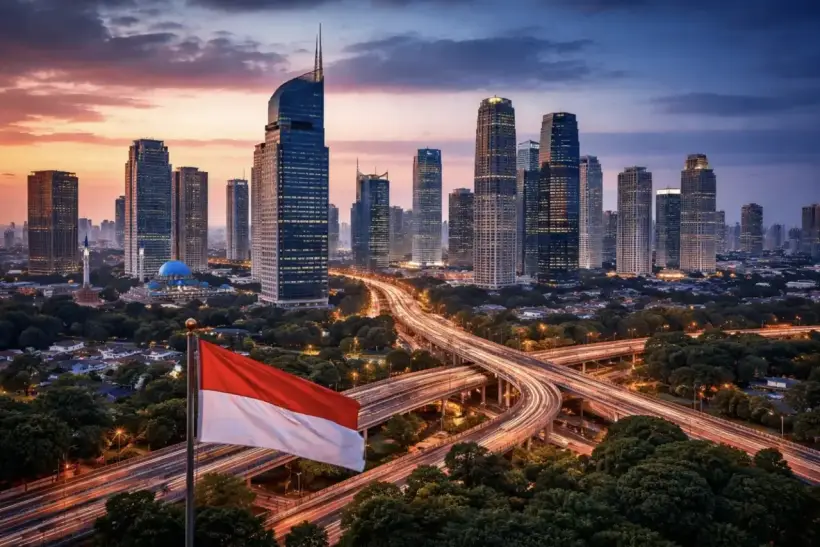
Fitch downgrades Indonesia’s credit outlook
Fitch Ratings has revised Indonesia’s credit outlook from stable to negative, adding to growing concerns among global investors about the economic policy direction of Southeast Asia’s largest economy. At the same time, the agency affirmed Indonesia’s long-term foreign-currency issuer default rating at investment-grade BBB.
The decision follows a similar move by Moody’s last month, which also lowered the outlook for Indonesia, citing weakening governance and increasing policy uncertainty under President Prabowo Subianto.
According to Fitch, the outlook revision reflects rising concerns over policy consistency and credibility. The agency noted that increasing centralization of policymaking authority could undermine investor confidence, weaken fiscal stability, and put pressure on Indonesia’s external buffers.
Markets react with pressure on the rupiah
Indonesia’s financial markets have already been experiencing volatility. Following Fitch’s announcement, the rupiah remained under pressure and earlier approached a near-record low, prompting intervention by the central bank to stabilize the currency.
At the same time, yields on Indonesia’s benchmark 10-year government bonds climbed to their highest levels since July 2025. Dollar-denominated Indonesian bonds also underperformed compared with other emerging-market debt instruments.
Geopolitical tensions have further intensified market caution. Analysts say that with global investors moving into risk-averse mode amid the Middle East conflict, the rupiah could test the psychological threshold of 17,000 per US dollar.
Political developments add to policy uncertainty
Investor concerns are also linked to political developments during the first year and a half of President Prabowo Subianto’s administration.
One of the most significant events was the departure of respected finance minister Sri Mulyani Indrawati following deadly street protests, which raised questions about economic policy continuity.
At the same time, the government has been restructuring parts of Indonesia’s corporate landscape through Danantara, a newly created sovereign wealth fund reporting directly to the president. Authorities have also intensified anti-corruption enforcement and launched efforts to reclaim large plantation areas and mining concessions.
Fiscal discipline under increasing pressure
Fitch expects Indonesia’s budget deficit to reach about 2.9% of GDP in 2026, remaining close to the country’s long-standing legal ceiling of 3%.
However, the agency warned that rising government spending could challenge fiscal discipline. One of the flagship programs of the current administration is a nationwide initiative to provide free daily meals to more than 80 million students and citizens.
President Prabowo has also set an ambitious target of boosting economic growth to 8% by 2029, a level last seen in Indonesia during the 1990s. Fitch believes such growth will be difficult to achieve without substantial structural reforms.
Another challenge highlighted by the agency is weak fiscal revenue. Government income in Indonesia averages about 13% of GDP, far below the 25.5% median for countries with a similar BBB rating.
Investment-grade status may face risks
A negative outlook signals that Indonesia’s investment-grade rating could be downgraded within the next 12 to 18 months if macroeconomic risks increase.
Fitch identified several possible triggers for a downgrade, including rising public debt, widening fiscal deficits, weakening policy frameworks, and a significant decline in foreign-exchange reserves caused by capital outflows.
Investors are also closely watching a planned review of the State Finance Law, which could potentially loosen fiscal rules and weaken policy credibility.
Despite these risks, Fitch projects Indonesia’s economy to continue growing at around 5% annually through 2027, mainly supported by strong domestic demand.
Georgia’s economy shows strong growth momentum
While some emerging markets are facing rating pressure, Georgia’s economy continues to demonstrate strong growth dynamics. According to official data, Georgia’s economy expanded by 7.9% in January 2026 compared with the same period a year earlier.
The European Bank for Reconstruction and Development has also raised its forecast for Georgia’s economic growth in 2026 from 5% to 5.5%, reflecting resilient domestic demand, increasing investment activity, and a strong tourism recovery.
As International Investment experts report, Georgia’s economic performance highlights the country’s growing attractiveness for international investors and confirms its position as one of the fastest-growing economies in the wider Caucasus region.