







 Vietnam Mortgage Surge Pushes Homes Out of Reach
 Lithuanian Apartment Prices Accelerate Across Major Cities
 London Flats Lose Value Ahead of Leasehold Reform
 Construction of the Batumi–Sarpi Highway Begins in Georgia
 Baltic Property Investment Accelerates in 2026
 Hong Kong and Singapore Renew Their Expat Rivalry
Hormuz Raised Global Recession Risks
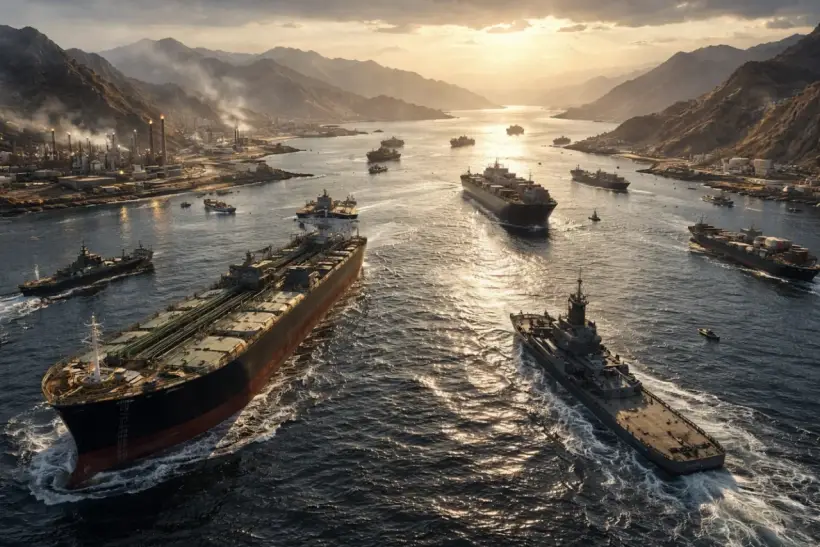
Hormuz disruption is putting the global economy under pressure
Fresh disruption around the Strait of Hormuz has pushed one of the world’s most sensitive economic chokepoints back to the center of market attention. In analysis published through Hospitality Net on March 25, 2026, GlobalData said prolonged constraints in the strait are increasing the risk of weaker growth combined with stickier inflation, with Iran, Israel, Egypt and major Asian energy importers appearing most exposed. The company identified higher energy costs, more expensive freight, rising insurance bills and broader logistics strain as the main channels through which the shock could damage economies over the next year.
The importance of Hormuz is rooted not only in geopolitics but in sheer throughput. The U.S. Energy Information Administration, or EIA, estimates that about 20 million barrels per day of oil and petroleum products moved through the strait in 2024, equal to roughly one-fifth of global petroleum liquids consumption. EIA also says Hormuz accounted for more than one-quarter of total global seaborne oil trade and around one-fifth of global liquefied natural gas, or LNG, trade.
Which countries GlobalData sees as most exposed
GlobalData separates exposure not only by region but by economic transmission channel. Iran and Israel are described as sitting at the epicenter of downside growth risk. For Iran, the company sees the strongest contraction threat because of pressure across energy logistics, insurance and financing. For Israel, the main concern is a confidence-led slowdown through weaker investment and tourism, alongside higher defence spending that could crowd out private activity.
Among countries facing the sharpest inflation pass-through, GlobalData specifically highlights Egypt. The reasoning is straightforward: for an economy with meaningful dependence on imported fuel and food, the combination of higher energy costs, currency pressure and subsidy burdens can quickly feed into both public finances and consumer prices. In Asia, India, Japan and South Korea are identified as especially exposed because higher energy bills can pass through into transport, industry and headline inflation for longer than markets expect.
That view aligns closely with EIA shipping data. The agency estimates that in 2024, 84% of the crude oil and condensate and 83% of the LNG moving through Hormuz went to Asian markets. China, India, Japan and South Korea were the main destinations for crude flows through the strait, while China, India and South Korea were also major recipients of Hormuz-linked LNG. That is why any serious disruption in the strait is first and foremost read as a macro risk for Asia’s energy importers.
How Hormuz disruption feeds inflation and weaker growth
GlobalData argues that the first-order macro shock is supply-led. In practice that means the problem is not limited to crude oil or gas prices themselves. It also includes the availability of shipping capacity, the cost of insurance, route extensions and tighter financing conditions. In the company’s view, even if oil prices stabilize, higher freight charges, longer journeys and elevated war-risk premiums can keep delivered prices for fuel and intermediate goods higher for longer. That is the mechanism through which inflation becomes stickier and monetary easing becomes harder to deliver.
That broader logic is consistent with UNCTAD, the United Nations Conference on Trade and Development. In its Review of Maritime Transport and subsequent updates, UNCTAD has warned that vulnerable chokepoints are extending routes, straining supply chains and increasing costs in ways that affect food security, energy supplies and the wider global economy. It has also said freight-rate volatility has intensified and that geopolitical spillovers toward Hormuz could deepen those pressures further.
Why Asia and the Middle East face the sharpest immediate risks
For the Middle East, the picture is uneven. GlobalData says major Gulf hydrocarbon exporters such as Saudi Arabia, the UAE, Qatar, Kuwait, Oman and Bahrain may partly offset the shock through stronger oil and gas receipts. But the same economies remain exposed through aviation restrictions, higher insurance and shipping costs, and sentiment damage affecting tourism, trade and services. For regional hub economies, especially the UAE, that vulnerability matters because their growth model relies not only on hydrocarbons but also on transit, logistics and business mobility.
For Asia, the vulnerability is more direct. EIA data show that the overwhelming majority of both oil and LNG flowing through Hormuz heads to Asian markets. In LNG alone, around 20% of world trade moves through the strait, primarily from Qatar. If disruption persists, the impact quickly spreads beyond crude oil into electricity, chemicals, fertilizers and energy-intensive industry. In its March Short-Term Energy Outlook, EIA explicitly said that reduced LNG flows through Hormuz have already lifted natural gas prices in Europe and Asia.
Europe faces a cost shock more than a route shock
GlobalData’s argument for Europe is slightly different. The main risk is not that Europe is the most direct user of Hormuz flows, but that higher delivered energy costs and shipping-related inflation could squeeze industrial margins and delay monetary easing if inflation accelerates again. That is an especially difficult setup for an economy where demand is already fragile and where manufacturing remains sensitive to fuel, gas and maritime transport costs.
UNCTAD frames the issue in similar terms. It says higher maritime transport costs hit vulnerable economies hardest, but the broader effect still spreads across world trade through prices and delivery times. Because more than 80% of global trade volume moves by sea, a prolonged shock in major maritime routes almost inevitably shows up as more expensive deliveries and slower transmission through supply chains.
Why recession risk is back in focus
GlobalData does not say a global recession is already underway, but it clearly argues that the probability of a global growth downshift rises if disruption lasts more than a few months. In that scenario, the shock moves from headline inflation into broader pricing and real economic activity. The company explicitly warns of stagflation-like outcomes, meaning a world of weaker growth combined with inflation that falls far more slowly than expected.
At the same time, exposure is far from uniform. EIA notes that the United States is much less dependent on Hormuz than many Asian economies. In 2024, the U.S. imported about 0.5 million barrels per day of crude oil and condensate from Persian Gulf countries through the strait, equivalent to about 7% of total U.S. crude and condensate imports and only around 2% of U.S. petroleum liquids consumption. That does not isolate the U.S. from global price shocks, but it does show why the economic burden is unevenly distributed.
As International Investment experts report, the current threat to the world economy is not just about oil itself but about the overlap of several pressure channels at once: energy markets, maritime logistics, insurance costs, exchange rates and monetary policy. If disruption in the Strait of Hormuz persists, the most painful effects are likely to fall on fuel-importing economies with limited fiscal room, while hub economies will feel the strain through transport, tourism and service-sector costs.
FAQ
Question: Why is the Strait of Hormuz so important to the global economy?
Answer: Because around 20 million barrels per day of oil and petroleum products pass through it, along with more than one-quarter of global seaborne oil trade and about one-fifth of global LNG trade.
Question: Which countries does GlobalData identify as most exposed?
Answer: GlobalData highlights Iran, Israel, Egypt and major Asian energy importers, especially India, Japan and South Korea.
Question: Why is Asia more vulnerable than many other regions?
Answer: Because 84% of crude and condensate flows and 83% of LNG flows through Hormuz go to Asian markets.
Question: How can Hormuz disruption raise inflation?
Answer: Through higher energy prices, more expensive shipping, rising insurance premiums, longer supply routes and the pass-through of those costs into fuel, industrial inputs and consumer goods.
Question: Does this mean a global recession is inevitable?
Answer: No, but GlobalData says the chance of a global growth slowdown and stagflation-like conditions rises materially if disruption lasts beyond a few months.