







 Latvia’s Residence Permits for Real Estate to Be Abolished from September 15
 Egypt Prepares New Law for Property Developers
 Young Japanese Buyers Turn to 50-Year Mortgages
 Argentina Narrows Tourism Gap as Arrivals Rise
 Seattle Luxury Housing Loses Its Former Momentum
 The World’s Strongest Passports for Travel, Living and Investment
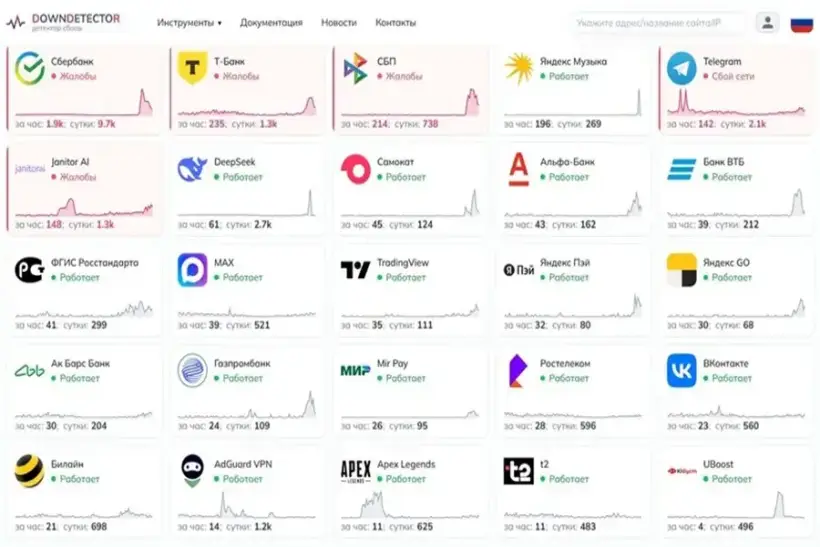
On April 3, 2026, Russia experienced a large-scale outage affecting banking services and online payments, reports Delovoy Peterburg. By April 4, the situation had largely stabilized, but the incident became one of the most notable disruptions in the financial infrastructure in recent times, raising questions about its causes and potential consequences.
Scope of Disruptions in Digital Services
The highest number of complaints came from Moscow, Saint Petersburg, Samara, Novosibirsk, and Omsk regions, as well as Kuzbass, Primorsky Krai, Irkutsk region, and Yekaterinburg. Users reported being unable to transfer money via mobile apps, pay for purchases with bank cards, or withdraw cash from ATMs. According to monitoring services, one of the largest banks, Sberbank, received about 9,700 complaints in a single day, with the peak occurring between 11:50 and 12:50 Moscow time. Clients of other financial institutions, including T-Bank, VTB, and Alfa-Bank, also faced issues. Additional disruptions were reported in the fast payment system, causing transfers to fail and online operations to freeze.
Temporary outages were also noted among some digital services. Users, in particular, complained about the delivery service Samokat. Meanwhile, a number of major platforms and operators — including marketplaces, telecom companies, and social networks — continued to operate without significant interruptions.
How It Affected Daily Life
The outage quickly went beyond mere "in-app inconvenience" and affected everyday life. Some pharmacies temporarily did not accept cashless payments, stores and cafes could not process transactions, drivers were unable to refuel, and there were problems paying for taxis. A resident of Yekaterinburg described the situation: "I went to several pharmacies in Uralmash. Some didn’t accept cashless payments at all, others only accepted Sberbank cards." Business representatives also reported significant disruptions: "Retail acquiring systems are down, online payments are freezing."
Sberbank confirmed the problem but did not disclose the reasons: "Some clients are experiencing difficulties using our services. We sincerely regret the inconvenience — the team is already working on restoring functionality as quickly as possible." VTB stated that their systems had returned to normal operation.
Causes of the Online Systems Outage in Russia
No official version of the incident has been provided. Several hypotheses are being discussed: failures in infrastructure or interaction between banking systems, network segment overloads, technical errors during administration, and traffic routing issues.
The outage occurred amid discussions of new internet regulation measures in Russia. The Ministry of Digital Development (Ministry of Digital Affairs) has demanded that the largest digital platforms restrict access for users with VPNs, according to RBC. By April 15, companies including Sberbank, Yandex, VK, Wildberries, Ozon, and Gazprom-Media must not only block VPNs identified by Roskomnadzor but also independently monitor new methods of bypassing restrictions. These measures should not affect corporate VPNs, although technically distinguishing them from regular traffic is difficult.
Ministry officials justify the measures by the widespread use of VPNs and the threat they pose to the national digital infrastructure. Failure to comply could result in companies losing IT benefits, being removed from "white lists," and being prohibited from preinstalling their services on devices in Russia. At the end of March, mobile operators were prohibited from allowing direct Apple ID payments via mobile accounts, and starting May 1, a fee will be charged for international traffic exceeding 15 GB per month.
Potential Consequences of Regulating Digital Platforms in Russia
The situation has sparked reactions at the regional level. Dmitry Pavlov, a deputy of the Saint Petersburg Legislative Assembly, called for a review of internet regulation. He emphasized that Russia has achieved a high level of digital service development — from banking apps to government platforms — and current measures could undermine this progress. Pavlov also warned of the risk of "digital inequality": access to full-featured internet could become a paid privilege, leaving users with lower incomes restricted in technology access, particularly affecting youth and education.
Experts believe that the restrictions may hinder the expansion of online platforms abroad and pose risks for streaming and entertainment services, as there is no transparent methodology for distinguishing VPN traffic from real foreign users.
International Investment analysts note that the April 3 outage demonstrated how critically dependent daily life in Russia is on the uninterrupted operation of digital and banking services. Even short-term disruptions caused failures in trade and services, restricted access to basic operations, and social tension. While core systems have been restored, the incident raises additional questions about the stability of Russia’s digital infrastructure and the potential consequences of its transformation in the coming months.