







 Australia’s Spring Auctions Rise but Remain Well Below 2025
 Number of Foreigners Holding Turkish Residence Permits Exceeds 1.27 Million
 Demand from Russian Tourists for Holidays in Georgia Rises by 20–25%
 Montenegro Property Buying Costs in 2026
 Four in Ten Companies Would Not Choose Slovakia
 Gulf Countries Prepare Unified Tourist Visa
Record Supply Meets Weaker Demand in CEE
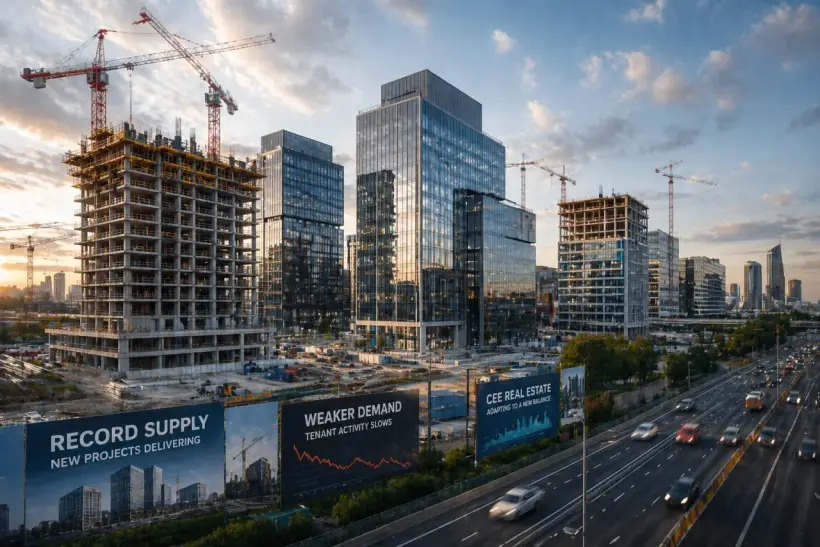
CEE real estate faces supply-demand imbalance
Central and Eastern Europe’s commercial real estate market is entering a new phase in 2026, where record levels of new supply are colliding with weaker occupier demand. According to EurobuildCEE, developers are delivering large volumes of new space while tenant activity remains subdued.
This mismatch reflects broader economic uncertainty and a more cautious approach from companies, many of which are delaying expansion or optimizing existing office footprints.
Pipeline-driven supply reaches peak levels
The surge in supply is largely driven by projects initiated before the rise in interest rates and construction costs. These developments are now being completed, pushing new space onto the market.
CBRE notes that structural supply-demand imbalances are expected to persist across European real estate sectors where development pipelines outpace occupier demand.
Occupier demand weakens across office markets
Tenant demand is softening across the region. Cushman & Wakefield reports that office leasing volumes in CEE capital cities fell by about 12% year-on-year in 2025, with activity dominated by lease renewals rather than expansion.
The shift reflects the growing adoption of hybrid work models, reducing the need for additional office space.
Investment activity rises despite softer fundamentals
At the same time, investment volumes are increasing. Cushman & Wakefield data shows that CEE real estate investment reached approximately €11.8 billion in 2025, up 34% year-on-year and the highest since 2019.
This creates a divergence between capital market optimism and occupier market caution.
Competition intensifies among buildings
The growing supply is intensifying competition, particularly in the office sector. Tenants are focusing on high-quality, sustainable buildings, leaving older stock under pressure.
Demand is increasingly concentrated in prime assets, while secondary properties face rising vacancy and rental pressure.
European outlook remains cautious
The situation mirrors broader European trends. PwC highlights that sentiment in the European real estate market in 2026 is shifting toward pragmatism amid geopolitical and economic risks.
Economic growth in the eurozone is expected to remain below 1%, limiting corporate expansion and real estate demand.
Shift toward quality-driven market dynamics
The current phase signals a structural transition. Developers and investors are prioritizing asset quality, sustainability and flexibility rather than sheer volume.
As International Investment experts report, the CEE market is entering a stage where competitiveness is defined by asset quality and adaptability. Record supply does not necessarily indicate overheating, but it requires market participants to adjust strategies to evolving tenant expectations.
FAQ
Why is supply at record levels?
Because projects launched before rising costs are now being completed.
Why is demand weaker?
Companies are downsizing or optimizing space due to hybrid work.
Are investments still growing?
Yes, investment volumes rose by 34% in 2025.
What properties are most in demand?
High-quality, ESG-compliant and centrally located buildings.