











Powerful Earthquake Near Japan: Tsunami Warning Issued
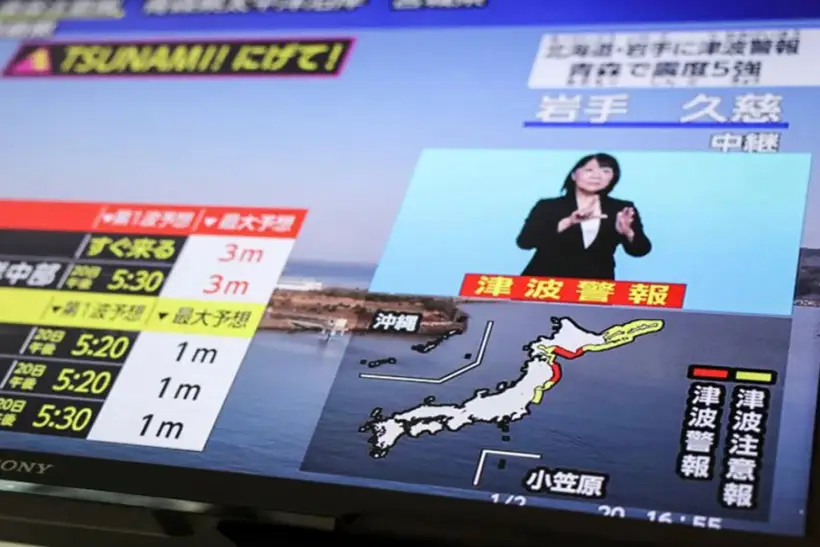
A strong earthquake with a magnitude of 7.5 struck off the northeastern coast of Japan on April 20, Reuters reports. Authorities issued a tsunami warning with waves of up to three meters and began evacuating areas close to the ocean.
Impact of the Earthquake in Japan
According to the Japan Meteorological Agency, the tremors occurred in the Pacific Ocean. The epicenter was located at a depth of around 10 kilometers, classifying it as a shallow earthquake with potentially highly destructive impact. It reached an “upper 5” level on Japan’s seismic intensity scale, a level at which movement becomes difficult and unreinforced concrete walls may collapse.
The disaster caused temporary disruptions to the transport system. High-speed rail services were suspended in the Aomori area in northern Honshu. Kyodo reported that inspections of infrastructure are ongoing, including bridges, tunnels, and energy facilities. Special attention is being paid to nuclear safety. Tohoku Electric Power said it is assessing the potential impact of the earthquake and tsunami risk on the Onagawa nuclear power plant.
Areas at Highest Risk in Japan
The Sanriku coastline, located on the northern part of Japan’s main island, is closest to the epicenter. Experts forecast tsunami waves of up to three meters. The most severe impact is expected in the prefectures of Iwate, Aomori, and Hokkaido.
Prime Minister Sanae Takaichi announced the establishment of an emergency response headquarters and urged residents in coastal areas to evacuate immediately and follow official instructions. Ships reportedly left Hachinohe port in Hokkaido to avoid the approaching waves.
Japan is one of the most earthquake-prone countries in the world, with tremors occurring frequently due to its location in the Pacific “Ring of Fire.” The country accounts for around 20% of all earthquakes of magnitude 6.0 and above globally.
Previous Earthquake Events in Japan
In December 2025, a powerful 7.5-magnitude earthquake in northeastern Japan damaged roads and injured at least 34 people. AP also notes that it has been 15 years since the devastating 9.0-magnitude earthquake and tsunami on March 11, 2011, which devastated northern Japan. More than 22,000 people were killed, and around half a million residents were displaced.
Around 160,000 people evacuated Fukushima Prefecture after radiation was released from the Fukushima Daiichi nuclear power plant, which was hit by the tsunami. About 26,000 have not returned due to restrictions or concerns about radiation exposure.
In 1944 and 1946, earthquakes triggered massive waves that killed more than 2,500 people and flooded the southern coast of Honshu.
What This Means for Tourism and Business
Analysts at International Investment note that earthquakes and tsunami warnings in Japan are generally seen as short-term shocks rather than long-term crises. However, risks to life and safety remain significant.
For travelers and businesses, potential disruptions include rail delays, restricted access to coastal areas, and localized evacuations. Supply chains may experience temporary slowdowns, particularly within the country.
At the same time, Japan has one of the most resilient disaster response systems in the world. Companies typically run well-prepared shutdown and recovery procedures, which helps prevent prolonged operational disruptions.
For investors, such events are usually viewed through the lens of short-term market volatility. News can trigger fluctuations in insurance, construction, transport, and energy sectors, while the overall impact depends largely on the final scale of physical damage.