







 Egypt Prepares New Law for Property Developers
 Young Japanese Buyers Turn to 50-Year Mortgages
 Argentina Narrows Tourism Gap as Arrivals Rise
 Seattle Luxury Housing Loses Its Former Momentum
 The World’s Strongest Passports for Travel, Living and Investment
 Russian Developers’ Debt Nearly Doubled in a Year
Train Tbilisi–Baku returns after a six-year pause

From May 26, passenger rail service between Tbilisi and Baku will resume, Interpressnews reports. The train will operate daily, reconnecting the capitals of Georgia and Azerbaijan after a six-year break. The restoration of the route is part of a broader package of agreements between the two countries and reflects deepening cooperation in the transport and energy sectors.
Agreement on the restoration of the Baku–Tbilisi route
The decision to resume passenger rail service resulted from negotiations at the level of the governments of Georgia and Azerbaijan. During Georgian Prime Minister Irakli Kobakhidze’s visit to Baku, the sides signed a protocol of the bilateral coordination council, which sets out the conditions for restoring the route and further developing rail connectivity between the countries. The signing ceremony was also attended by Azerbaijani President Ilham Aliyev and relevant ministers responsible for economy, energy, and transport.
A special focus was placed on infrastructure. The sides confirmed readiness for the full launch of the Baku–Tbilisi–Kars railway section, considered one of the key components of regional transport corridors. Within the framework of the agreements, a package of energy deals was also concluded, including long-term arrangements for electricity supply and transit, as well as an extension of the gas supply contract from Azerbaijan to Georgia.
The launch of the passenger train is viewed as part of a broader framework of cooperation — from transport integration to energy stability. The two governments emphasize that joint projects should strengthen sustainable economic ties, particularly amid the growing importance of transit routes through the South Caucasus.
Preparation and integration of Azerbaijan and Georgia systems
Ahead of the launch, railway operators from both countries carried out technical and organizational preparations aimed at synchronizing all passenger service processes. In Tbilisi, staff of Georgian Railway underwent training conducted by specialists from the Digital Development Department of Azerbaijan Railways.
The main goal of the training was the integration of ticketing systems and the creation of a unified mechanism for recording and processing operations. This will enable real-time mutual access to data and harmonize the operation of cash and digital platforms in both countries.
Until full integration is completed, part of ticket sales operations will be handled through Azerbaijani software. This temporary arrangement allows a unified ticketing standard from the outset and reduces the risk of technical disruptions during the launch of the international service.
Operational issues regarding rolling stock are also being addressed: at the initial stage, part of the service will be operated using locomotives of Azerbaijan Railways, due to limited traction resources on the Georgian side. This ensures the route can launch without delays and maintain a stable timetable.
Train schedule: Baku–Tbilisi service
The train will begin operating on May 26, 2026, during nighttime hours, according to Azerbaijan Railways (ADY). Departure from Baku is scheduled at 23:10, with arrival in Tbilisi at 08:41 the following morning. In the opposite direction, the train will depart at 21:00 and arrive in Baku at 06:24.
Travel time includes border and customs procedures, with approximately one hour allocated on each side of the border for inspections.
The route includes several stops in both countries. In Azerbaijan, stops are planned at Balajari, Yevlakh, Ganja, Aghstafa, and Boyuk Kesik. In Georgia, stops include Gardabani and Tbilisi Central Railway Station. This schedule covers key hubs along the line while maintaining convenience for both international and domestic passengers.
Conditions and ticket prices
Modern sleeper carriages manufactured by Switzerland’s Stadler Rail Group will operate on the route, replacing rolling stock used until 2019. The new trains are designed for higher comfort standards and meet international requirements for overnight rail travel.
The carriages offer improved conditions for long-distance travel, including updated interiors, sleeping berths, and enhanced onboard services. Special attention is given to comfort and service stability throughout the international segment of the journey.
One-way travel from Baku to Tbilisi will start at 81 AZN ($48), from Yevlakh at 67 AZN ($40), from Ganja at 62 AZN ($37), and from Aghstafa at 57 AZN ($34). The short segment between Boyuk Kesik and Gardabani starts at 51 manat ($30). Railway officials note that prices may vary depending on seat selection and comfort level.
Passenger transport in Georgia
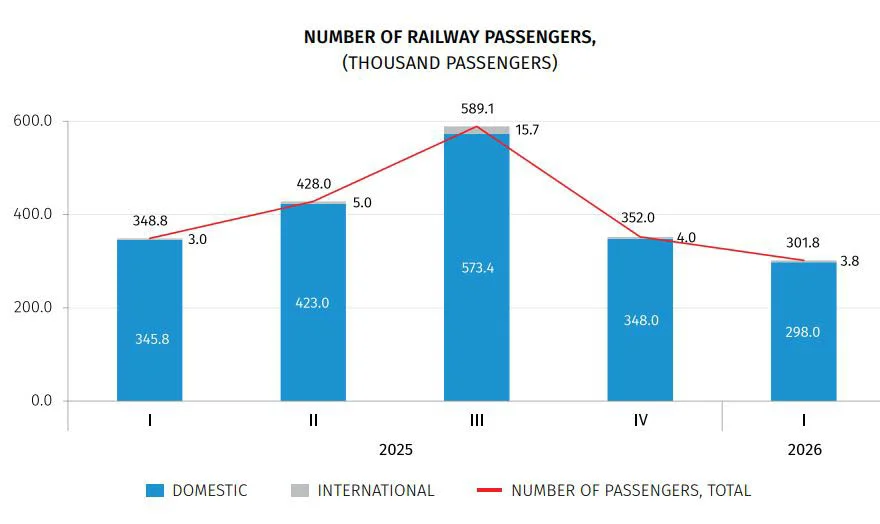
In the first quarter of 2026, Georgian railways transported 301.8 thousand passengers, a 13.5% decrease compared to the same period in 2025, according to the National Statistics Office of Georgia. International passenger transport accounted for 1.3% of total rail traffic, while this segment recorded significant growth of 26.1%, reaching 3.8 thousand passengers. Most trips were from Armenia (73.1%), while 26.9% were in the opposite direction.
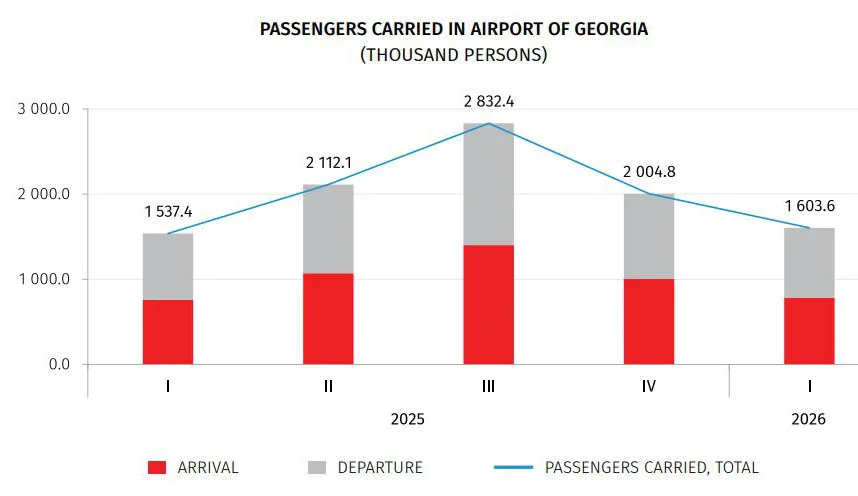
Land travel had a major impact on overall mobility, accounting for more than 53% or 621,705 trips to Georgia, although this segment also declined by 5.8%. Air transport ranked second, showing steady growth. In the first quarter of 2026, passenger traffic through Georgian airports increased by 4.3% to 1.6 million passengers, while the number of flights rose by 20.8% to 7.3 thousand. Key entry points include Tbilisi Airport, the Sarpi, Kazbegi, and Sadakhlo land border checkpoints, as well as the international airports of Kutaisi and Batumi.
Significance of the route and prospects for passenger transport
Analysts at International Investment note that the resumption of passenger rail service between Tbilisi and Baku will enhance mobility between countries with close economic and humanitarian ties. For Georgia, the launch strengthens its role as a transit hub between East and West, developing both freight and passenger transport segments.
The introduction of regular rail service with Azerbaijan expands opportunities for tourism and business travel, especially amid increasing pressure on aviation routes and the ongoing transformation of the regional transport market.
The launch may also encourage interest in combined travel routes across the South Caucasus, where Georgia traditionally serves as a key destination hub. In the long term, this could increase passenger exchange both between the two countries and across broader regional routes.