












Number of Foreigners Holding Turkish Residence Permits Exceeds 1.27 Million

Unsplash
After two years of decline, the number of foreigners holding valid Turkish residence permits is rising again. By the end of summer, the figure had already surpassed the total recorded for all of 2025 and was approaching an all-time high. Tax incentives, property purchases and the possibility of working remotely are supporting demand, Nordic Monitor reports, citing Turkey’s Presidency of Migration Management.
Trends in Turkish Residence Permit Applications
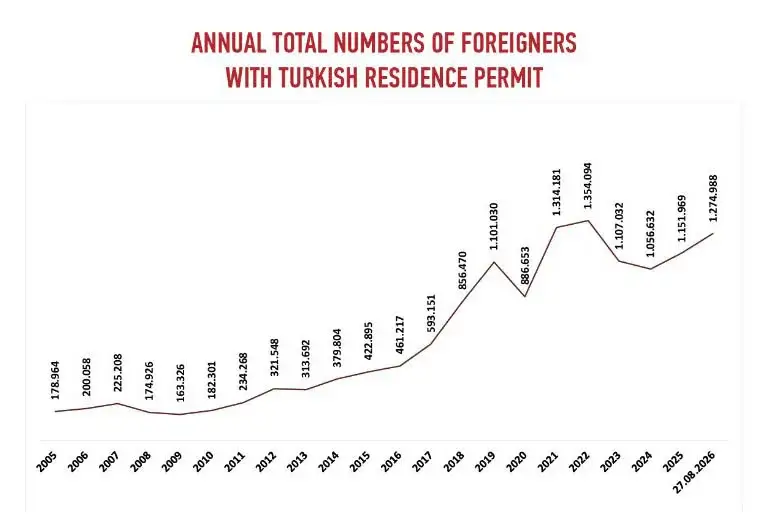
In 2022, Turkey recorded the highest number of foreigners with valid residence permits in its history — 1,354,094. The figure then declined to 1,107,032 in 2023 and 1,056,632 in 2024. Over two years, the number of foreigners holding residence permits fell by almost 300,000.
The decline came to an end in 2025, when the number of migrants holding valid Turkish residence permits reached 1,151,969 by the end of December. The recovery continued in 2026, with the figure reaching 1,274,988 by August 27. The result for the first eight months was more than 123,000 higher than the total for the whole of last year and approached the record level. Turkey could set a new record by the end of the year.
Short-term residence permits account for the largest category, with 451,817 permits. This status is used by property buyers, retirees and foreigners who live in Turkey for extended periods. Another 426,598 foreigners hold permits issued on other grounds, including permits related to property ownership. A further 222,429 people hold student residence permits, while 174,144 have family residence permits.
Who Is Obtaining Turkish Residence Permits
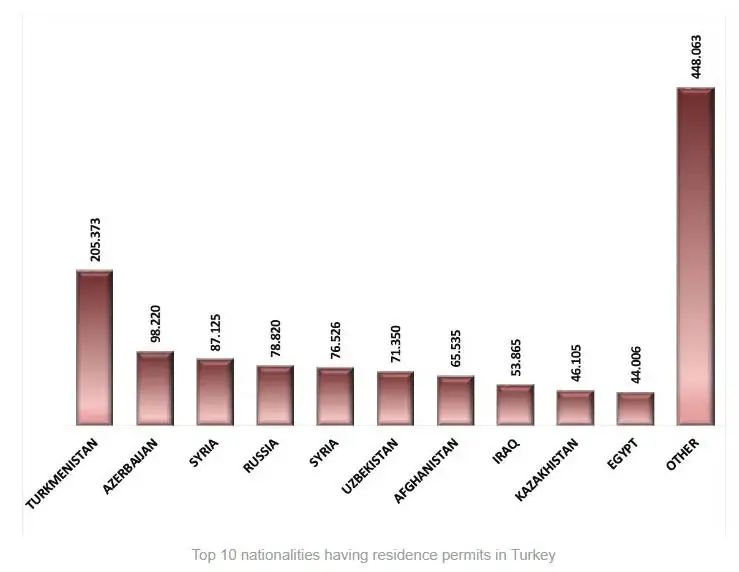
Turkmenistan has the largest number of citizens holding Turkish residence permits, at 205,373. Azerbaijan ranks second with 98,220, followed by Syria with 87,125. The top 10 countries by the number of valid permits also include Russia, Iran, Uzbekistan, Afghanistan, Iraq, Kazakhstan and Egypt. The remaining countries account for 448,063 permits.
The composition varies depending on the grounds for residence. Among short-term residence permit holders, Syrian nationals are the largest group, with 64,513 permits, followed by Turkmenistan with 53,523. They are followed by Iraq, Russia, Azerbaijan, Egypt, Iran, Ukraine, Palestine and Afghanistan.
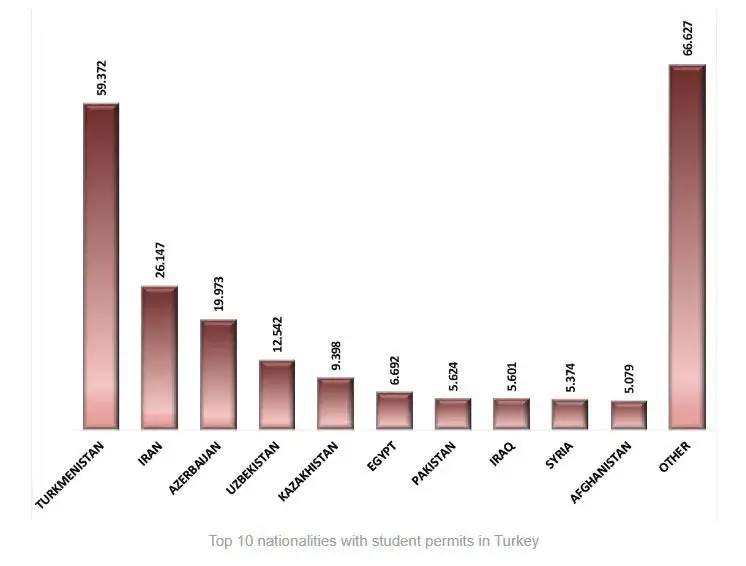
Turkmenistan is by far the leading country of origin among foreign students, with 59,372 residence permits. Iran ranks second with 26,147. The remaining places in the ranking are occupied by Azerbaijan, Uzbekistan, Kazakhstan, Egypt, Pakistan, Iraq, Syria and Afghanistan. Among family residence permit holders, Uzbekistan leads with 19,854, followed by Turkmenistan with 19,285. The top 10 also include Russia, Azerbaijan, Morocco, Iran, Syria, Ukraine, Afghanistan and Kyrgyzstan.
Syrians living in Turkey under temporary protection are not included in these figures. Their status is recorded separately by the Presidency of Migration Management and differs from a standard residence permit.
Turkish Tax Incentives for Foreigners
Salary paid in foreign currency by an overseas employer may be exempt from tax in Turkey. The law provides tax incentives for foreign companies whose employees work remotely, as well as for professionals and firms providing services to clients outside Turkey.
In the first case, the employer must not have a taxable presence in Turkey. The second applies to income from software development, engineering services, product design, medical reporting, accounting and other activities. When payments are transferred to Turkey in foreign currency, the taxable base for such income is reduced.
The rules also apply to freelancers and small companies working with foreign clients. Depending on the type of activity, registration as a sole proprietor or a limited liability company may be required.
Since 2026, new residents of Turkey have been eligible for a 20-year tax exemption on foreign-sourced income and investment income. It is available to foreigners who were not tax residents of Turkey during the three years preceding their move. A similar provision applies to Turkish citizens returning after living abroad. To claim the exemption, applicants must obtain a certificate from the local tax office.
In addition, since the beginning of 2026, certain income earned by foreign subsidiaries and from cross-border services has been subject to a reduced effective tax rate of as little as 5%.
Property Purchases Support Demand for Turkish Residence Permits
Buying property remains one of the ways to obtain the right to long-term residence. A property worth at least $200,000 qualifies the buyer for a short-term Turkish residence permit. The permit can be renewed annually as long as the buyer retains ownership of the property.
The status does not lead to Turkish citizenship, although the period of residence may count toward eligibility for a long-term residence permit after eight years. Family members of the owner may also be eligible for the relevant permit if they hold a share in the property.
Different requirements apply to Turkish citizenship. They include a real estate investment of at least $400,000, provided that the property is not sold for three years. The program has been in place since 2018; the investment threshold was raised from $250,000 to $400,000 in 2022. That same year, the minimum property value for obtaining a residence permit was increased from $75,000 to $200,000.
Illegal Turkish Residence Permit Schemes
Growing demand for Turkish residence permits has also been accompanied by attempts to circumvent legal migration procedures. Law enforcement agencies have uncovered several such schemes.
On June 24, 2026, Istanbul police carried out an operation across eight provinces and detained 64 people. Investigators found that the group helped foreigners obtain residence permits through companies whose employees posed as immigration consultants. They forged notarized documents and altered electronic accounting records. The suspects were charged with forming a criminal organization, bribery, migrant smuggling, forgery of official documents and providing false information to government authorities.
In June, law enforcement agencies also uncovered another scheme involving 18 suspects. The case involved the preparation of fake notarized declarations for foreigners who had entered Turkey illegally. The investigation began after one such case was identified and eventually led authorities to a larger network. Seven people were detained following the first stage of the operation in January.
What This Means for Investors
Analysts at International Investment note that the growing number of foreigners holding residence permits is supporting the attractiveness of Turkey’s real estate market. Many areas are open to foreigners who want to purchase property and use it to obtain a residence permit. At the same time, risks remain: more than 6,000 people have already lost Turkish citizenship obtained through investment.
In July 2026, residential property sales fell by 17%. Sales to foreign buyers increased by 1.9% during the month, but declined by 7.3% year on year in January-July, to 11,203 transactions.
Earthquake risks and currency volatility remain additional factors. Real estate yields calculated in lira may appear attractive, but the result can be significantly more modest when converted into US dollars. Turkey’s legislation has also been changed repeatedly, after which many foreigners were forced to leave the country.
Overall, the growing number of foreigners holding residence permits is supporting demand for real estate, but it does not make the market straightforward for investors. Turkey remains a large and sought-after market, but the combination of currency, natural and regulatory risks requires careful assessment.