










Home sales in Turkey fell by 17%

Unsplash
The Turkish housing market slowed noticeably in July 2026, with the number of transactions falling by 17%. The sharpest decline was recorded in the secondary market. At the same time, mortgage-financed sales continued to grow, while Russians retained the top spot among foreign property buyers, according to the Turkish Statistical Institute (TÜİK).
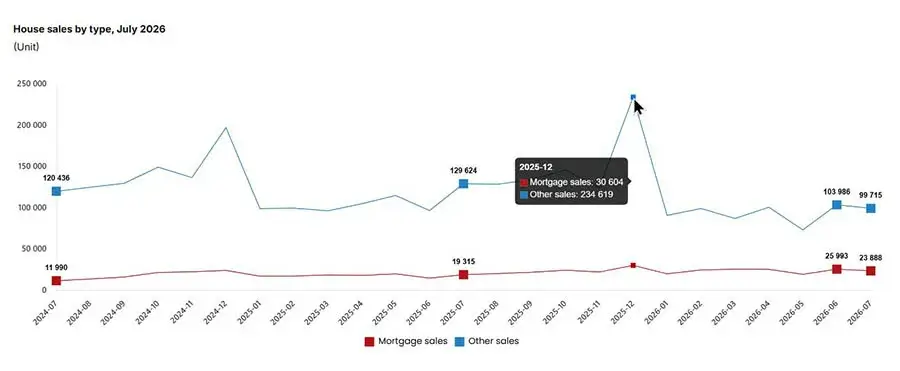
Property sales dynamics in Türkiye
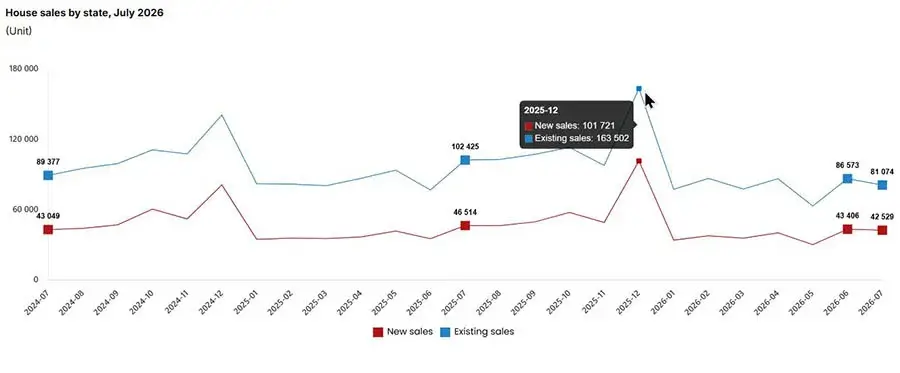
A total of 123,603 residential properties were sold in Türkiye in July, down 17% compared with the same month of 2025.
In the primary market, buyers purchased 42,529 homes, 8.6% fewer than a year earlier. New homes accounted for 34.4% of all sales. Activity declined more sharply in the secondary market, where the number of transactions fell by 20.8% to 81,074. Existing homes accounted for 65.6% of total sales.
From January through July 2026, 823,119 residential properties were sold across the country, 5.5% fewer than in the same period of 2025. New home sales declined by 0.8% to 264,016, while existing home sales fell by 7.5% to 559,103.
Seasonally and calendar-adjusted figures also showed a decline compared with June: new home sales decreased by 5.1%, while existing home sales fell by 5.4%.
Mortgage-financed sales rose by almost 24%
In July, 23,888 homes were sold in Türkiye with mortgage financing, up 23.7% from the same month of 2025. Such transactions accounted for 19.3% of total sales.
The number of purchases without mortgage financing fell by 23.1% to 99,715, representing 80.7% of the market.
From January through July 2026, mortgage-financed transactions increased by 30.9% to 166,682. Sales without mortgages, by contrast, declined by 11.7% to 656,437.
Russians lead among foreign buyers in Türkiye
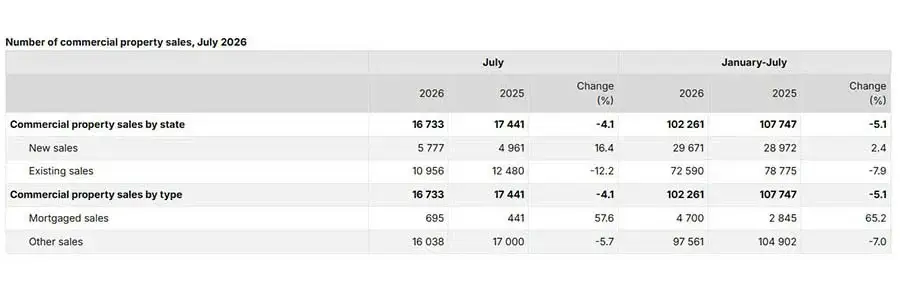
Foreign buyers purchased 2,120 homes in Türkiye, 1.9% more than in July last year. Foreigners accounted for 1.7% of all housing transactions. Russians made the largest number of purchases in July, acquiring 394 properties. Iranian citizens ranked second with 189 purchases, followed by Ukrainians with 145.
However, the longer-term trend remains negative. From January through July, foreigners bought 11,203 homes, 7.3% fewer than during the same seven months of 2025.
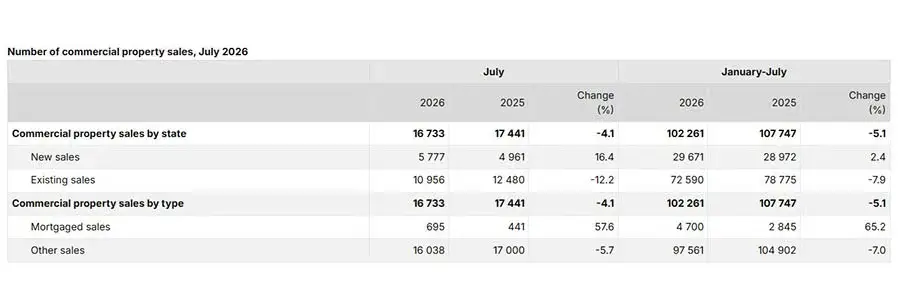
Commercial property sales declined by 4.1%
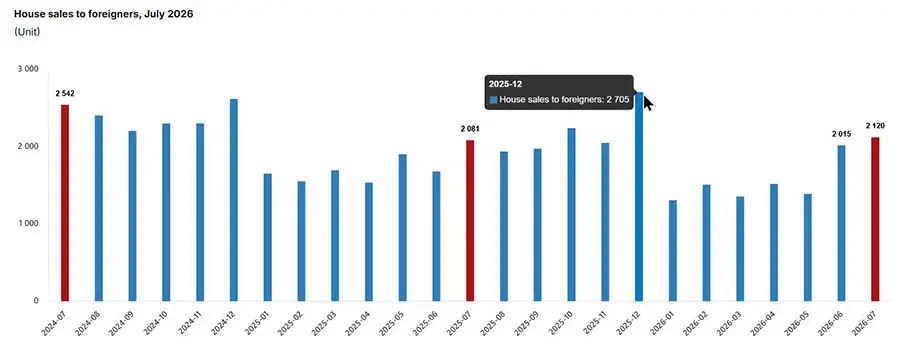
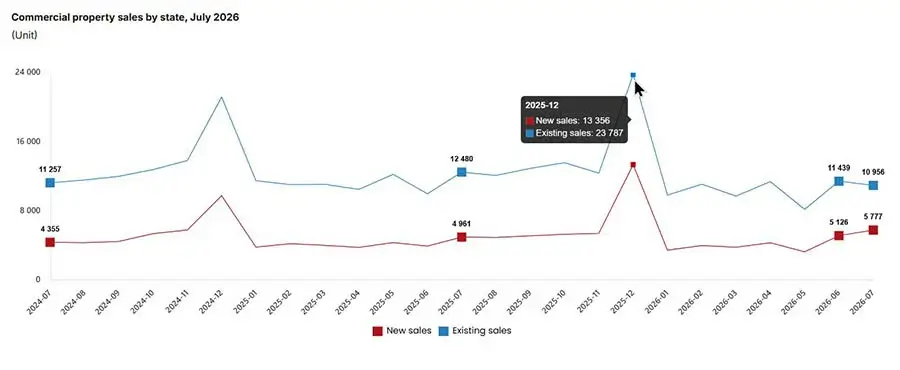
A total of 16,733 commercial property transactions were recorded in Türkiye in July, 4.1% fewer than a year earlier. Sales of new commercial properties increased by 16.4% to 5,777, while transactions involving existing properties declined by 12.2% to 10,956.
From January through July, 102,261 commercial properties were sold across the country, down 5.1%. Sales of new properties increased by 2.4% to 29,671, while existing property sales declined by 7.9% to 72,590.
On a calendar-adjusted basis, sales of new commercial properties rose by 16.5% year-on-year in July, while existing property sales declined by 12.2%. Month-on-month, the respective changes were an increase of 8.2% and a decline of 3.1%.
Mortgage financing in Türkiye’s commercial property segment
The number of commercial property transactions involving mortgage financing reached 695 in July, up 57.6% from a year earlier. Sales without mortgages fell by 5.7% to 16,038.
The gap was even more pronounced over the first seven months of the year. From January through July, mortgage-financed commercial property transactions increased by 65.2% to 4,700, while sales without mortgage financing declined by 7% to 97,561.
What this means for investors
International Investment analysts note that the main signal from the July data is the market’s increasing dependence on credit-driven demand. Mortgage-financed transactions are growing at double-digit rates, while purchases without borrowed funds are declining. If financing conditions continue to improve, this could support market activity, but it would also make the sector more sensitive to mortgage costs.
For investors, the widening gap between the primary and secondary segments is particularly important. Existing homes are losing buyers much faster, which could mean longer resale periods and greater pressure on sellers. At the same time, this environment may create more room for negotiation and purchases at a discount.
New-build properties are showing greater resilience so far, although part of the demand may be supported by instalment plans and other financing schemes offered by developers. The relatively stronger performance of the primary market therefore does not yet indicate an acceleration in property price growth.
Foreign demand has also failed to become a significant source of support for the market. Its share remains small, while sales over the first seven months are still down. It is therefore too early to expect overseas buyers to become a factor capable of significantly pushing up prices or making subsequent property resales easier.