







 Covivio Hotels Revenue Grows 4.7% as European Markets Split
 Lithuanian Apartment Prices Accelerate Across Major Cities
 Georgia's Tourism Revenue Hits Record High
 Norway's Sovereign Fund Commits €1.5bn to European Warehouses
 Market Rout of October 2026: Can Branded Hotels Protect Capital?
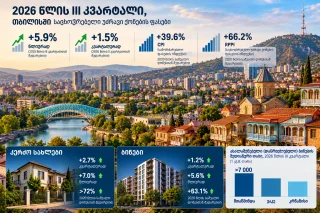 Residential Property Prices in Tbilisi Rise by 5.9% Year-on-Year
New RE:VALUE Awards Nomination: Best Redevelopment Projects

RE:VALUE Awards announces a new category: "Best Redevelopment Projects".
Which is easier: building a hotel from scratch or turning an abandoned prison, a Soviet telegraph office, or a former monastery into a five-star resort? Investors and architects are increasingly choosing the second path.
Redevelopment is considered one of the most challenging sectors in real estate. A building's heritage status restricts floor plans, utilities must be laid millimeter by millimeter, and deadlines and budgets almost always drift from the original estimates. In return, the developer gains something that cannot be built from scratch: a prime location in the historic center and a property biography that drives sales better than any advertising.
However, a historic facade alone does not guarantee quality. The editorial team at International Investment is launching this nomination to distinguish careful heritage preservation from superficial cosmetic renovations hiding behind a glamorous facade.
What and How We Evaluate
We prioritize completed or nearly completed properties—those where results can be assessed in real life rather than on renders. The core evaluation principle: the new function must not erase the building's history. On the contrary, history becomes its main market advantage.
Projects are evaluated against five criteria.
1. Historical Value of the Property
What was actually saved: a state-protected architectural monument, an iconic city landmark, or an ordinary building with a compelling legend. The higher the protection status, the stricter the restrictions and the more costly every architectural decision becomes.
2. Quality of Restoration
Whether authentic elements—facades, staircases, frescoes, stucco moldings—have been preserved or replaced with faux-vintage replicas. We also examine how modern engineering systems are concealed: in historic buildings, this is the most expensive and least visible part of the work.
3. Scale and Complexity of the Work
It is one thing to repurpose a mansion, but quite another to overhaul a city-block-sized department store or revitalize an entire island. We consider technical complexity: floor slabs, load-bearing structures, seismic engineering, and preservation constraints.
4. Logic of the New Function
How appropriate the hotel is within these walls. A prison, an embassy, and a telegraph office were designed for isolation and control—making such a space comfortable for a guest is far more difficult than adding an extra floor.
5. Impact on the Urban Environment
Whether a previously closed property remains private or opens up to the city. Projects that introduce restaurants, cultural venues, and public spaces alongside the hotel receive higher ratings.
Nomination Longlist and Geography
The longlist includes 20 projects from 12 countries—ranging from palazzos and monasteries to former prisons, factories, and sanatoriums given a second life as hotels and residences. Countries are listed in alphabetical order; projects within each country are unranked.
- The Chancery Rosewood (UK) — former US Embassy, London.
- Waldorf Astoria London – Admiralty Arch (UK) — Admiralty Arch near Trafalgar Square.
- Cambridge House, Auberge Collection (UK) — 18th-century officers' club.
- Six Senses London / The Whiteley (UK) — former Whiteleys department store, London.
- Keranis Residences (Greece) — Keranis tobacco factory, Piraeus.
- Xenia Ouranoupolis × Domes Resorts (Greece) — mid-20th century state-owned Xenia chain hotel.
- Hilton Tskaltubo (Georgia) — Soviet sanatorium in Tskaltubo.
- ROOMS Abastumani (Georgia) — 1924 sanatorium.
- The Telegraph Hotel (Georgia) — Central Telegraph building in Tbilisi.
- Parador de Veruela (Spain) — 12th-century monastery near Zaragoza.
- Six Senses Rome (Italy) — 15th-century palazzo.
- Villa San Michele, A Belmond Hotel (Italy) — 15th-century Franciscan monastery, Fiesole.
- Orient Express Venezia (Italy) — 15th-century palazzo in Cannaregio.
- Berengaria (Cyprus) — 1930 mountain hotel in Prodromos.
- Rosewood Amsterdam (Netherlands) — 17th-century Palace of Justice.
- H15 Palace, a Luxury Collection Hotel (Poland) — 16th-century palace complex, Krakow.
- The Standard Lisbon (Portugal) — historic building in central Lisbon.
- Radisson RED Bucharest Old Town (Romania) — 1940s office building.
- Zannier Île de Bendor (France) — 1950s private island resort.
- HOSHINOYA Nara Prison (Japan) — 1908 prison in Nara.
The full longlist broken down by country is published on the awards website.
Award Format and Statuses
Based on the analysis, participants will receive one of four RE:VALUE Awards statuses.
Winner
The main winner of the nomination. The project with the best overall performance across all criteria.
Shortlisted
Award finalists. Up to four projects that have passed the full editorial selection.
Editor's Choice
Editorial pick. The project with the most unconventional approach to working with heritage.
Special Mention
Special recognition for an outstanding result in a specific evaluation category—such as rescuing a site of national significance or exceptional restoration precision.
Announcement of Results
The study results and winners will be announced on August 28, 2026.
Projects enter the RE:VALUE Awards radar in two ways: the developer submits an application, or the editorial team selects the property during its global market analysis.
The previous award nomination focused on guaranteed yield projects—see the results here.
Follow RE:VALUE Awards updates—we will soon announce the best redevelopment projects.
For collaboration inquiries, please contact: internationalinvestmentbiz@gmail.com