







 Covivio Hotels Revenue Grows 4.7% as European Markets Split
 Lithuanian Apartment Prices Accelerate Across Major Cities
 Georgia's Tourism Revenue Hits Record High
 Norway's Sovereign Fund Commits €1.5bn to European Warehouses
 Market Rout of October 2026: Can Branded Hotels Protect Capital?
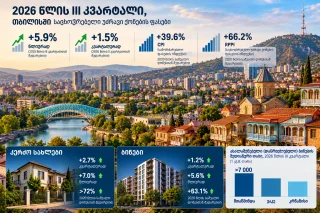 Residential Property Prices in Tbilisi Rise by 5.9% Year-on-Year
RE:VALUE Awards 2026 Results: Best Redevelopment Projects
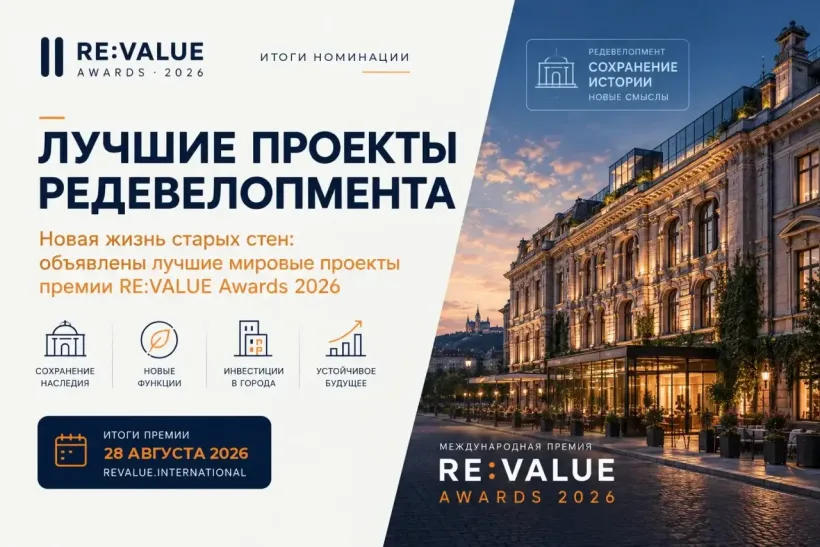
The independent editorial investment real estate award RE:VALUE Awards has announced the results for the “Best Redevelopment Projects” category. The top prize went to Six Senses Rome — a hotel in a 15th-century palazzo that also restored the facade of a neighbouring church. The category features seven properties: a former prison in Japan, the US Embassy in London, a Soviet telegraph building in Tbilisi, an entire island in France, and an abandoned mountain hotel in Cyprus. Here is the full breakdown: selection criteria and all the winners.
Market Insights: Why Redevelopment
What is simpler — building a hotel from scratch or converting an abandoned prison, a Soviet telegraph building, or a former monastery into a five-star resort? Investors and architects are increasingly choosing the second route.
Redevelopment is considered one of the most challenging sectors in real estate: protected building status restricts layouts, utilities have to be routed with millimetre precision, and deadlines and budgets almost inevitably exceed initial estimates. In return, the developer gains something that cannot be built — a location in a historic centre and a building's biography that drives sales better than any advertising.
The edition's longlist included 19 projects across 12 countries. The editorial board assessed not just appealing visuals, but the quality of heritage preservation work. The core principle: the new function must not erase the building's history. On the contrary, history becomes its main market advantage.
How Projects Were Selected: Five Criteria
Priority was given to completed or nearly finished properties — those where results can be evaluated in reality rather than in renders. The projects then passed through five filters.
1. Historical Value of the Property
What exactly was preserved: a protected architectural monument, an iconic city landmark, or an ordinary building with a compelling legend. The higher the status of the structure, the stricter the constraints and the costlier every architectural decision.
2. Quality of Restoration
Whether authentic elements — facades, staircases, frescoes, mouldings — were preserved or replaced with modern imitations. This also evaluated how modern engineering systems were concealed: in historic buildings, this is the most expensive and invisible part of the work.
3. Scale and Complexity of Works
Repurposing a mansion is one thing; reconfiguring a department store spanning an entire city block or renovating a whole island is another. Technical complexity was also factored in: floor slabs, load-bearing structures, seismic requirements, and conservation encumbrances.
4. Logic of the New Function
How fitting a hotel is within these walls. A prison, an embassy, and a telegraph office were engineered for isolation and control — transforming such spaces into comfortable guest environments is harder than adding an extra floor.
5. Impact on the Urban Environment
Whether a previously closed property remains gated after reconstruction or opens up to the city. Projects that integrated restaurants, cultural venues, and public spaces alongside the hotel received higher ratings.
Winner: Six Senses Rome (Italy)
The category winner is Six Senses Rome — a hotel housed in the Palazzo Salviati Cesi Mellini in Rome's historic centre, a UNESCO World Heritage site. Built in the 15th century, it was redesigned in the Baroque style in the 18th century by architect Tommaso De Marchis. The reconstruction project was led by Patricia Urquiola, and the hotel opened in March 2023.
The architects did not hide the building's age. The 600-year-old columns in the lobby were restored and left on display, the monumental marble staircase with a skylight was fully preserved, and a 4th-century baptismal font discovered during the works was covered with a glass floor — now visible directly from the restaurant. Roman baths in the spa recreate the classic caldarium – tepidarium – frigidarium circuit.
- Property: A 15th-century palazzo with 18th-century Baroque modifications, facing Via del Corso.
- What was preserved: Protected facade, marble staircase, 15th-century columns, and archaeological layers beneath floor level.
- New function: 96 rooms and suites, spa with Roman baths, restaurant, and a panoramic rooftop terrace.
- Contribution to the city: The hotel funded the restoration of the facade of the neighbouring Church of San Marcello al Corso — the team's first urban initiative even before the official opening.
Why it won: A rare case where a developer invested beyond its own walls. The hotel returned a restored church facade to the city and showcased the building's archaeology to guests rather than concealing it under concrete screed.
Shortlisted Projects
HOSHINOYA Nara Prison (Nara, Japan)
The most unusual project in the category. The red-brick prison built in Nara in 1908 closed several years ago. The walls were kept intact and the history of the site preserved — the building was transformed into a hotel under the HOSHINOYA brand.
The primary challenge was not structural, but atmospheric: the space was designed for isolation and strict routine, yet needed to serve as a restful retreat. Former cells were merged to create guest rooms, and the radial layout once used by guards for surveillance now offers guests quiet and zero shared walls with neighbours.
Why shortlisted: An extraordinarily complex change of use where a sombre past was turned into a distinct aesthetic experience.
The Chancery Rosewood (London, United Kingdom)
The former US Embassy in Grosvenor Square is a 20th-century modernist landmark designed by Eero Saarinen. The architecture is austere, enclosed, and decidedly functional: the building was engineered against external threats, including bombings, resulting in a rigid structural framework.
Integrating guest rooms, restaurants, and a spa without destroying anything required surgical precision. The monumental facade was fully preserved, while the interior was transformed into a contemporary British Rosewood hotel.
Why shortlisted: Large-scale and meticulous work with complex modernist architecture, which is more often demolished than restored.
Zannier Île de Bendor (Bendor Island, France)
Here, the developer worked not with a single building, but with an entire seven-hectare island. In the mid-20th century, Bendor was a popular private resort, but its infrastructure eventually deteriorated and the island was deserted.
The Zannier project revitalises the entire island: restoring old buildings, constructing new hotel pavilions, and introducing craft workshops (as tourists increasingly seek authentic souvenirs and workshops over mass-produced goods), restaurants, and walking trails. The island operates once again as a cohesive resort blending heritage with modern hospitality.
Why shortlisted: Scale and master planning across an entire territory rather than an individual building.
Orient Express Venezia (Venice, Italy)
Redevelopment of a 15th-century palazzo in the Cannaregio district, once owned by influential Venetian families Donà and Giovannelli. The approach was the exact opposite of London: there were no large-scale structural changes.
The building was adapted for the Orient Express hotel with extreme care. Utility systems were installed without disturbing antique frescoes, stucco work, or historic decor. The hotel seamlessly blends into the palazzo walls — making interventions virtually imperceptible.
Why shortlisted: Supreme craftsmanship and an exceptionally gentle approach to historic architecture.
Special Nominations
Editor's Choice: The Telegraph Hotel (Tbilisi, Georgia)
The “Editor's Choice” title was awarded to The Telegraph Hotel for its bold handling of 20th-century architecture. The central telegraph building in the heart of the Georgian capital was converted into a five-star hotel designed by Neri&Hu.
The architects did not soften the modernist structure to mimic classical styles, preserving its raw industrial character. A previously closed departmental facility was opened to the public, featuring a restaurant, a jazz club, a wine shop, and cultural venues.
Why this is our choice: The project proved that Soviet modernism can be stylish, relevant, and commercially viable — setting a precedent for dozens of similar vacant buildings across the region.
Special Mention: Berengaria Hotel (Prodromos, Cyprus)
The Berengaria Hotel received a Special Mention for its loyalty to history. Built in 1930 in the mountains of Cyprus, it was an island icon for decades before being abandoned and falling into disrepair.
The new project does not alter the building's purpose. The team is restoring the hotel to its original splendour, reinstating its former status while adding modern luxury standards.
Why Special Mention: Rescuing a national heritage asset and returning to its authentic original function rather than inventing a new one.
Key Takeaways
The seven category properties demonstrate the diverse forms of high-calibre redevelopment. A prison turns into a hotel, a palazzo becomes accommodation without altering a single partition, an abandoned mountain lodge welcomes guests again, and an entire island transforms into a resort. Different countries, budgets, and scales.
They share one key trait: top redevelopment does not rewrite a building's history, but gives it a continuation. For an investor, there is also a practical conclusion — in projects of this type, one should look not at 3D renders, but at heritage protection status, the scope of restoration works, and the team's track record with architectural landmarks. These factors determine actual timelines and budgets.
The previous edition of the awards was dedicated to guaranteed yield projects — find the results and criteria review here. Complete methodology, longlists, and full results are available on the official RE:VALUE Awards website.