










Housing prices in Montenegro reach record level
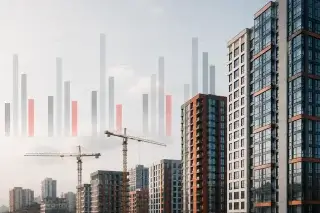
The average cost of housing in Montenegro has reached a new all-time high, although the pace of growth has slowed significantly, according to the Vijesti portal. Experts believe the market is entering a stabilization phase, while in the long term they still expect further price increases as the country moves closer to European Union membership.
How much do apartments cost in Montenegro
The average apartment price in Montenegro has reached €2,445 per square meter. As a result, a 40 sq. m property now costs close to €100,000. According to Monte Business, in Q1 2026 the primary market price reached €2,445 per sq. m. Prices are slightly higher on the coast at €2,575, while Podgorica and the northern region are cheaper at €2,395 and €1,708 respectively.
Stefan Miskovic, President of the Association of Real Estate Agencies, noted that in previous years prices had been increasing by around 20% annually. However, in the last quarter growth slowed to just 1.2%, indicating a clear deceleration in market dynamics.
Mile Gujic, Chairman of the Board of the Construction Association of the Chamber of Commerce of Montenegro, stressed that purchasing an apartment remains a serious challenge for citizens whose income depends on salaries and mortgage lending. At the same time, he believes that for those who can solve their housing needs, buying real estate remains more advantageous in the long term than renting.
Meanwhile, rental prices have decreased by around 20% compared to December 2025. One-bedroom apartments in Podgorica are most often rented for €400–450 per month.
Construction costs rose by 5.1% in January–March, but decreased by 12.6% over the quarter. Developers are facing labor shortages and a significant increase in the cost of basic services, which have become much more expensive in recent years.
Reasons for changes in the Montenegrin real estate market
The President of the Association of Real Estate Agencies of Montenegro, Stefan Miskovic, attributes the slowdown in price growth to market saturation. In addition, following stricter rules for investment-based residence permits and business-based residency, fewer foreigners are coming to the country. The investment and migration climate has become less favorable, leading to lower demand for both property purchases and rentals.
Montenegro residence permits based on real estate
To obtain a residence permit through property ownership, non-EU citizens must now own real estate with a tax-assessed value of at least €150,000. The purchase price is not considered, only the valuation determined by tax authorities. Those who obtained residence permits before the amendments came into force may continue to renew under the previous rules, without the minimum value requirement.
Applicants must also prove property ownership, actual use of the property, and absence of outstanding property tax obligations. This type of residence permit is issued for one year with the possibility of renewal, but does not grant the right to work or conduct business activities.
Montenegro residence permits based on business
Changes also affected business-based residence permits. Initially, authorities proposed requiring foreign entrepreneurs to employ at least two Montenegrin citizens, but after consultations with the business community this requirement was dropped. In the final version of the law, it is sufficient for a company to employ one worker, regardless of nationality. The company must also demonstrate payment of more than €5,000 in taxes and social contributions for the previous year, as proof of genuine economic activity.
Applicants who began the residence permit process before the amendments entered into force may complete it under the previous rules, but for no longer than 12 months. Citizens of the EU, United Kingdom, Switzerland, Norway, and Iceland are exempt from the minimum tax payment requirement.
Outlook for Montenegro’s housing market
Mile Gujic, Chairman of the Construction Association of the Chamber of Commerce of Montenegro, believes that future market dynamics will depend on continued economic and institutional reforms. Key factors, in his view, include monetary and fiscal stabilization, as well as strengthening legal certainty in the real estate and investment sectors.
He also highlights the potential equalization of conditions between foreign buyers and domestic citizens, which, in his opinion, could increase Montenegro’s attractiveness for investors and support further growth in the housing market.
Analysts at International Investment note that Montenegro’s progress toward EU membership could trigger a new wave of property price growth, especially along the coast, where investment demand is traditionally concentrated. However, the timeline for EU integration remains uncertain. Among the factors slowing the process are ongoing disagreements with European Commission requirements. In particular, authorities have only declared the introduction of visa requirements for Russian citizens but continue to postpone the reform, citing the importance of tourism flows from Russia for the economy.