












Greece’s Golden Visa: Applications Fall 25%, Backlog Drops 7.3%
Stacker
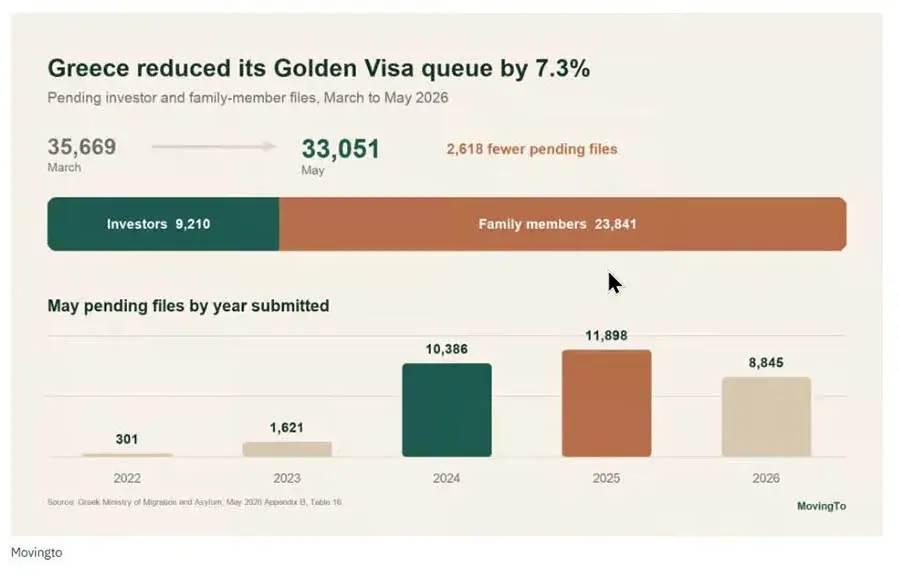
The pressure on Greece’s Golden Visa system has started to ease following a notable decline in new applications, Stacker reports, citing an analysis by Movingto. From March to May 2026, authorities made nearly 3,000 decisions on applications from principal investors, while the total number of pending cases fell to 33,051.
Family members account for the majority of pending cases
At the end of March 2026, Greece had 10,032 applications from principal investors and 25,637 from family members. By the end of May, these figures had fallen to 9,210 and 23,841 respectively, meaning the number of pending cases decreased by 8.2% and 7% over the two-month period. Family-member applications accounted for almost 72% of the total, so the figure of 33,051 does not represent the number of investors waiting for approval.
Most of the pending applications were submitted in 2024 and 2025, accounting for 22,284 cases. Another 8,845 were filed during the first five months of 2026. At the same time, 1,922 applications submitted in 2022–2023 were still pending.
In March, Greek authorities processed 1,446 applications from principal investors, including 1,239 initial permits and 207 renewals. The figure was 882 in April and 659 in May. In total, 2,987 decisions were made over the three-month period.
New applications fall by 25%
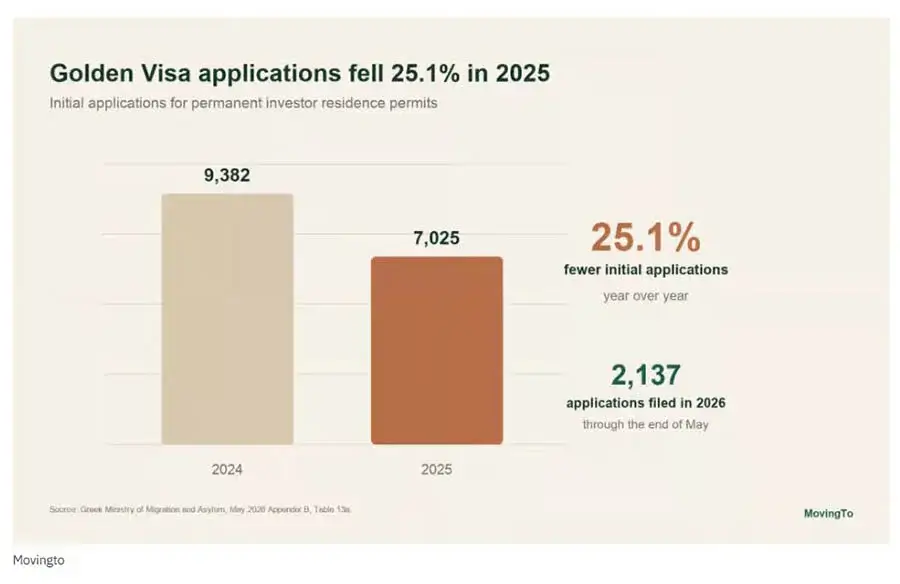
In 2024, Greece received 9,382 initial Golden Visa applications from investors. In 2025, the number fell to 7,025, a decline of 25.1%. A further 2,137 new applications were filed during the first five months of 2026. By the end of May, 250 of them had already been approved, two had been rejected, and 1,885 remained pending.
The decline in new applications followed changes to the programme’s requirements. Greece raised the minimum property investment to €800,000 in Attica, the Thessaloniki Regional Unit, Mykonos, Santorini and islands with populations of more than 3,100. Elsewhere, the standard threshold is €400,000. Under certain conditions, investors can still qualify for a Golden Visa with an investment of €250,000, for example by purchasing a property and converting its use or restoring a listed heritage building.
Impact of the 2022 reform
The Bank of Greece previously analysed the impact of the 2022 reform, which increased the minimum Golden Visa investment from €250,000 to €500,000 in several areas. The largest sample covered Attica, with 61,346 transactions, while Thessaloniki accounted for 18,604 and the South Aegean for 2,135.
Before the reform, a large number of transactions were concluded at around €250,000. After the minimum threshold was raised, there were significantly fewer purchases in this price range. The change also affected the geographical distribution of the market. In municipalities subject to the higher threshold, price growth was slower, while activity increased in nearby markets.
What is changing for investors
Analysts at International Investment note that Greece’s Golden Visa is becoming a more expensive and less flexible programme. Higher investment thresholds have already contributed to a decline in new applications and changed the distribution of demand in the property market. Many investors have shifted towards areas with less restrictive requirements.
At the same time, the Greek authorities are restricting the use of property for short-term rentals. This is changing the previous model, under which buying a property could combine obtaining residency with income from tourist rentals.
Investors must now consider more than the property’s price and its eligibility for a residence permit. The location, applicable investment threshold and rules governing the subsequent use of the property have also become important factors. If the current policy continues, demand is likely to keep shifting between regions. Investors also need to take into account pressure from the European Commission, which recommends phasing out such programmes, with most EU member states having already done so.