







 Covivio Hotels Revenue Grows 4.7% as European Markets Split
 Lithuanian Apartment Prices Accelerate Across Major Cities
 Georgia's Tourism Revenue Hits Record High
 Norway's Sovereign Fund Commits €1.5bn to European Warehouses
 Market Rout of October 2026: Can Branded Hotels Protect Capital?
 Residential Property Prices in Tbilisi Rise by 5.9% Year-on-Year
В Belarus, an old estate linked to the legend of Napoleon’s gold is being put up for sale
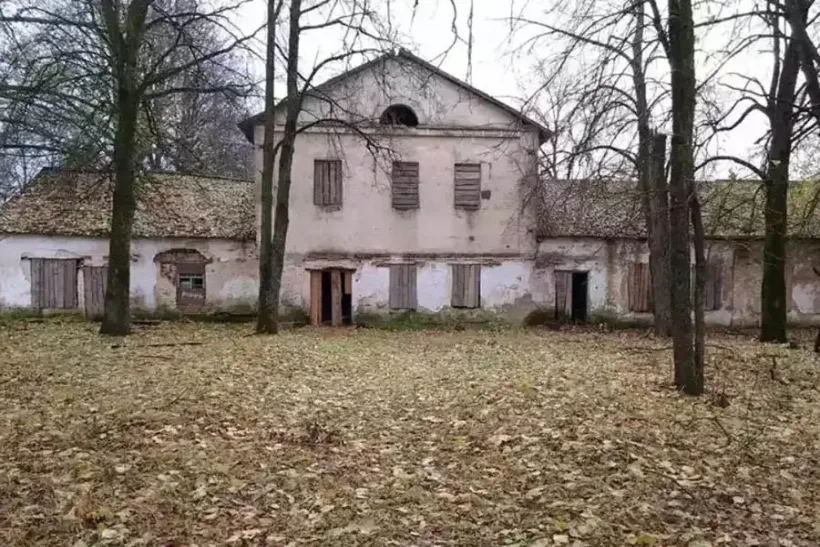
An old estate built in 1897 has been put up for electronic auction in Belarus. The starting price is just 45 Belarusian rubles — about $15. It is believed that Napoleon’s gold may have been hidden at this location in the past, reports Nasha Niva.
The Tyndevitsky Family Estate
The estate is located in the village of Goloshevo in the Tolochin district of the Vitebsk region. Before the surviving stone house was built, there was a wooden building on the site. After the 1863 uprising, the authorities planned to confiscate the estate from the Tyndevitsky family, and its owner, Anton Tyndevitsky, was arrested. His brother Mikhail was executed by firing squad in Minsk that same year for taking part in the uprising. However, Anton’s guilt and his connection to the rebels could not be proven, so the estate remained with the family.
In 1897, Anton’s nephew, also named Mikhail Tyndevitsky, is believed to have begun construction of a new estate house with a total area of 621 sq m, using locally produced bricks. He was an engineer and designed the building himself in the classical style.
After the 1917 Revolution, the Tyndevitsky family left Goloshevo. The estate house was later used for various purposes. During the German occupation, it served as a headquarters; after the war, it housed a school for deaf children and a boarding school, and from 1974 it was used as an ordinary eight-year rural school. The building has stood vacant since the late 1990s and has gradually fallen into disrepair.
The estate is also associated with a legend about the so-called “Moscow treasure.” According to the story, Napoleon’s looted gold may have been hidden here during the retreat of the French army in 1812. There is no historical evidence confirming the story.
Additional Purchase Conditions
The starting price for the estate is 45 Belarusian rubles, or about $15. However, this is only the starting price: under the auction terms, the buyer must also reimburse almost 4,800 Belarusian rubles in expenses related to organizing the auction and preparing the documents.
The lot includes the remains of the 621-sq-m estate house and two brick utility buildings. The building is not registered in the Unified State Register of Real Estate. The new owner will instead receive a registered passport for the unused structure.
A plot of approximately 0.77 hectares will be provided under a free 50-year lease, without a separate auction or payment for the lease right. However, part of the land is located within the water protection zone of a lake, which imposes additional restrictions on its use.
The estate has the status of a historical and cultural heritage site, so the buyer is required to carry out repair and restoration work. These works must be completed within the timeframe specified in the design and cost-estimate documentation and, in any case, no later than three years after the sale agreement is signed. The buyer must also sign a preservation agreement within 30 days of acquiring the property.
The estate complex may be used only for cultural and educational activities or agro-tourism. Applications for the current auction are being accepted until September 18, with the auction scheduled for September 23.
Other Historic Estates Are Also Being Sold in Belarus
The current auction is not the first attempt to find a buyer for the estate. In January 2026, the property was already put up for auction, but no buyer was found. Back in 2021, the building was included on a list of properties planned for demolition.
The Tyndevitsky estate is not the only historic property in Belarus being offered for a symbolic price. In November 2025, the Yelensky estate in the agricultural town of Tucha, Kletsk district, was offered for 42 Belarusian rubles ($13). The property was being sold together with outbuildings and a plot of land. It had previously been put up for sale, but no buyer was found.
In 2026, a new owner was finally found for the Chechotov-Bohvits estate in Padorosk, Grodno region, after several unsuccessful attempts. It was offered at the latest auction with a starting price of BYN 450 ($137). Ten people took part in the auction, and the final price reached BYN 200,992.50 ($61,200).
International Investment analysts note that such sales indicate the emergence of a separate niche: the state is willing to transfer historic properties at almost nominal prices, while shifting the main costs to the new owner. The potential investment appeal of such projects arises only when there is a clear model for future use — for example, as a tourist attraction, hotel, or another commercial project compatible with historic preservation requirements. The low entry price therefore lowers the barrier to attracting an investor rather than creating an attractive investment opportunity in itself.