







 Covivio Hotels Revenue Grows 4.7% as European Markets Split
 Lithuanian Apartment Prices Accelerate Across Major Cities
 Georgia's Tourism Revenue Hits Record High
 Norway's Sovereign Fund Commits €1.5bn to European Warehouses
 Market Rout of October 2026: Can Branded Hotels Protect Capital?
 Residential Property Prices in Tbilisi Rise by 5.9% Year-on-Year
Cyprus Housing Prices Rise 8.5% in a Year

Unsplash
Housing in Cyprus became 8.5% more expensive over the 12 months to the second quarter of 2026 and rose 2.4% over three months. Strong demand from foreign buyers remains the main driver, while activity among local buyers is also increasing. Rising construction costs are putting additional pressure on prices, according to the Central Bank of Cyprus (CBC).
Cyprus Housing Price Trends
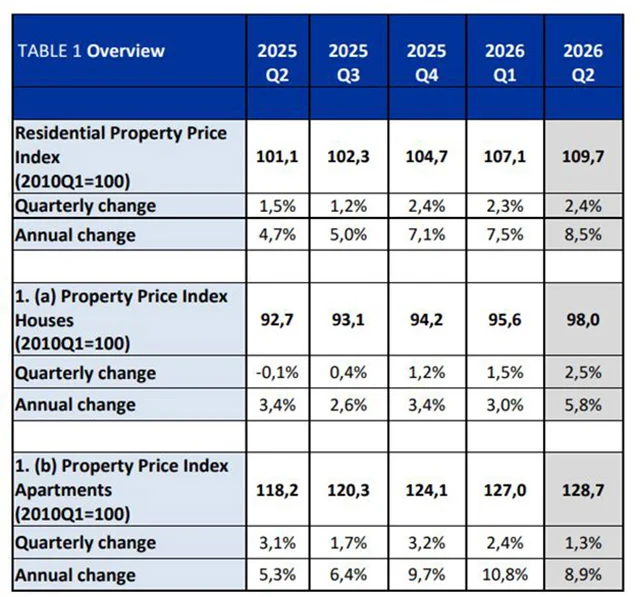
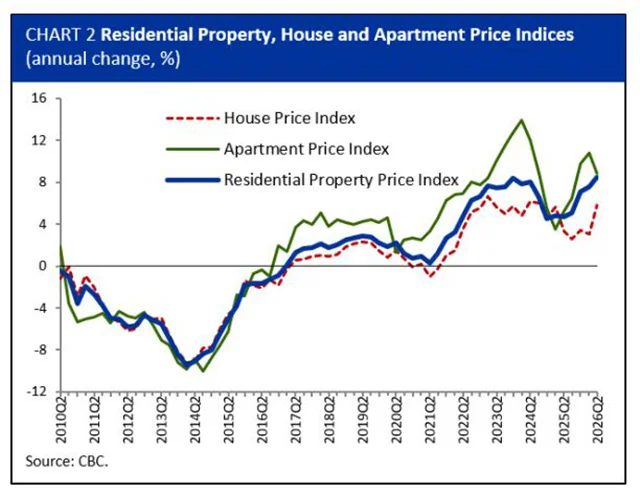
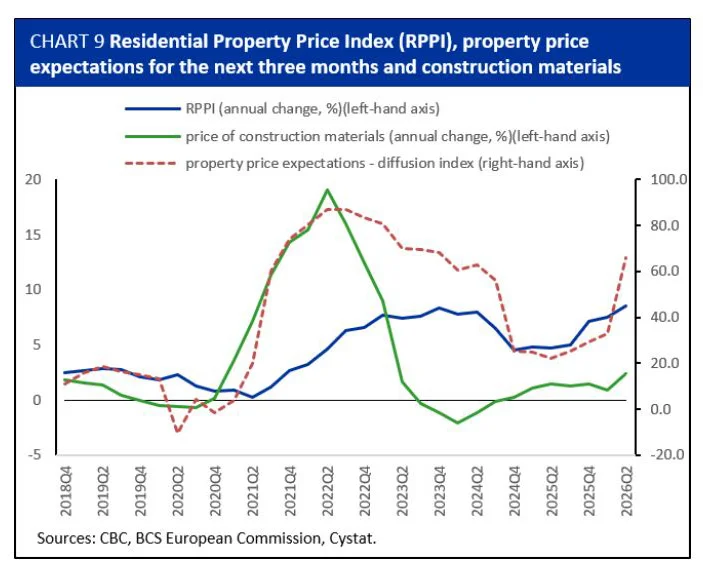
In the second quarter of 2026, the Cyprus Residential Property Price Index (RPPI) reached 109.7 points. Housing prices increased by 2.4% over three months and by 8.5% over 12 months. By comparison, annual growth stood at 7.5% in the first quarter, indicating a further acceleration in the overall market.
Apartments continued to record the strongest price increases, rising 8.9% over the year. However, the pace slowed from 10.8% in the first quarter. The opposite trend was observed for houses, where annual growth accelerated from 3% to 5.8%. During the second quarter alone, apartment prices rose 1.3%, while house prices increased 2.5%.
The CBC index is calculated using market valuations of residential properties submitted by credit institutions. It covers apartments and houses across the government-controlled areas of the Republic of Cyprus. The central bank notes that, due to the methodology used, the index may reflect turning points in market trends with a slight lag.
Cyprus Housing Market by District
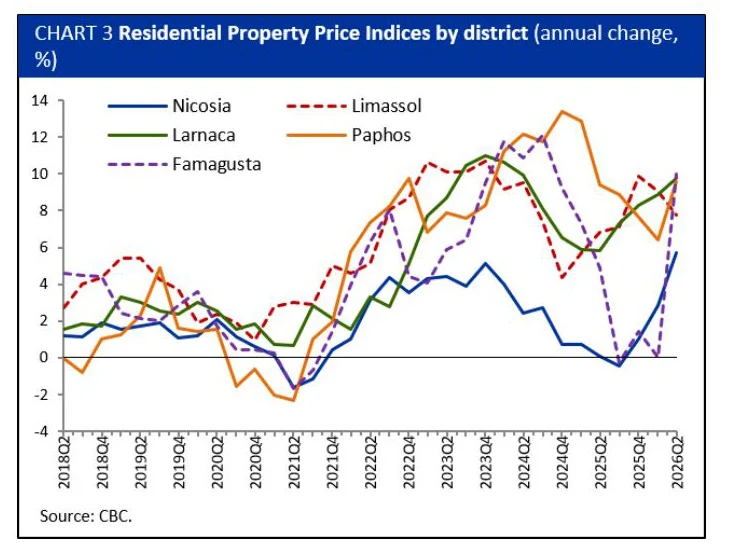
Price trends varied considerably across Cyprus in the second quarter of 2026. The overall index recorded its strongest increase in Famagusta, rising 10% over 12 months. Housing prices climbed 9.8% in Larnaca, 9.6% in Paphos, 7.8% in Limassol and 5.7% in Nicosia. Compared with the first quarter, growth accelerated in four districts and slowed only in Limassol.
Paphos stood out in the apartment market, with prices rising 18.5% over 12 months. This was more than twice the rates recorded in Larnaca (7.9%), Limassol (7.8%) and Famagusta (7.4%). Apartment prices in Nicosia increased by 4.6%. Growth accelerated in Paphos, Nicosia and Famagusta, while slowing in Limassol and Larnaca.
In the house segment, Famagusta recorded the largest increase at 10.5%. Prices rose 8.9% in Larnaca, 4.4% in Nicosia and 4.3% in Limassol. Despite the sharp rise in apartment prices, Paphos posted the most moderate increase in house prices, at 3.1%. It was also the only district where growth in this segment slowed.
Foreign Demand for Cyprus Property
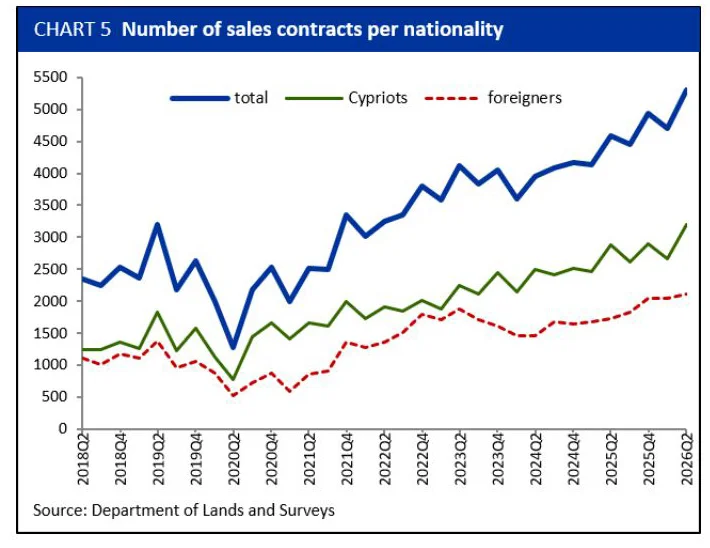
A total of 5,298 property sales contracts were registered in Cyprus between April and June 2026, up 15.4% compared with the same period of 2025. Land Department statistics cover all types of property, not only residential real estate.
Transactions involving foreign buyers increased by 22.7% to 2,107. Local residents signed 3,191 contracts, 11% more than in the same period of 2025. Cypriots therefore continued to account for the majority of sales, although activity among overseas buyers expanded significantly faster.
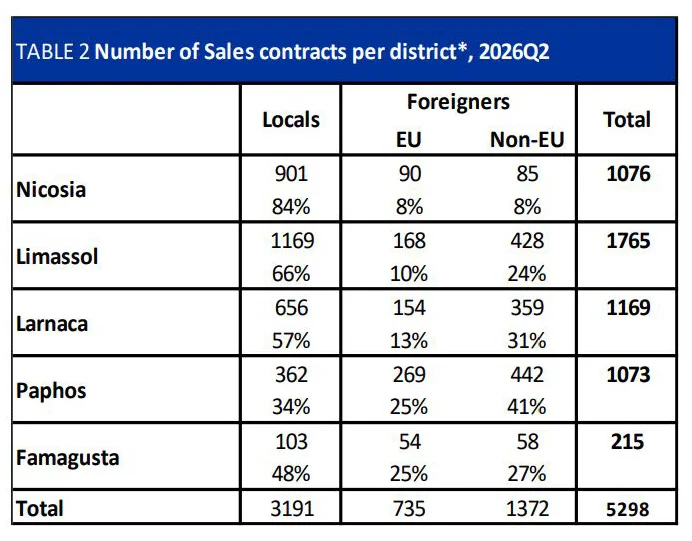
The balance between domestic and foreign demand varied considerably by district. Cypriots accounted for 84% of transactions in Nicosia, 66% in Limassol and 57% in Larnaca. In Famagusta, the split was almost even, with local residents accounting for 48% and foreigners for 52%. Overseas buyers generated 66% of sales in Paphos, including 41% of the total involving buyers from non-EU countries.
Cyprus Mortgages: Lending Volume Rises 14.2%
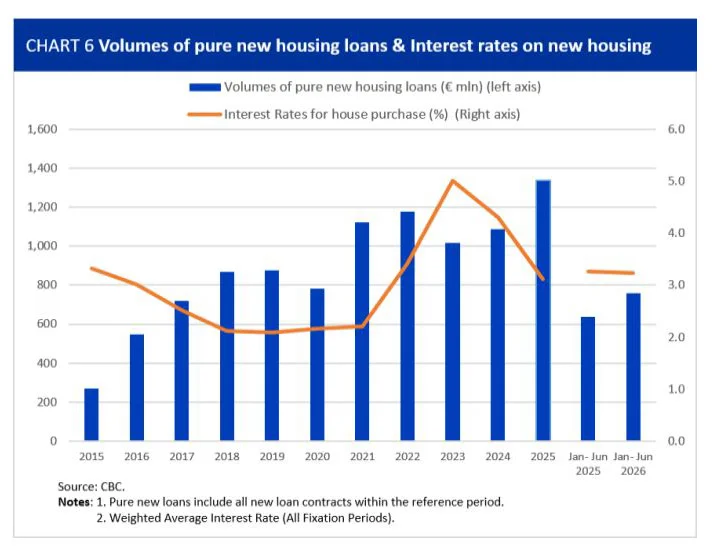
New housing lending in Cyprus increased significantly. The volume of new housing loans stood at €353.5 million in the second quarter of 2025 and reached €403.6 million in the same period of 2026, an increase of 14.2% over 12 months.
Interest rates edged down over the period, from 3.26% to 3.23%. A July survey also showed stronger demand for housing loans compared with the first quarter. Lending criteria remained unchanged and continued to be strict. Banks expect mortgage demand to increase further in the third quarter without easing requirements for borrowers.
Cyprus Construction: Labour Shortages
A European Commission survey shows that labour shortages are constraining Cyprus's construction sector. The Central Bank notes that the lack of workers is putting upward pressure on property prices. Labour costs are adding to this pressure, with wages in the sector rising faster than in the pre-pandemic period.
The construction selling price expectations index climbed from 22.2 points in the second quarter of 2025 to 65.9 in the same period of 2026. The indicator reflects industry participants' expectations for the following three months. The sharp increase means that a substantially larger share of developers expect selling prices to rise.
What This Means for Investors
International Investment analysts note that the Cyprus property market retains growth potential, although its momentum may moderate over the medium term. A substantial increase in new construction should gradually expand supply, while high development costs and labour shortages are likely to prevent a significant decline in prices.
Government regulation of the housing sector is another factor to consider. Cyprus is tightening requirements and introducing measures aimed at improving housing affordability for local residents. For property owners, changing rules may result in additional costs and restrictions that could affect investment returns.
Under these conditions, property buyers need to consider not only potential capital appreciation but also net returns after taxes, maintenance and operating costs, rental conditions and possible legislative changes. Tighter regulation makes such calculations increasingly important and means that the choice of investment model may matter more than the overall direction of the market.