







 Covivio Hotels Revenue Grows 4.7% as European Markets Split
 Lithuanian Apartment Prices Accelerate Across Major Cities
 Georgia's Tourism Revenue Hits Record High
 Norway's Sovereign Fund Commits €1.5bn to European Warehouses
 Market Rout of October 2026: Can Branded Hotels Protect Capital?
 Residential Property Prices in Tbilisi Rise by 5.9% Year-on-Year
AI Companies Bring Tenants Back to Dublin Offices

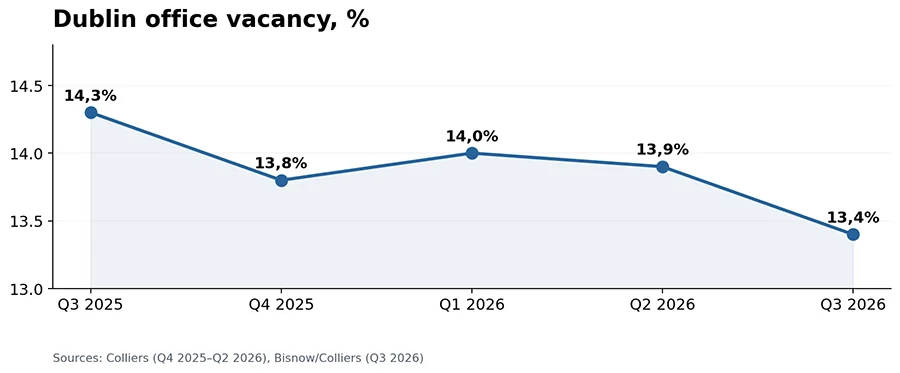
Artificial intelligence firms are becoming a more visible source of demand for Dublin offices. Irish AI companies have raised €256 million across 75 venture deals so far in 2026, while overall office vacancy fell to 13.4% in the third quarter from 14.3% a year earlier. OpenAI announced another 200 jobs in October and is developing an Applied AI Lab at its European headquarters. But the recovery cannot be attributed to AI alone: financial services, professional firms and other occupiers are also active.
The strongest demand is focused on modern, efficient buildings in central locations. Landlords of secondary offices face higher refurbishment costs and a more difficult leasing environment, despite the improvement in the headline vacancy rate.
Dublin office vacancy falls by 0.9 percentage points
Third-quarter vacancy reached 13.4%, down from 13.9% in Q2 and 14.3% in Q3 2025. The annual decline was 0.9 percentage points, not a 0.9% proportional fall. Colliers figures reported by Bisnow relate to the wider Dublin office market, rather than a discrete survey of AI company premises.
There were 55 transactions covering roughly 531,000 sq. ft., or about 49,000 sq. m, during the quarter. Take-up was around 15% below Q2 and the five-year third-quarter average. The first nine months accounted for roughly 1.6 million sq. ft. of activity. More than 1 million sq. ft. was under offer at quarter-end; excluding this space would reduce effective availability to 11.4%, but these transactions are not all completed.
A lower vacancy rate does not mean every office building is recovering. Some transactions relocate occupiers from older stock and demand remains concentrated in higher-quality premises.
Irish AI startups raised €256 million so far in 2026
PitchBook research published by Enterprise Ireland on October 12 identifies €947.3 million of venture capital across 182 Irish AI deals since the beginning of 2025. The record year 2025 accounted for €691.3 million and 107 transactions; the 2026 year-to-date figure is €256 million across 75 deals. The two periods are not directly comparable as full years.
Median deal value fell from €2.4 million in 2025 to €1.6 million in 2026, but remained higher than in every year before 2025. Late-stage financing reached €135.5 million across 18 deals in 2026 to date. Ireland ranks ninth in Europe for AI venture deal count and second per capita.
Venture funding does not automatically become demand for office floorspace. Compute infrastructure, research and commercial expansion may absorb the investment before companies add physical teams.
OpenAI expands its European headquarters
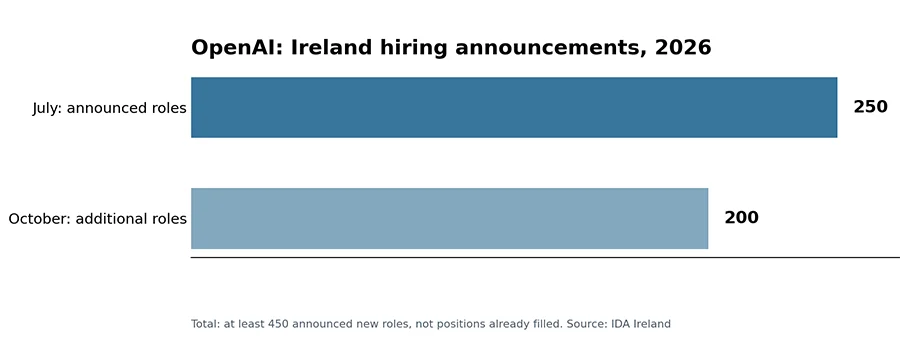
On October 12, OpenAI announced a further 200 Irish jobs alongside its Applied AI Lab. These follow 250 positions announced in July, taking the commitment to at least 450 new roles. OpenAI employed more than 120 people in Ireland at the time of the latest announcement. The 450 roles are planned additions, not positions already filled.
The Applied AI Lab will bring engineering, privacy, enterprise implementation and commercial functions to the company's new EU headquarters at Tropical Fruit Warehouse in the Docklands. The move is scheduled for December 2026.
OpenAI announced approximately 88,000 sq. ft. of headquarters space in July. Bisnow reports that the quarter's largest office deal involved a lease assignment previously held by TikTok. This is an important occupier commitment but not proof of an equivalent increase in net city-wide office demand.
Anthropic also takes more space
Anthropic announced 200 additional jobs by 2027 in March and a sixfold expansion of its central Dublin offices to 21,000 sq. ft. The roles span engineering, sales, finance, legal, compliance and operations. Tines has also outlined plans for 100 new Irish jobs and a new Dublin headquarters, while Version 1 opened a new headquarters and AI Studio.
These transactions connect the development of AI services to real property demand, although the share of Dublin's overall vacancy decline attributable to the sector has not been measured.
Prime premises recover faster than secondary offices
Colliers reported in Q2 that Dublin occupiers increasingly favoured energy-efficient Grade A buildings in central locations. Finance, insurance, legal services and technology were among the active sectors, demonstrating demand well beyond AI.
Prime central business district rents stood at €65–70 per sq. ft. annually in Q2, equivalent to roughly €700–753 per sq. m per year before lease incentives or additional charges. At that time, less than 1.4 million sq. ft. was under construction or refurbishment across six developments, with more than 65% pre-let or intended for owner-occupation. These supply figures are from Q2, not a verified updated Q3 pipeline.
|
Metric |
Period |
Value |
|
Office vacancy |
Q3 2026 |
13.4% |
|
Office take-up |
Q3 2026 |
≈531,000 sq. ft. |
|
AI venture capital |
2026, by Oct 12 |
€256 million |
|
OpenAI jobs announced |
July + October |
250 + 200 |
|
Prime CBD office rent |
Q2 2026 |
€65–70 / sq. ft. annually |
|
Office pipeline |
Q2 2026 |
below 1.4m sq. ft. |
Investor pricing is a separate question
Irish commercial property investment approached €1.5 billion in H1 2026. Q2 office transactions exceeded €187 million, including the purchase of One Molesworth Street for roughly €110 million. These property investment volumes must not be confused with venture capital invested in Irish AI companies.
Higher rent and lower vacancy do not necessarily increase capital values if borrowing costs, capital expenditure or required yields also rise. Buyers must consider lease terms, tenant credit quality, energy performance and future refurbishment obligations.
International Investment's earlier Ireland property outlook highlighted the shortage of best-in-class office space. Its broader European prime-rent analysis also explained why rising rental income can coexist with softer real estate valuations.
AI creates demand, but the recovery remains selective
OpenAI and Anthropic provide concrete examples of AI-led occupier expansion, while funding for Irish startups may support future growth. Yet venture deals cannot simply be translated into square metres, and relocation transactions can leave space vacant elsewhere.
The clearest beneficiaries are well-located, adaptable office buildings with stable tenants. For property investors the question is not only which AI firms raise money, but which actually take space, under what lease terms, and with what long-term ability to pay.
FAQ
What was Dublin office vacancy in Q3 2026?
13.4%, down from 14.3% a year earlier, a 0.9 percentage-point decrease. Excluding space under offer would lower effective availability to 11.4%.
How much have Irish AI companies raised in 2026?
€256 million across 75 venture deals by October 12, compared with €691.3 million during the full year of 2025.
How many new jobs has OpenAI announced in Ireland?
At least 450 new roles, comprising 250 announced in July and 200 in October. These are hiring commitments, not already-filled positions.
Where will OpenAI's Dublin EU headquarters be?
At Tropical Fruit Warehouse in the Docklands, with around 88,000 sq. ft. of office space and a planned move in December 2026.
Which Dublin offices are most in demand?
Modern, centrally located, energy-efficient premises that support changing workplace needs and corporate occupiers.
Is AI alone responsible for the office recovery?
No. Colliers also identifies demand from finance, professional services, healthcare and other sectors; AI's precise contribution to vacancy reduction is not established.