











Swiss Tourism Growth Remains Concentrated
Switzerland’s largest tourism destinations continue to grow faster than smaller regions despite a strategy designed to distribute visitors more evenly. Compared with 2023, the country’s 50 leading destinations recorded 1.7 million additional overnight stays, an increase of 6%, while roughly 130 smaller destinations grew by less than 2%.
Switzerland has yet to redistribute tourism demand
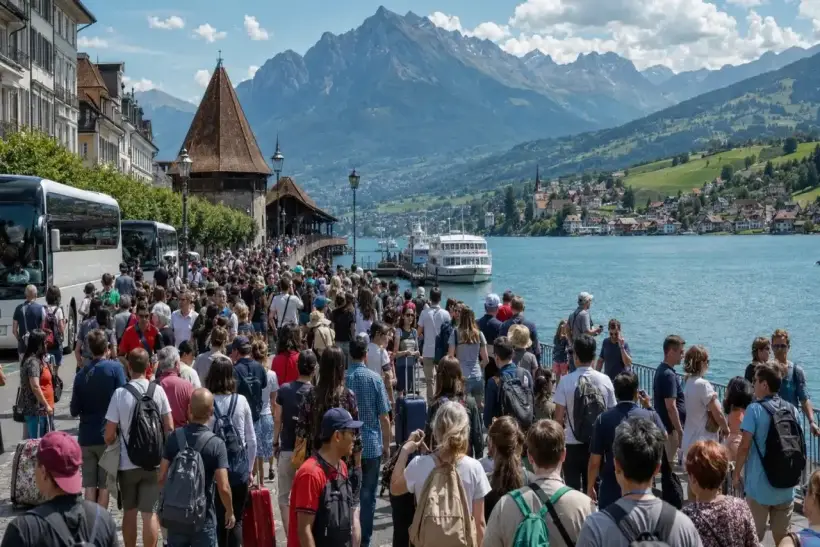
Since 2024, Switzerland Tourism has placed greater emphasis on distributing visitors across more destinations and seasons instead of focusing solely on increasing travel volumes. The policy is intended to reduce pressure on Lucerne and other major cities, Alpine resorts and popular natural attractions.
Initial accommodation data show no significant redistribution. According to an analysis by NZZ am Sonntag cited by SWI swissinfo, the 50 largest destinations gained 1.7 million overnight stays compared with 2023, representing growth of 6%. Approximately 130 smaller destinations expanded by less than 2%.
The analysis also found no improvement in the distribution of demand throughout the year. Visitor activity remains concentrated in the traditional summer and winter seasons.
The performance agreement with the federal government calls for small and medium-sized destinations to increase or at least maintain their market share relative to the 50 largest locations. Based on the overnight-stay figures examined, that objective has not yet been achieved.
CHF60 million was not a dedicated overtourism budget
Federal funding for Switzerland Tourism totalled approximately CHF60 million in 2025. It is inaccurate, however, to describe the entire amount as spending on overtourism or congestion management.
The organisation promotes Switzerland in domestic and international markets, works with transport companies and tour operators, attracts business events, runs digital campaigns and markets lesser-known regions. Geographic and seasonal visitor distribution is one of its objectives, not the sole purpose of its public funding.
Up to CHF233 million is available to Switzerland Tourism for the 2024–2027 funding period. A further CHF45 million is allocated to Innotour, which supports innovation and cooperation in the tourism sector. The New Regional Policy also provides up to CHF200 million in loans and CHF200 million in non-repayable grants for projects with a regional economic impact, according to the State Secretariat for Economic Affairs.
The accommodation figures therefore indicate that a specific distribution target has not been reached. They do not establish that all federal tourism funding has been ineffective.
Swiss hotels reached another record
Redistributing demand has become more difficult as the overall market expands. Swiss hotels registered 43.9 million overnight stays in 2025, an increase of 1.1 million, or 2.6%, from the previous year and a new national record.
Foreign visitors accounted for a record 22.8 million overnight stays, up 803,000, or 3.7%. Domestic demand increased by 296,000 nights, or 1.4%, to a record 21.1 million.
Both main tourism seasons reached new highs. Hotels registered 18.6 million overnight stays between November 2024 and April 2025, while the May-to-October summer season produced 25.2 million.
Eleven of Switzerland’s 13 tourism regions reported growth. Zurich added 253,000 overnight stays, or 3.5%; Vaud gained 170,000, or 5.8%; and Graubünden increased by 153,000, or 2.8%. Seven regions, including Zurich, Lucerne, Geneva and Vaud, recorded their highest totals in more than 30 years.
The national net room-occupancy rate rose by 1.7 percentage points to 56.8%, exceeding the previous record set in 2019. Geneva recorded 67.9%, while Basel reached 60.3%, according to the final results from the Swiss Federal Statistical Office.
Foreign visitors spent CHF20.5 billion
Revenue generated by foreign travellers in Switzerland increased by 1.6% to CHF20.5 billion in 2025. Swiss residents spent CHF19.3 billion abroad, an increase of 1.9% from 2024.
Switzerland retained a positive tourism balance of approximately CHF1.2 billion. The figures help explain why the authorities are seeking to distribute tourism rather than reduce it nationwide.
Tourism supports hotels, restaurants, railways, mountain transport, retail businesses and regional employment. At the same time, concentrated visitor numbers place pressure on roads, housing, public spaces, municipal services and natural areas, the latest official tourism balance figures show.
The strategy promotes year-round travel
Switzerland Tourism’s approach includes promoting spring and autumn travel, extending the average length of stay, encouraging public transport and marketing places outside the best-known itineraries.
The organisation also seeks to develop more sustainable tourism products and maintain public acceptance of the sector. Additional demand is meant to be directed towards destinations with available accommodation and transport capacity.
The national body does not control the entire market, however. Major cities and resorts finance their own campaigns, airlines and rail operators concentrate passengers in established gateways, and social-media platforms amplify a limited number of recognisable attractions.
National promotion can suggest alternative itineraries, but it cannot independently change the plans of millions of visitors. Municipalities, regional operators, accommodation providers and transport companies must also participate.
Overnight stays do not represent all visitors
The main limitation of the analysis is its statistical basis. Overnight stays provide a consistent measure of hotel demand, but they do not represent every visitor to a city or natural attraction.
The data exclude day trippers, coach-tour passengers, sightseeing visitors and travellers staying overnight in another municipality. These groups may create significant pressure on railway stations, roads, car parks, cable cars and viewing areas without generating a local overnight stay.
The stronger growth of the 50 largest destinations confirms the continued concentration of accommodation demand. It is not, however, a complete measure of overtourism.
A broader assessment would require passenger counts, road traffic, attraction admissions, environmental indicators and surveys of local residents.
Attractions are imposing their own capacity controls
Some attractions have introduced direct visitor-management systems. Lake Oeschinen in the Bernese Oberland uses online ticketing with timed reservations for the cable-car ascent.
The number of places available in each period is limited. When all time slots are booked, no additional tickets are sold on site. Visitors are also advised to arrive in the morning or use public transport because hiking routes and parking areas can become heavily congested after midday in good weather, according to the Lake Oeschinen cable-car operator.
Such measures directly regulate the capacity of a specific attraction. National marketing can influence demand, but it cannot replace timed admission, parking controls or the suspension of sales once capacity has been reached.
Most residents remain positive about tourism
Tourism congestion remains a local rather than nationwide problem. In a survey conducted in April and May 2024, 5% of respondents said tourism caused them concern, while 78% expressed pride in Switzerland’s appeal to international visitors.
The issues most frequently associated with tourism were higher prices at 10.4%, litter and pollution at 9.7%, traffic at 9.6%, housing shortages at 9.4%, and damage to nature and the environment at 8.4%. These concerns were more common in major tourism centres.
The survey was commissioned by Switzerland Tourism and the Conference of Regional Tourism Directors, which should be considered when interpreting the results. It nevertheless illustrates the gap between nationwide attitudes and conditions in specific overloaded communities, according to the published tourism acceptance research.
Smaller destinations may not be ready for rapid growth
Redirecting visitors can increase revenue in smaller towns and rural areas, but it also raises spending on transport, waste collection, water, sanitation and environmental protection.
If a lesser-known destination lacks sufficient accommodation and transport capacity, promotion may transfer congestion instead of resolving it.
Performance should therefore be assessed using more than overnight-stay growth. Relevant indicators include infrastructure capacity, the share of day visitors, average length of stay and spending per traveller. For some regions, longer stays and higher visitor spending may be preferable to a sharp increase in arrivals.
Frequently Asked Questions
Has Switzerland successfully redistributed visitors?
Not yet, according to the overnight-stay data. The largest destinations continue to grow faster than smaller tourism centres.
How much did the leading destinations grow?
The 50 largest destinations gained 1.7 million overnight stays compared with 2023, representing an increase of 6%.
What happened in smaller destinations?
Approximately 130 smaller tourism locations recorded growth of less than 2%, leaving them behind the largest centres.
Did Switzerland spend CHF60 million solely on overtourism?
No. The amount represented total federal funding for Switzerland Tourism in 2025. Visitor distribution is one objective within its wider tourism-promotion mandate.
What is overtourism?
Overtourism occurs when visitor concentration exceeds the capacity of local transport, public spaces, natural attractions and municipal infrastructure at a particular place or time.
Do the figures include day visitors?
No. The analysis is primarily based on overnight stays and does not capture all people who visit an attraction without staying nearby.
As International Investment experts report, Switzerland has not yet achieved its goal of distributing hotel demand more evenly, but it would be misleading to associate that outcome with the entire amount of federal tourism funding. The national organisation can influence promotion and destination choice, but it does not control attraction capacity, municipal transport or day-tour itineraries. Overnight-stay statistics also understate pressure in locations visited for only a few hours. For congested destinations, reservations, timed admission, parking management and capacity limits may provide more measurable relief than a national marketing strategy alone.