







 Latvia’s Residence Permits for Real Estate to Be Abolished from September 15
 Egypt Prepares New Law for Property Developers
 Young Japanese Buyers Turn to 50-Year Mortgages
 Argentina Narrows Tourism Gap as Arrivals Rise
 Seattle Luxury Housing Loses Its Former Momentum
 The World’s Strongest Passports for Travel, Living and Investment
11 countries call for stricter issuance of Schengen visas for Russian citizens
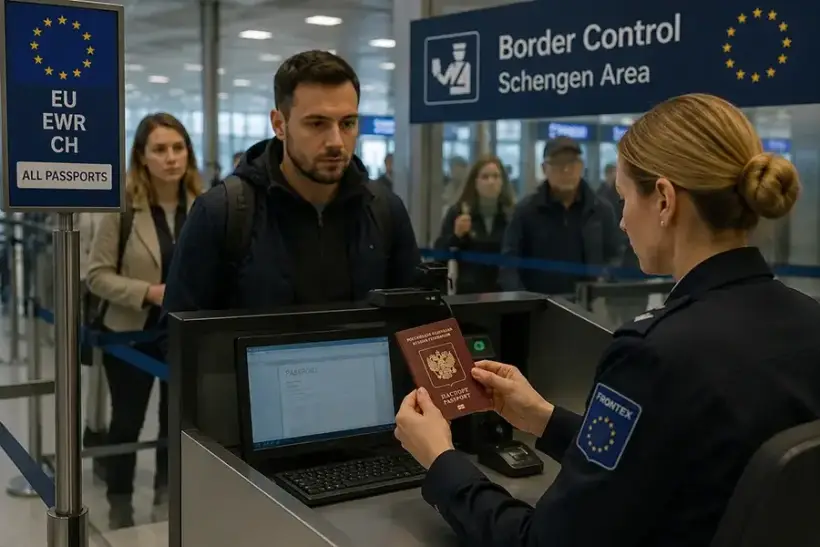
A group of 11 European countries has supported further restrictions for Russian nationals in the Schengen Area. The initiative was presented ahead of a meeting of the EU Justice and Home Affairs Council, ERR reports. The move is linked to a recent increase in visa issuance for Russian citizens.
Appeal to the European Commission
The appeal was signed by representatives of Sweden, Estonia, Latvia, Lithuania, the Czech Republic, Denmark, Finland, the Netherlands and Poland, as well as non-EU members Norway and Iceland. The letter was sent to the leadership of the European Commission.
Schengen visas for Russians: security risks
The document notes that EU countries implement tightening recommendations unevenly, and this fragmentation weakens the EU’s influence and creates an unclear impression of the bloc’s resolve toward Russia. The letter also warns that inconsistent visa issuance for Russian tourists could pose a security risk across the entire Schengen Area, especially given the movement of hundreds of thousands of Russian military personnel.
Estonian Interior Minister Igor Taro stated that the country has already stopped issuing visas to Russian citizens, but this is not enough as other countries continue to accept Russian tourists. He stressed that citizens of a state conducting military operations in Ukraine should not benefit from travel privileges in Europe.
Ban for participants in military actions in Ukraine
The signatory states also supported Estonia’s initiative to introduce a ban on entry for Russian citizens who participated in combat operations in Ukraine. Igor Taro said the issue will be raised again at a meeting of European counterparts. He argued that preventing entry of Russian military personnel into the Schengen Area serves the common security interests of European countries.
Estonia has already banned entry for 2,000 former combatants. To identify such individuals, the country cooperates with Ukrainian security services. Taro called on other states to act jointly and support similar measures at the EU-wide level.
How many visas Russians received in 2025
In 2025, Russian citizens were issued 8% more Schengen visas than in 2024 — 623,451 in total. At the same time, the number of applications also increased to 674,000 (+8.42%). Russia remained among the largest source countries for Schengen visas, behind China, India and Turkey. Chinese citizens received around 2 million visas, while India and Turkey received about 1.2 million each.
Most visas issued to Russians were for tourism purposes — 478,000, or about 77% of all cases. This was followed by visits to relatives and friends (70,500) and business trips (35,000). There was also an increase in sports-related travel, while transit and medical visas declined.
France led issuance, granting 173,000 visas to Russian citizens, nearly 30% more than a year earlier. Italy ranked second with about 160,000 visas, down 5.8%, and Spain third with just under 100,000, remaining stable.
Visa losses for Russians: market estimate for 2026
In 2026, the number of Schengen visas issued to Russian citizens increased by 12%, said Alekasan Mkrtchyan, Vice President of the Russian Alliance of Travel Agencies. At the same time, losses for Russian applicants due to visa rejections are approaching 0.5 billion rubles (€6 million). He noted that the rejection rate is around 5%, affecting roughly 35,000 people. Average application costs are estimated at €150, which he described as not critical.
The expert emphasized that due to rising consular fees and a reduction in multi-entry visas, European destinations are gradually becoming a niche product focused mainly on organized tourism. Most Schengen visas are issued by a small number of countries. “Five countries account for 95% of all visas: France, Italy, Spain, Greece and Hungary,” he said. The remaining 5% is distributed among other states, including Germany, Austria and Denmark. He added that the United Kingdom, which is not part of Schengen, maintains a low rejection rate of around 2.3%.
Conclusion
Analysts at International Investment note that the most significant tightening toward Russian citizens occurred in September 2022, when the European Union suspended its visa facilitation agreement. In autumn 2025, the European Commission recommended ending the issuance of multiple-entry Schengen visas, and in most cases EU countries shifted to issuing visas strictly for the duration of travel.
Travel logistics to Europe remain complicated due to the absence of direct flights and the need to route through third countries. Current volumes remain significantly below pre-pandemic and pre-war 2019 levels, when more than 4 million Schengen visas were issued, including about 3.35 million multiple-entry visas. At that time, Russia accounted for roughly 26% of all Schengen visas worldwide.
In recent years, Russian tourism demand has shifted toward more accessible destinations. Among nearby countries, Georgia stands out due to visa-free entry, direct flights, and the possibility of overland travel. It also offers a wide range of travel formats — from seaside resorts and ski areas to wine routes, gastronomic tourism, and cultural trips — making it a versatile destination for different types of travelers.